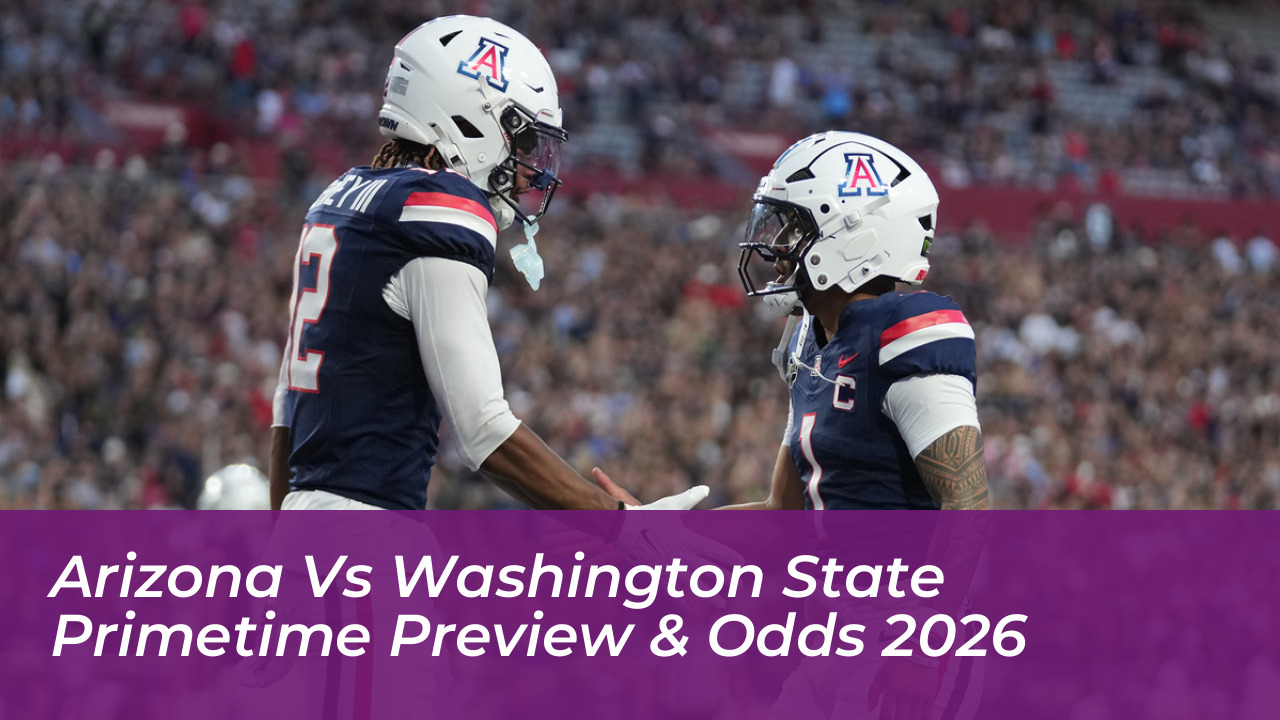
The Arizona Wildcats head to Gesa Field for a high-stakes primetime nonconference matchup against the Washington State Cougars on Saturday, Sept. 26, 2026, at 4:30 p.m. MT. Broadcast nationally on CBS and streaming via Paramount+, this legacy Pac-12 pairing arrives as a unique scheduling anomaly. Following conference realignment that sent Arizona to the Big 12, athletic department officials arranged this early-season contest to preserve regional rivalries. Arizona enters the Pacific Northwest as a 10.5-point road favorite according to FanDuel Sportsbook, carrying a 2-1 record. Meanwhile, the Cougars sit at 1-2, looking to establish consistency under head coach Kirby Moore after bouncing back with a dominant victory over Duquesne.
- Betting Landscape and Program Trajectories
- Offensive Profiles and Quarterback Play
- Arizona Passing Attack and Noah Fifita
- Ground Game Struggles and Rushing Metrics
- Washington State Ground-First Identity
- Defensive Vulnerabilities and Third-Down Battles
- Arizona Defensive Attrition and Third-Down Woes
- Cougars Defensive Struggles Against the Run
- Turnover Margins, Red Zone Efficiency, and Discipline
- Ball Security and Turnover Statistics
- Red Zone Contrast and Time of Possession
- Statistical Comparison Overview
- Historical Context and Strategic Outlook
- Frequently Asked Questions
- What time is the Arizona versus Washington State game?
- Where can I watch the game on television or streaming?
- What is the point spread for this nonconference showdown?
- How have Noah Fifita and the Arizona offense performed so far?
Saturday night acts as a critical bridge for both programs. For the Wildcats, this serves as the final warmup before plunging headfirst into a grueling Big 12 conference slate starting next week against Cincinnati. For Washington State, defending home turf against a high-powered visiting roster offers an immediate measuring stick before hosting Fresno State. Both squads possess distinct tactical identities, glaring statistical vulnerabilities, and urgent motivations to secure a signature victory.
Betting Landscape and Program Trajectories
The betting market reflects clear expectations for this matchup, with Arizona installed as a comfortable double-digit favorite on the road. Bettors and analysts are weighing Arizona’s explosive offensive upside against its lingering defensive inconsistencies. Program trajectories point in opposite directions following the opening month of the season. Arizona wants to validate its preseason hype as a Big 12 dark horse, while Washington State looks to prove that its new identity under Kirby Moore can stand up to high-caliber competition.
Preparation in Pullman has centered on shutting down the perimeter weapons of the Wildcats while finding an offensive rhythm that mirrors their dominant ground performance against Duquesne. Both coaching staffs recognize the significance of this contest. A victory provides massive momentum going into October, whereas a loss exposes glaring structural flaws that require immediate fixes during the upcoming bye weeks and conference schedules.
Offensive Profiles and Quarterback Play
Arizona Passing Attack and Noah Fifita
Arizona operates through the precise arm of quarterback Noah Fifita, who continues to orchestrate a prolific passing attack. Fifita enters this contest having completed 80.9 percent of his passes for 834 yards, seven touchdowns, and just one interception. During a dominant 42-17 victory over Northern Illinois, Fifita set a school record by completing 31 of 34 passes, finishing with 325 yards and four touchdowns while also punching in a score on the ground.
Wide receiver Tre Spivey and pass-catcher Gio Richardson lead a dynamic receiving corps capable of stressing opposing secondaries across every level of the field. Their ability to run precise routes creates immediate separation against zone coverages. This aerial efficiency forces opposing linebackers to drop deep, opening up occasional running lanes despite the overall struggles of the offensive line.
Ground Game Struggles and Rushing Metrics
Despite elite passing metrics, Arizona struggles to generate consistency on the ground. The Wildcats rank last in the Big 12, averaging just 123.3 yards per game via the run. Offensive coordinator Seth Doege shoulders the blame for the stagnant ground game, noting that opponents frequently load the box to neutralize running backs like Kedrick Reescano.
Reescano paces the backfield with 127 yards and two touchdowns on 33 carries, but sacks taken by Fifita have repeatedly derailed drives. Eliminating negative plays in the backfield remains the primary offensive objective for the coaching staff. Establishing even a modest rushing threat will prevent Washington State from pinning its ears back and rushing the passer unchecked.
Washington State Ground-First Identity
Washington State counters with a dual-threat rushing attack quarterbacked by Caden Pinnick. Pinnick has accumulated 171 yards and two touchdowns on 40 carries, anchoring an offense that leans heavily on ground production when operating at peak efficiency. Running backs Maxwell Woods and Kirby Vorhees complement Pinnick effectively, combining for explosive outings like the 48-7 blowout over Duquesne where multiple rushers eclipsed the century mark.
Through the air, Pinnick has compiled 403 yards, two touchdowns, and three interceptions, relying heavily on targets like Daniel Blood and Branden Ganashamoorthy. The Cougars prefer to control the tempo by pounding the rock on early downs. Sustaining drives on the ground keeps the dangerous Arizona offense cooling its heels on the sideline.
Defensive Vulnerabilities and Third-Down Battles
Arizona Defensive Attrition and Third-Down Woes
Both defenses feature significant vulnerabilities that opposing play-callers intend to exploit under the lights at Gesa Field. Arizona ranks 81st nationally in total defense, allowing opponents to convert 39.0 percent of their third-down opportunities. Defensive coordinator Danny Gonzales has expressed extreme frustration regarding third-down efficiency, specifically highlighting struggles against long-yardage situations.
The Wildcats have surrendered 11 conversions on third downs requiring seven or more yards, an unacceptable metric for a unit aiming for postseason contention. Injury attrition further complicates the defensive outlook for Arizona. The Wildcats held out defensive linemen Mays Pese and Zac Siulepa, linebacker Chase Kennedy, and cornerback Dwight Bootle II against Northern Illinois. While all four players maintain a chance to return against Washington State, safety Daylen Austin suffered a season-ending injury, forcing younger contributors like Tyrese Boss and Cam Chapa into high-pressure rotational roles.
Depth remains a double-edged sword for the visiting squad. Arizona has deployed 32 different defenders across three games, preserving legs at the expense of cohesive secondary communication. Communication breakdowns in the defensive backfield could lead to easy scoring opportunities for Washington State if assignments are missed during play-action sequences.
Cougars Defensive Struggles Against the Run
Washington State presents its own defensive concerns, particularly against the run and in crucial situational downs. Washington State ranks 131st in third-down conversion defense and struggles mightily inside the red zone, allowing opponents to dictate the line of scrimmage.
If Fifita and the Arizona passing game establish an early rhythm, the Cougars risk getting stretched thin across the hashes. Linebackers must constantly diagnose play action while keeping tabs on speedy slot receivers. Stopping the bleeding on third downs is the absolute priority for the Washington State defensive coaching staff.
Turnover Margins, Red Zone Efficiency, and Discipline
Ball Security and Turnover Statistics
Securing the football and winning the turnover battle will likely determine which roster hoists the victory trophy in Pullman. Both programs enter this primetime showdown struggling mightily with ball security and defensive takeaway generation. Arizona ranks 126th in the FBS with a dismal -4 turnover margin, having forced just one solitary takeaway through three games while committing five turnovers.
Washington State sits close by at 119th nationally with a -3 turnover margin. The Cougars are hindered by early-season interceptions from Pinnick and unforced fumbles during losses to Washington and Kansas State. Cleaning up these mental errors is mandatory for both teams if they hope to avoid gifting short fields to their opponents.
Red Zone Contrast and Time of Possession
Red zone efficiency highlights another stark contrast between these regional rivals. Washington State ranks 131st in FBS red zone offense, scoring on only 62.5 percent of their trips inside the 20-yard line. Conversely, Arizona boasts the 5th-ranked red zone defense, clamping down and holding opponents to a mere 57.1 percent success rate inside the red zone.
Penalties and discipline metrics further emphasize the razor-thin margin for error. Washington State averages 28:13 in time of possession, ranking 108th nationally, while Arizona controls the clock better at 31:16, good for 51st in the country. Whichever defense manages to force early punts and avoid extended penalties will dictate the tempo of the evening.
Statistical Comparison Overview
Evaluating the hard numbers reveals where each team holds a distinct advantage heading into this primetime clash. Arizona dominates through the air, while Washington State holds a slight edge in raw rushing yardage output per game.
| Metric | Arizona Wildcats | Washington State Cougars |
|---|---|---|
| Record | 2-1 | 1-2 |
| Scoring Offense (PPG) | 31.3 (72nd) | 21.7 (114th) |
| Total Offense (YPG) | 429.3 (54th) | 308.3 (123rd) |
| Passing Offense (YPG) | 306.0 (20th) | 134.3 (132nd) |
| Rushing Offense (YPG) | 123.3 (110th) | 174.0 (56th) |
| Scoring Defense (PPG) | 17.3 (41st) | 21.7 (66th) |
| Total Defense (YPG) | 299.7 (48th) | 356.3 (83rd) |
| Turnover Margin | -4 (126th) | -3 (119th) |
Historical Context and Strategic Outlook
This matchup carries heavy historical weight as the first meeting between Arizona and a legacy Pac-12 opponent outside of the newly formed Big 12 footprint since conference realignment. Historically, the Wildcats hold a 28-19 advantage over the Cougars all-time, including a respectable 12-7 record inside Pullman. However, historical precedents hold little weight when two desperate teams collide under primetime lights.
Washington State head coach Kirby Moore understands the internal preparation required to slow down an explosive Arizona offensive scheme. Containing Fifita requires a disciplined pass rush that does not open up scrambling lanes. On the other side, the Arizona defensive mandate remains straightforward: get downhill, swarm ball carriers, and eliminate explosive run plays before they develop.
Ultimately, this game will be decided in the trenches and on high-leverage third downs. If Arizona protects the football and cleans up its third-down tackling, the Wildcats should cover the spread and secure a hard-fought road victory in hostile territory.
Frequently Asked Questions
What time is the Arizona versus Washington State game?
The game kicks off on Saturday, Sept. 26, 2026, at 4:30 p.m. MT at Gesa Field in Pullman, Washington.
Where can I watch the game on television or streaming?
The matchup will be broadcast nationally on CBS and is available for live streaming via Paramount+. Check local listings for exact channel numbers.
What is the point spread for this nonconference showdown?
According to FanDuel Sportsbook, Arizona enters Gesa Field as a 10.5-point road favorite over the Washington State Cougars.
How have Noah Fifita and the Arizona offense performed so far?
Noah Fifita is playing at an elite level, completing 80.9 percent of his passes for 834 yards, seven touchdowns, and only one interception through three games.