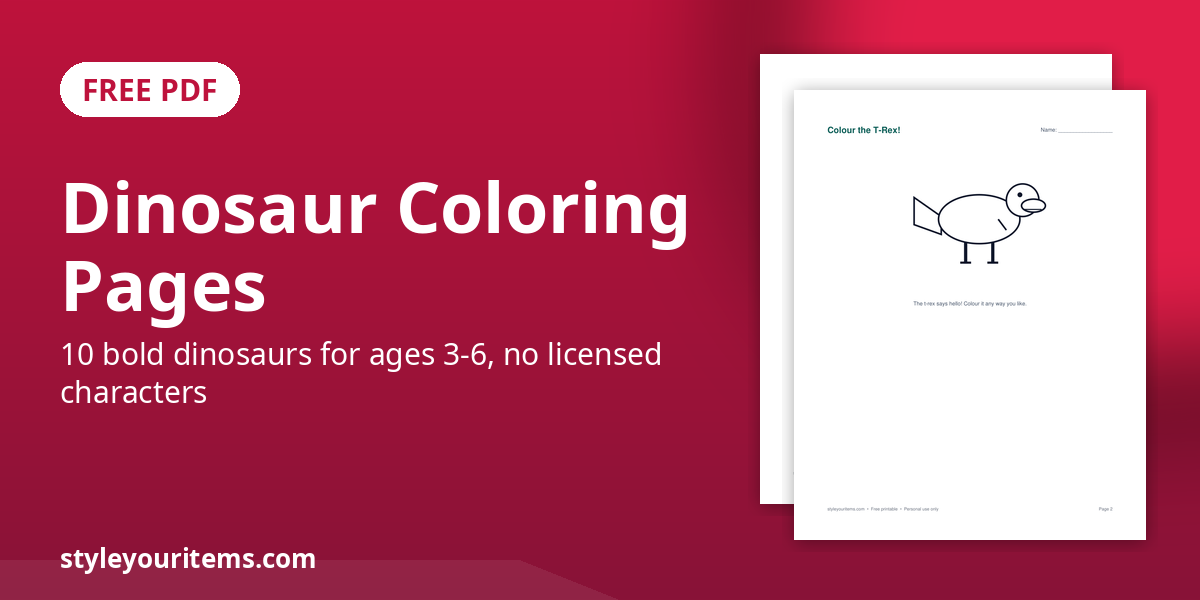
Dinosaurs are the first animals most children learn by name, and they learn them long before they can read. A three-year-old who cannot yet write their own name can often tell you that a T-Rex has tiny arms and a Stegosaurus has plates on its back. That is why dinosaur colouring pages work so well: the child already cares about the subject, so the colouring holds their attention far longer than a page they have no feelings about. This free printable dinosaur coloring pages PDF gives you ten original dinosaurs, one per page, drawn with thick bold outlines and big open spaces so a small hand with a chunky crayon can stay inside the lines.
The PDF has 11 pages. Page 1 is the cover. Pages 2 to 11 are the colouring pages: T-Rex, Triceratops, Stegosaurus, Brontosaurus, Pterodactyl, Ankylosaurus, Velociraptor, Spinosaurus, Baby Dinosaur, and Diplodocus. Every page has a “Name:” line at the top, a short caption under the picture, and nothing else to distract from the colouring. The dinosaurs are all our own drawings, with no licensed characters, so you can print them as often as you like for home or classroom use. Print on Letter or A4, at 100% (Actual size).

What Your Child Practises While Colouring
- Staying inside the lines. The outlines are thick and the shapes are big, which gives a young child a fair chance. A page that is too detailed teaches frustration, not control. These pages are drawn for ages 3 to 6, so the lines are exactly where a small hand expects them.
- Grip and hand strength. Colouring a big shape needs a steady grip and a lot of small back-and-forth movements. That is the same hand strength a child needs later for holding a pencil and forming letters.
- Choosing and naming colours. Ten dinosaurs invite ten different colour choices, and each choice is a small decision. Ask “What colour is your T-Rex today?” and you get a conversation about colour, not just a finished page.
- Learning dinosaur names. Every page names its dinosaur in the heading, so the child reads or hears the name while they colour. After a few rounds, most children can name all ten without looking.
- Finishing something. A colouring page has a clear end: when the picture is full of colour, it is done. That feeling of finishing is worth a lot at this age, and a page a day builds the habit of sitting down and completing a small task.
Ten Dinosaurs to Meet, One Page at a Time
| Dinosaur | What to look for on the page |
|---|---|
| T-Rex | Big head, tiny arms, and two strong legs. The most famous dinosaur of all. |
| Triceratops | Three horns and a wide frill behind its head. The frill is a lovely shape to colour. |
| Stegosaurus | Four tall plates along its back, in a row like triangles. Colour each plate differently. |
| Brontosaurus | A very long neck reaching up, and a long tail reaching back. Good for two colours. |
| Pterodactyl | Wide wings spread out on both sides. The only dinosaur here that flies. |
| Ankylosaurus | Low and armoured, with spikes on its back and a heavy club on its tail. |
| Velociraptor | Standing upright on two legs, with a long tail for balance and a pointed snout. |
| Spinosaurus | A tall sail on its back, like a fin. Try stripes across the sail. |
| Baby Dinosaur | A little dinosaur hatching out of a cracked egg. The easiest page for the youngest children. |
| Diplodocus | The longest neck and tail in the set. A good page for a child who likes big pictures. |
How to Use the Pages
- Print one page, not all ten. A young child does better with one page and a small box of crayons than with a whole stack. Print the dinosaur they ask for, and keep the rest for another day.
- Start with the Baby Dinosaur for ages 3 and 4. It has the fewest shapes and the biggest spaces. The T-Rex and the Stegosaurus suit ages 5 and 6, who want more detail to work with.
- Offer three colours, not thirty. Put out three crayons and let the child choose. Too many colours turns colouring into choosing, and the page never gets finished.
- Colour together for the first page. Sit next to the child and colour your own copy, or the same page in turns. Children copy the pace of the adult next to them, and a calm ten minutes together beats a hurried page alone.
- Name the dinosaur as you finish. When the page is done, ask the child to point at the dinosaur and say its name, then write their name on the “Name:” line. Pin the finished pages on the fridge or a bedroom wall, one at a time, so the set grows in front of them.
Colouring Tips That Actually Help
Crayons beat felt tips for this age, because a crayon cannot bleed through the paper and ruin the page underneath. If you use felt tips, put a spare sheet under the page. Thick crayons are easier to hold than thin ones, and they fill big shapes faster, which keeps a young child going until the picture is done.
There is no right colour for a dinosaur. Nobody knows what colour a T-Rex really was, so a pink T-Rex is as correct as a green one. If a child colours the Stegosaurus purple with orange plates, that is a good page, not a wrong one. The only rule worth keeping is the one the child sets for themselves: try to stay inside the lines, and if the colour goes outside, keep going anyway.
If your child loves animal pages, the free printable animal coloring pages use the same bold-outline style with ten friendly animals, from a fish to a lion. For reading and writing practice, the free printable alphabet tracing worksheets and the free printable days of the week worksheets follow the same short-activity shape, so a child who enjoys these dinosaurs will recognise the next set at once.
Questions People Ask Before They Print
Is the PDF really free?
Yes. The PDF is completely free, with no sign-up, no email address, and no account needed.
What age is it for?
It is drawn for ages 3 to 6. Three-year-olds will enjoy the Baby Dinosaur and the T-Rex; five and six-year-olds can handle all ten, including the spikier ones like the Ankylosaurus.
Are these real dinosaur pictures?
They are simple original drawings, not photographs or licensed characters. Each one shows the feature children remember best: the plates on the Stegosaurus, the horns on the Triceratops, the sail on the Spinosaurus, and the long neck on the Brontosaurus.
Can a teacher use it in class?
Yes. Print one copy per child. The ten pages work as a dinosaur week, one dinosaur a day, or as a rainy-day folder the children can choose from.
Does it print on A4 as well as Letter?
Yes. The PDF is designed for both US Letter and A4 paper, at 100% (Actual size).
Details
- Format: free PDF download
- Paper size: US Letter and A4
- Pages: 11 – 1 cover page + 10 dinosaur colouring pages (T-Rex, Triceratops, Stegosaurus, Brontosaurus, Pterodactyl, Ankylosaurus, Velociraptor, Spinosaurus, Baby Dinosaur, Diplodocus)
- Cost: free – no sign-up, no email, and no account needed
- Print as many copies as you like, for personal use
More Free Printables
Looking for more free printables? Browse the full Kids, School & Learning collection, or try these popular downloads: