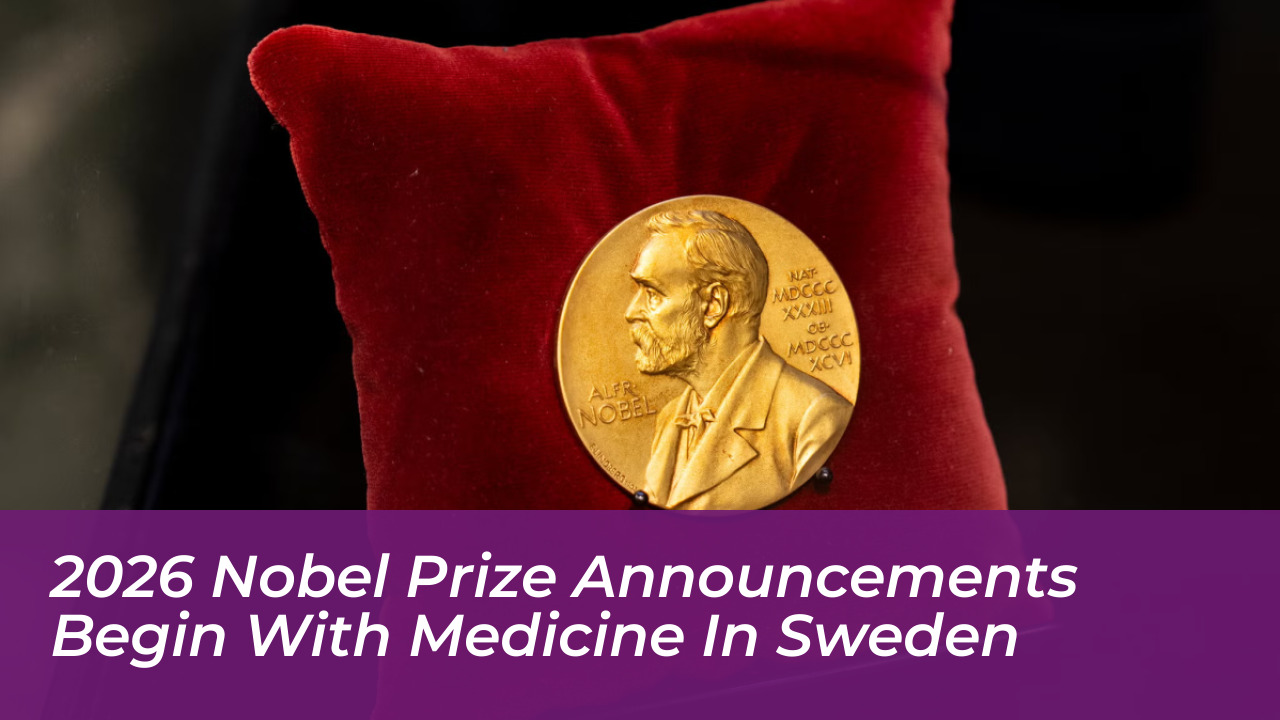



Committees in Sweden and Norway begin revealing the winners of the 2026 Nobel Prizes on Monday, October 5, starting with the prestigious prize for physiology or medicine. Six distinct awards will be announced through October 12. This marks 125 years since the prizes were first presented in 1901 under the final will of Swedish scientist and inventor Alfred Nobel.
Live coverage for the medicine award announcement begins at 5:15 a.m. Eastern time (11:30 CEST at the earliest) from the Nobel Assembly at the Karolinska Institutet in Stockholm. Individual announcements will continue daily across physiology or medicine, physics, chemistry, literature, peace, and economic sciences. Video streams will be broadcast globally on official Nobel digital channels.
Schedule of the 2026 Nobel Prize Announcements
The prize-awarding institutions have structured the announcement dates across an intensive eight-day period in October:
- October 5: Physiology or Medicine – Announced at the Karolinska Institutet, Stockholm.
- October 6: Physics – Announced at the Royal Swedish Academy of Sciences, Stockholm.
- October 7: Chemistry – Announced at the Royal Swedish Academy of Sciences, Stockholm.
- October 8: Literature – Announced by the Swedish Academy, Stockholm.
- October 9: Peace – Announced by the Norwegian Nobel Committee, Oslo.
- October 12: Sveriges Riksbank Prize in Economic Sciences in Memory of Alfred Nobel – Announced at the Royal Swedish Academy of Sciences, Stockholm.
Increased Prize Funds and Core Traditions
For the 2026 award cycle, the monetary reward attached to each discipline has increased to 12 million Swedish kronor. This is roughly equivalent to $1.2 million or 1.1 million euros, representing a 9% increase from previous prize funds. This change helps ensure the long-term economic independence of the laureate selection process.
A 50-member Nobel Assembly at the Karolinska Institutet selects the medicine recipient. Secretary Thomas Perlmann places direct phone calls to the newly chosen laureates just ahead of the public statement. All laureates across the six categories will receive a diploma, a gold medal, and the cash award at formal ceremonies held in Stockholm and Oslo on December 10, known globally as Nobel Day.
Scientific Fields and Contenders
Medical discussions leading into the opening announcement centered heavily on developments in glucagon-like peptide-1 (GLP-1) receptor therapies, which are used to treat type 2 diabetes and obesity. Researchers frequently cited among prospective candidates included Svetlana Mojsov, Joel Habener, Lotte Bjerre Knudsen, and John Eng. Additional medical contenders featured Emmanuel Mignot and Masashi Yanagisawa for their discoveries regarding orexin and narcolepsy, as well as Carl June for chimeric antigen receptor (CAR) T-cell therapies.

In the physics and chemistry categories, speculation spanned light-controlling materials associated with Federico Capasso, atomic clocks, quantum information, superconductivity, lipid nanoparticles for vaccines, optogenetics, and advanced DNA sequencing technologies.
Nominations for the 2026 Nobel Peace Prize
The Norwegian Nobel Committee will present the Peace Prize in Oslo from a roster of 287 nominated candidates. This group comprises 208 individuals and 79 organizations. Potential honorees featured in international discussions include the International Space Station for enduring Russian and American scientific cooperation, Save the Children alongside Ukrainian activist Mykola Kuleba, Sudan’s Emergency Response Rooms, and the Committee to Protect Journalists.
Nobel Foundation statutes mandate that all nomination records, expert evaluations, and committee deliberations remain strictly confidential for 50 years. Since its inception, the committees have presented hundreds of awards to individuals and organizations, establishing a historic legacy of scientific, literary, and humanitarian achievement.