


A critical look at John Wayne’s filmography shows a clear shift from early Westerns to large-scale war epics. These films highlight how massive production scales and complex characters shaped his legacy. While Hollywood’s golden age featured many prominent actors, few matched Wayne’s enduring charisma. He embodied American masculinity and resilience across more than 150 film projects over nearly half a century.
Wayne’s early career built his foundation through breakout Western projects like the 1930 film The Big Trail, directed by Raoul Walsh. In this early production, Wayne played a mountaineer leading a wagon train to California while facing unexpected dangers and personal struggles. This performance paved the way for classics like John Ford’s Stagecoach (1939) and later masterpieces like The Searchers (1956). In The Searchers, Wayne played Ethan Edwards, a Civil War veteran on a multi-year quest to rescue his kidnapped niece, bringing deep moral complexity to the role.
The Evolution Into Combat and Military Films
Although best known as an icon of the American Western, Wayne also starred in many non-Western war films. Out of his massive filmography, just over a dozen features placed him in military settings, and these projects often became blockbusters. His transition into combat cinema began with Flying Tigers (1942). This was Republic Pictures’ first production to pass the $1 million mark at the box office. It featured thrilling dogfight sequences and captured the urgency of volunteer pilots defending China.
Throughout the 1940s and 1950s, Wayne expanded his military portfolio with films like Back to Bataan (1945), Flying Leathernecks (1951), and Operation Pacific (1951). These productions balanced patriotism with character-driven conflict. They frequently paired Wayne with longtime collaborators like director John Ford and co-stars such as Ward Bond and Robert Ryan to explore the psychological toll of combat and leadership.
Scaling Up: Monumental War Epics of the 1960s
Wayne’s career reached a stylistic peak during the 1960s. The sheer scale of his war epics surpassed even his grandest Western endeavors. Films like The Longest Day (1962) and The Alamo (1960)-which Wayne personally produced and directed-showcased a massive shift toward sweeping historical re-creations.
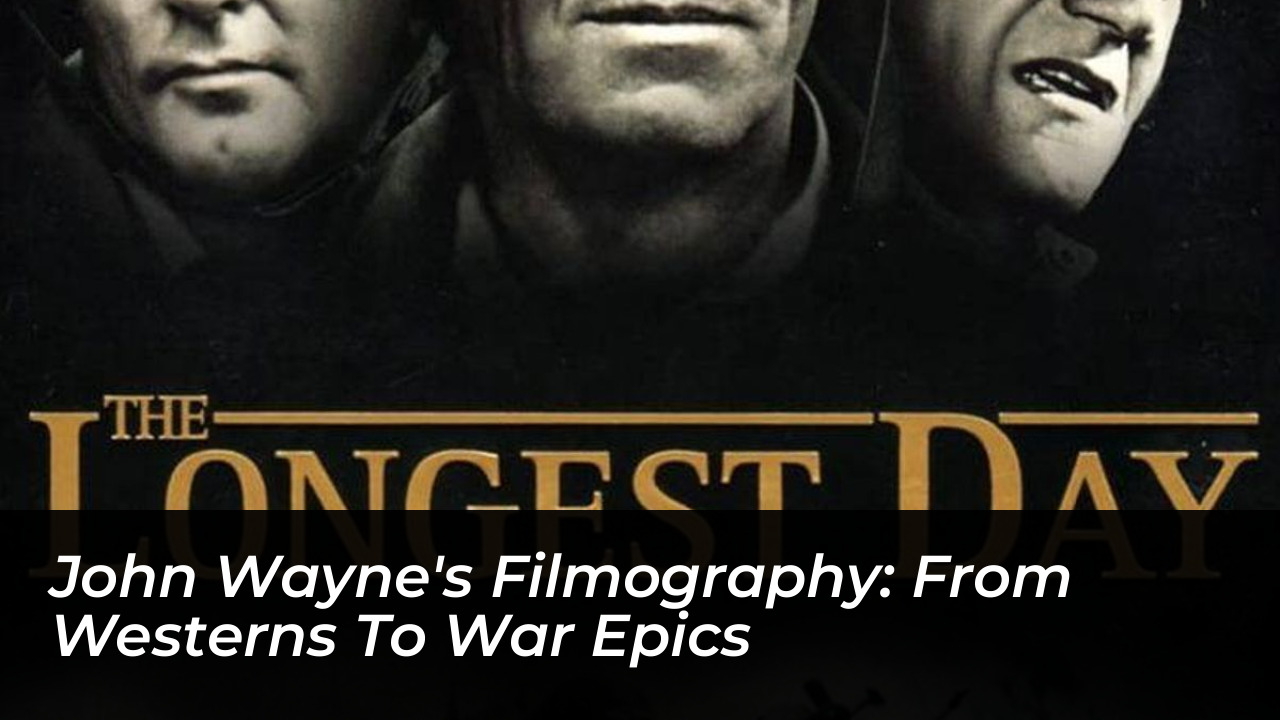
The Longest Day is an ambitious 182-minute film about the June 6, 1944, Normandy landings. It featured an unprecedented international cast that included Robert Mitchum, Henry Fonda, Sean Connery, and Richard Burton. Using real military vessels, restored World War II tanks, and thousands of extras across actual European locations, the production achieved a documentary-like realism that went far beyond traditional Hollywood Westerns.
In contrast, Wayne’s 1968 directorial and starring effort in The Green Berets placed him directly into the Vietnam War. Playing a Colonel in the U.S. Army Special Forces, Wayne’s character championed a traditional patriotic narrative that sparked intense public debate. This proved his dedication to military storytelling remained strong even as public sentiment shifted.

John Wayne Filmography Milestone Comparison
| Film Title | Year | Genre Focus | Key Collaborators / Cast |
|---|---|---|---|
| The Big Trail | 1930 | Early Western | Raoul Walsh |
| Flying Tigers | 1942 | World War II Combat | John Carroll, Anna Lee |
| The Searchers | 1956 | Revisionist Western | John Ford, Natalie Wood |
| The Alamo | 1960 | Historical Epic / Western | Richard Boone, Frankie Avalon |
| The Longest Day | 1962 | World War II Epic | Darryl F. Zanuck, Henry Fonda, Robert Mitchum |
| The Green Berets | 1968 | Vietnam War Drama | David Janssen, Jim Hutton |
Frequently Asked Questions
Did John Wayne star in more Westerns or war movies?
John Wayne is predominantly known for his extensive work in Westerns, having starred in more than 130 western films. In contrast, he appeared in just over a dozen non-Western war films throughout his career.
What was John Wayne’s first combat war movie?
Wayne’s first major combat film was Flying Tigers (1942). In this film, he portrayed the leader of a squadron of volunteer fighter pilots defending China shortly after the United States entered World War II.
Which war epic featured John Wayne alongside an all-star international cast?
The Longest Day (1962) featured Wayne alongside more than 40 major international stars, including Henry Fonda, Robert Mitchum, Sean Connery, and Richard Burton, chronicling the D-Day landings in Normandy.
Did John Wayne direct any of his war or western films?
Yes, John Wayne directed or co-directed prominent projects, most notably the historical epic The Alamo (1960) and the controversial Vietnam War drama The Green Berets (1968).
How did John Wayne’s portrayal of soldiers evolve over time?
His early war films focused heavily on morale, volunteerism, and localized resistance during World War II. His later 1960s epics expanded into massive, multi-perspective historical reconstructions of global military operations.