
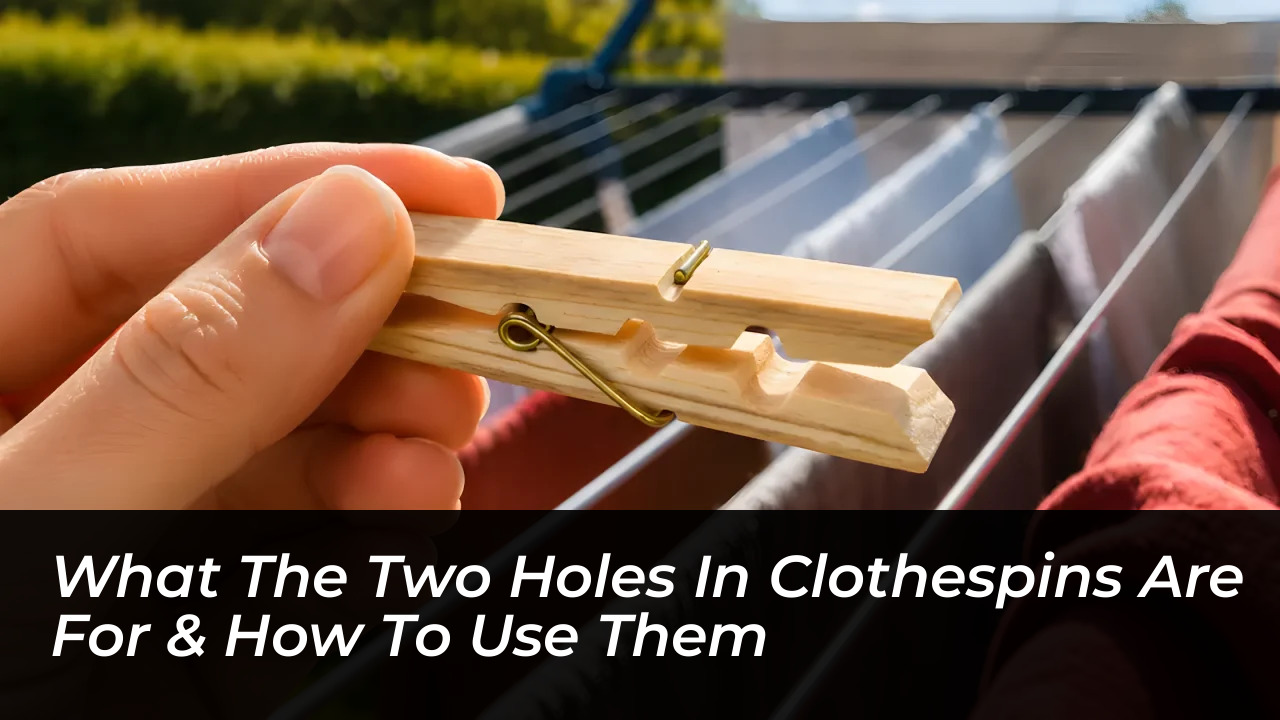

The clothespin is a humble household object that almost nobody thinks about. American roots date back to the mid-19th century-specifically patented by David M. Smith, with a coiled wire addition later by Solon E. Moore. This classic design has survived the arrival of every modern laundry gadget, including electric and gas dryers.
Yet, millions of people still use clothespins every day without knowing a small, intentional design detail that can drastically change the way laundry hangs, dries, and wrinkles. In every ordinary clothespin, there are two distinct openings where the halves meet: a smaller one located near the spring, and a larger one positioned toward the tips.
Most people grab their laundry and clip it with whatever part of the jaw happens to land first. However, each opening was engineered for a specific, different job.
What Are the Two Clothespin Holes Made For?
If you have been clipping your garments at random, understanding the anatomy of a clothespin will transform your laundry routine. The two openings serve separate functions designed to distribute tension evenly:
- The Small Opening (Near the Center): This inner opening is designed to grip the clothesline or the rail of a drying rack securely.
- The Large Opening (Toward the Tips): This outer opening is meant to hold the actual fabric of your clothing.
The proper technique is to clip the pin so that the taut clothesline sits directly inside the small hole, while the garment hangs from the large hole. By doing this, the mechanical pressure is distributed right where it needs to be: firmly anchored on the line, but gently holding the fabric.
When you clip incorrectly-such as squeezing both the fabric and the line together at the very tip-the pin presses down heavily on a tiny surface area of cloth. That concentrated force leaves stubborn dents, ridges, and creases that require extra time with an iron.
The Physics and Engineering Behind the Life Hack
The secret to why this method works lies in basic physics. A standard clothespin operates as a lever. The metal spring acts as the pivot point, and the clamping force it exerts gets progressively weaker the farther you move away from it toward the tips.
This means the jaws squeeze with maximum intensity near the spring and much more softly at the outer tips. Placing the thick clothesline in the tighter, high-pressure inner hole secures the pin against wind gusts. Placing delicate garment fabrics in the wider, softer outer hole prevents fiber crushing.
, there is a distinct manufacturing logic behind the cut-outs. The openings save raw material and reduce weight-crucial factors when producing millions of plastic pins annually. On traditional wooden pins, typically manufactured from birch because it resists splitting and avoids leaking resin onto wet laundry, these cut-outs allow the wood to flex smoothly and cope with repeated cycles of soaking and outdoor drying.
Where to Clip: Garment-by-Garment Guide
Mastering the two-hole clothespin technique is only half the battle. Knowing exactly where to attach the pin to each specific type of garment ensures your clothes maintain their shape:
- T-Shirts and Light Tops: Always hang them upside down by the bottom hem rather than the shoulders, which can stretch out, deform, and develop unsightly pin dents.
- Pants and Jeans: Hang denim and trousers upside down by their lower leg hems to allow gravity to pull out wrinkles naturally.
- Dresses and Skirts: Secure them at the waistband or along sturdy side seams to protect delicate panels.
- Socks and Underwear: Fasten them securely by their thick elastic bands.
Additional Pro Tips for Faster, Gentler Air-Drying
Optimizing your line-drying setup involves a few extra habits that protect your wardrobe and speed up chore times:
- Shake It Out: Give every piece of clothing a sharp shake before hanging it up so it dries flat instead of locked into the crumpled shape it had coming out of the washing machine drum.
- Watch the Sun: Hang dark-colored garments in shaded areas of your yard, as strong ultraviolet sunlight quickly fades vibrant dyes.
- Bring Your Pins Inside: Do not leave wooden or plastic pins outdoors on the line day after day. Constant exposure to rain and extreme sun causes wooden pins to turn gray and potentially stain light-colored fabrics, while making plastic pins brittle and prone to snapping.
When clothes hang freely from their fabric edges instead of being jammed flat against the line, air circulates much more efficiently around them. This results in faster, more even drying times-especially for heavy, thick items like bath towels and heavy denim jeans. Small hole on the line, big hole on the fabric, and a clip by the hem mean fewer marks, minimal ironing, and faster drying.


