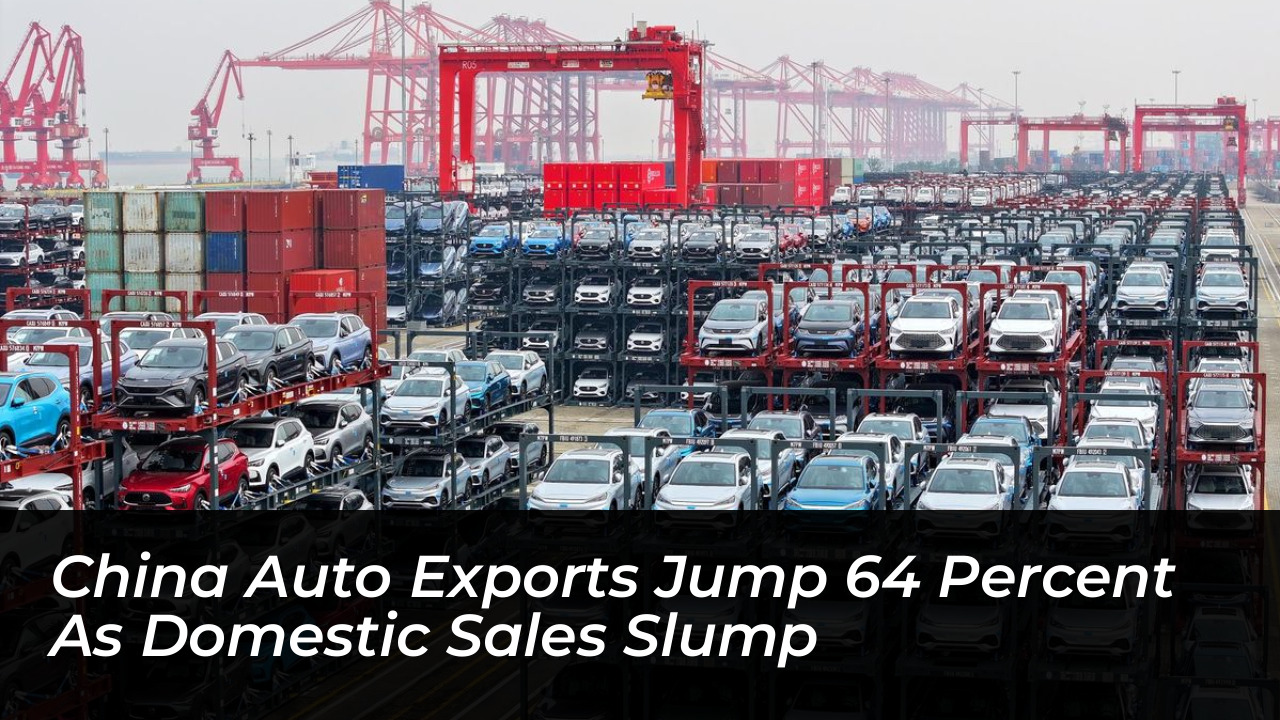

Chinese automakers are increasingly turning to overseas markets to sustain growth as domestic demand weakens. Passenger vehicle exports rose 64% year over year in September 2026. According to the China Association of Automobile Manufacturers, China shipped around 919,000 passenger vehicles during the month. This was driven by strong overseas demand for plug-in hybrids and fully electric cars.
The export surge underscores a widening rift in the world’s largest automotive market. While international shipments continue to shatter previous records, domestic sales have faced severe headwinds due to weaker consumer confidence and reduced government subsidies.
Exports Cross 7 Million Mark in First Nine Months
For the broader year, the numbers reflect an aggressive global push by Chinese manufacturers. Exports exceeded 7.1 million passenger cars during the first nine months of 2026. This marked an increase of more than 70% from the same period in 2025, the industry association reported.
By contrast, the domestic market has struggled significantly. Domestic passenger vehicle sales fell 27% year over year in September, dropping to more than 1.6 million units.
Analyst Stephen Chan of S&P Global Ratings noted that the automotive industry is increasingly depending on international markets for sales and profit growth to offset ongoing weakness at home. Consultancy AlixPartners and other auto experts expect Chinese manufacturers to export nearly 10 million vehicles globally by the end of 2026.
Global Expansion and Regional Trade Pressures
To navigate the domestic slowdown, Chinese brands are aggressively targeting regions including Europe, Latin America, Southeast Asia, and Africa. Simultaneously, Canada is opening its market to Chinese electric vehicles under a newly enacted tariff-reduction agreement.
However, this rapid international expansion is encountering significant geopolitical pushback. The European Union has implemented higher tariffs on pure electric vehicles. It also reached an interim trade agreement capping Chinese hybrid vehicle imports at 350,000 annually. Senior EU officials confirmed that customs authorities across the 27-nation bloc will monitor shipments beginning in December to enforce the annual limit.
Industry leaders acknowledge that geopolitical friction remains a primary hurdle. Stella Li, executive vice president at BYD, stated at a recent industry summit that navigating trade policies and tariffs is the biggest challenge for the company’s global growth. To mitigate these risks, major Chinese original equipment manufacturers (OEMs) are actively establishing local manufacturing plants in regions such as Thailand, Indonesia, Brazil, and Hungary.
Meanwhile, the United States remains largely closed to Chinese electric vehicles due to heavy tariffs. Political uncertainty keeps the U.S. market a lower priority for major Chinese exporters.
Frequently Asked Questions
Why are Chinese auto exports increasing so rapidly?
Chinese auto exports are surging because local automakers face severe overcapacity and a steep decline in domestic demand. This is driven by weaker consumer confidence and reduced government subsidies. To maintain growth and profitability, manufacturers are aggressively expanding into international markets.
What were the exact export numbers for September 2026?
In September 2026, China exported approximately 919,000 passenger vehicles. This represented a 64% increase compared to the same month in 2025.
How are domestic sales performing in China?
Domestic passenger vehicle sales fell by 27% year over year in September 2026, dropping to more than 1.6 million units as part of a broader, months-long domestic market slump.
How is the European Union responding to the influx of Chinese vehicles?
The EU has implemented higher tariffs on pure electric vehicles from China. It also recently negotiated an interim deal capping Chinese hybrid vehicle imports at 350,000 units annually to protect domestic industries.
What strategies are Chinese automakers using to bypass trade barriers?
Major Chinese electric vehicle makers, including BYD, are increasingly investing in local overseas production facilities, such as plants in Thailand, Indonesia, Brazil, and Hungary. This minimizes their exposure to international tariffs and trade restrictions.