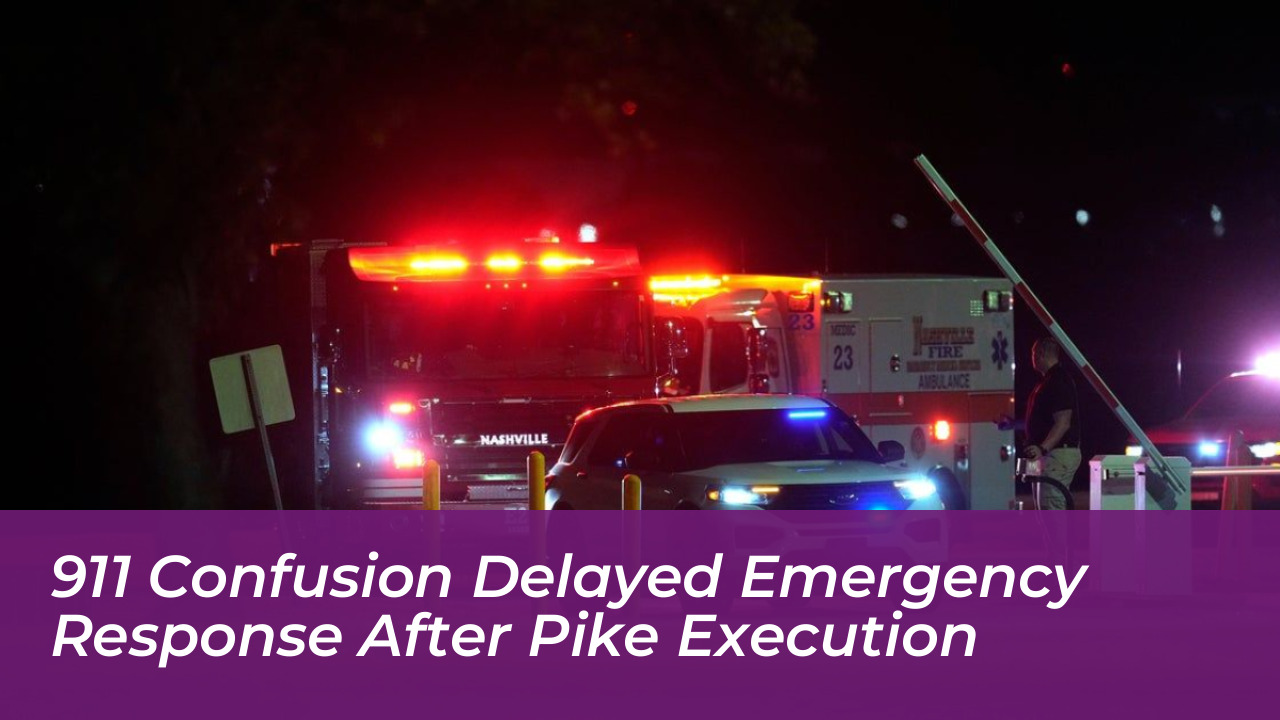

Confusion over emergency verification protocols significantly delayed medical responders trying to reach Christa Pike after state officials administered lethal injection drugs during a botched execution attempt at Riverbend Maximum Security Institution in Nashville. Newly released public records reveal that dispatchers spent roughly half an hour verifying the emergency before prison officials finally authorized secure access for an ambulance.
Pike, 50, survived two doses of pentobarbital administered on September 30, 2026, during the attempt to execute her for the 1995 murder of 19-year-old Colleen Slemmer. According to records obtained from the Metro Nashville Department of Emergency Communications, the initial emergency call arrived at 8:40 p.m., but the caller lacked a vital security verification code required to facilitate facility entry for emergency personnel without accompanying law enforcement.
The Critical 911 Call and Missing Verification Code
The initial emergency call originated from an unidentified official within the Tennessee Department of Correction (TDOC) using a cell phone from inside the prison. Because the call came from the facility without the proper verification code, dispatchers initially suspected it could be a prank, a fake report, or a security breach.
Transcripts released by the city show the immediate communication breakdown:
Dispatcher: Okay. What’s your code? I’ll wait.
Caller: I’m sorry?
Dispatcher: What’s your code?
Caller: My code? For reporting an emergency, or you, do you want to know what the emergency is?
Dispatcher: What’s the code? For the location?
Caller: I, I don’t have a code.
Dispatcher: You don’t have a verification code?
Caller: I don’t.
The caller then explained the dire medical situation to the dispatcher, stating: “We’ve been carrying out an execution tonight. We’ve administered 10 grams of pentobarbital. The person is not yet deceased. That started approximately one hour ago. And we’re calling for an ambulance.”
Internal Disjointed Response Among Agencies
Following the initial call, Metro Nashville dispatchers placed a series of anxious inquiries to the Nashville Fire Department, the Metro Nashville Police Department (MNPD), and the Tennessee Highway Patrol (THP) to determine whether an active emergency response was authorized.
Fire department personnel expressed disbelief that prison officials lacked a security code for Riverbend Maximum Security Institution, noting that it was the primary location requiring strict protocol adherence. Simultaneously, dispatchers contacted TDOC Central Control, where an employee stated they had no knowledge of any outgoing 911 call, briefly leading dispatchers to log the incident as a false alarm over radio channels.
As the situation escalated, one of Pike’s defense attorneys, Kelly Gleason, also contacted 911 to demand immediate life-saving care for her client. “My client, Christa Gail Pike, is undergoing a state execution. She has completed the stages of the protocol and last we knew from the attorney who is present, she is still alive and breathing and needs immediate life-saving care,” Gleason stated on the recording.
Hospitalization and Subsequent Recovery
At approximately 9:06 p.m.-nearly 26 minutes after the first call-TDOC officials called back to provide the proper verification code and clear the way for medical personnel. An ambulance and fire truck finally passed through the gates, arriving outside the execution chamber building at approximately 9:10 p.m.
Pike was loaded into an ambulance and transported under flashing lights at 9:28 p.m., arriving at Vanderbilt University Medical Center shortly thereafter. She remained on a ventilator for several days before regaining consciousness, eventually returning to the Debra K. Johnson Rehabilitation Center on October 10.
Governor Bill Lee has paused further execution attempts pending an ongoing state review into the failed procedure. Meanwhile, TDOC officials have declined to comment on why the initial caller lacked the mandatory security code or why the emergency call was delayed.