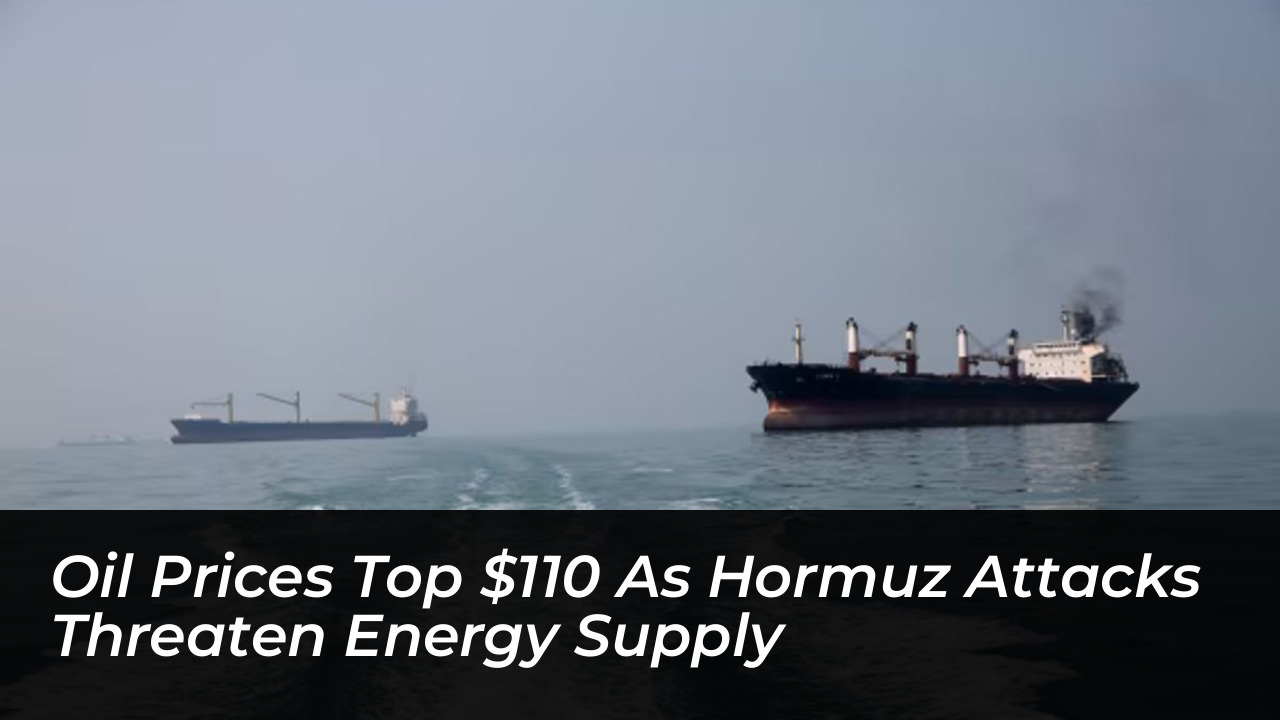

Global oil prices climbed to their highest levels in months on Friday, October 16. Attacks on commercial vessels near the Strait of Hormuz, strikes on Russian refineries, and declining U.S. crude inventories heightened intense concerns over global energy supplies. Brent crude briefly exceeded $110 per barrel during afternoon trading. The U.S. benchmark, West Texas Intermediate (WTI), settled above $100 for the first time since September.
According to market data reported by CNBC, WTI futures gained 3.5% to close at $101.41 per barrel. Meanwhile, Brent crude rose 3.8% to settle at $109.93 after briefly surpassing the psychological $110 threshold earlier in the session, as confirmed by NBC News. Over the course of the week, WTI gained more than 10%. Brent advanced nearly 5% amid escalating geopolitical conflicts that continue to disrupt production, refining, and maritime shipping routes.
Strait of Hormuz Disruptions Stoked by Rising Attacks
The primary driver behind the sudden price spike is the severe disruption of commercial shipping through the Strait of Hormuz, one of the world’s most vital crude oil transit corridors. Kpler data indicated that tanker traffic through the strategic waterway dropped sharply, with only seven tankers crossing on recent peak tracking days-less than half the average number of crossings seen over previous weeks.
The decline follows an unprecedented wave of attacks on commercial vessels. Reports show that multiple tankers came under fire in and around Hormuz. This jeopardized the fragile recovery in crude oil flows that had begun earlier in the autumn. The recurring assaults on shipping infrastructure have driven up marine freight rates and war-risk insurance premiums, compounding financial pressures for global energy buyers.
Geopolitical Pressures Expand Across Middle Eastern Infrastructure
In addition to maritime security risks in the Gulf, energy markets reacted nervously to escalating military actions targeting regional production facilities. In Saudi Arabia, state energy infrastructure faced renewed threats as suspected Houthi strikes targeted administrative buildings and airports, including locations in Dhahran, Riyadh, and Abha. While Saudi energy officials reported that major pipeline networks like the East-West pipeline managed to restore partial throughput, the persistent vulnerability of processing facilities has kept a heavy risk premium embedded in oil prices.
Traders and analysts note that the market is pricing in the constant threat of a large-scale, prolonged supply shock. Samer Hasn, a senior market analyst at trading platform XS.com, pointed out that the sustained ability of militant groups to target vital facilities hundreds of kilometers inland keeps the risk of sudden production interruptions elevated.
International Response and Domestic Economic Fallout
In response to soaring energy costs, governments and international organizations have debated further interventions. The International Energy Agency (IEA) previously noted that member states had deployed roughly 325 million barrels of oil under emergency action plans. However, with only about 100 million barrels remaining from those agreed releases-including diesel stocks targeted by G7 economies-markets remain skeptical that reserve taps will fully offset the physical bottlenecks occurring in the Middle East.
The sustained surge past $100 and $110 a barrel is already transmitting shockwaves through consumer markets and importing nations. In major economies reliant on foreign energy, such as India, higher import bills threaten to widen trade deficits, spark domestic inflation, and increase foreign exchange pressures. Simultaneously, businesses and motorists across Western nations face mounting costs for fuel, transport, and manufacturing as energy markets grapple with ongoing volatility.