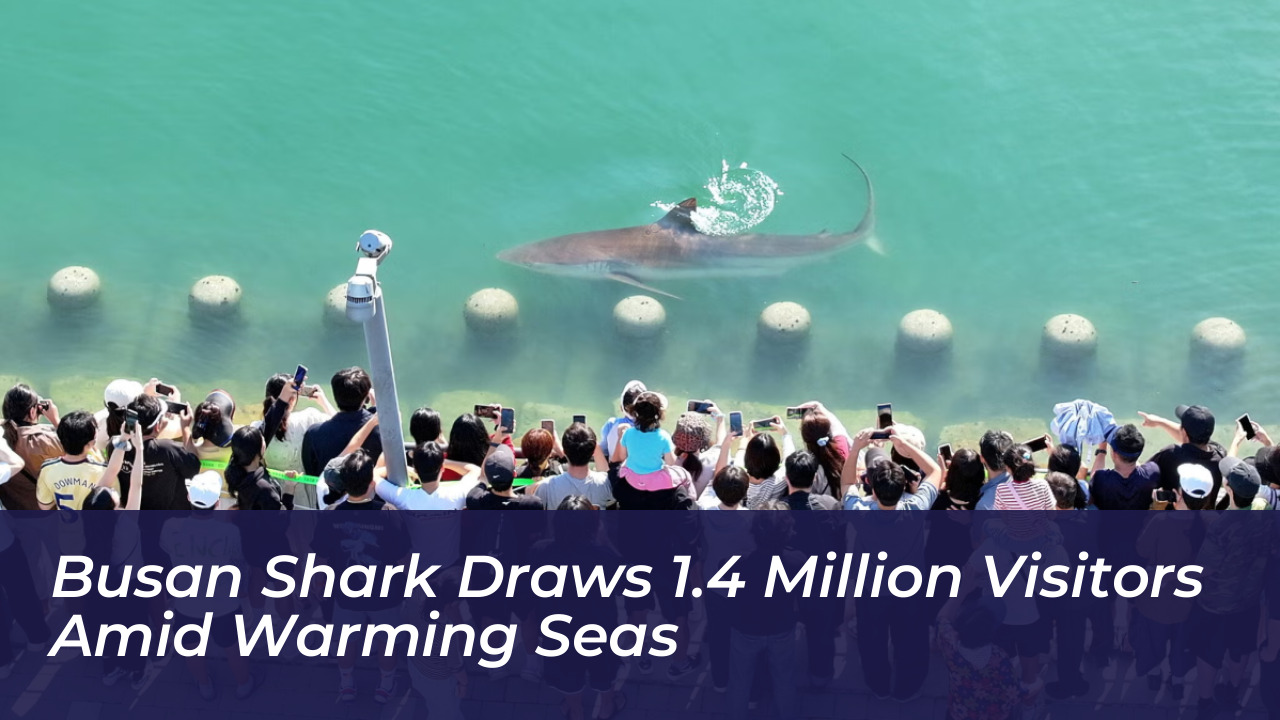

A female shark residing in an artificial canal at Bukhang Waterfront Park in Busan, South Korea, has drawn approximately 1.4 million visitors since September. It has transformed into a nationwide tourist attraction while sparking urgent discussions about marine environmental shifts. City officials, researchers, and environmental advocates are balancing public fascination with growing concerns regarding regional sea temperature increases.
Identified as a female blacktip or bronze whaler shark measuring roughly 3 to 3.5 meters (10 to 11.5 feet) in length, the animal was first spotted on September 18 in the southeastern coastal city. The species is classified as Endangered on the International Union for Conservation of Nature’s Red List. Local authorities nicknamed the shark “Bukangi,” combining “Bukhang” (the Korean name for Busan’s North Port) with an affectionate suffix, and later appointed it an honorary promotional ambassador.
Extensive Monitoring and Failed Rescue Operations
The unexpected presence of a large predator within an urban waterway prompted a massive multi-agency response. Busan Mayor Jeon Jae-soo deployed 105 personnel daily from municipal agencies, the police, coast guard, firefighters, fisheries research institutions, and the Busan Port Authority to monitor the shark’s physical condition and manage crowd safety.
City authorities have attempted twice to guide the animal back into open water. The first operation utilized rescue boats, water pumps, and high-pressure spray to create noise and currents, while a second attempt involved a specialized net. Both operations failed after the shark evaded the equipment and returned to the shallow canal. Officials subsequently paused active rescue efforts to prevent inflicting excessive stress on the animal.
Broader Environmental Concerns and Climate Links
While local businesses experienced a surge in foot traffic, and the Busan baseball team alongside a local soju distillery released special edition merchandise featuring the shark, environmental groups and researchers have criticized the lighthearted public frenzy.
The Busan Federation for Environmental Movement argued that the waterfront park’s heavy land reclamation and human-centric design prevent marine wildlife from easily escaping enclosed spaces. Environmental organizations and political groups have linked the sighting to broader climate change impacts.
According to the National Institute of Fisheries Science (NIFS), sea surface temperatures around the Korean Peninsula have risen 0.7°C over the past decade, a rate more than double the global average. Long-term climate data indicates that South Korean coastal waters warmed by 1.6°C between 1968 and 2025. This warming trend has driven warm-water prey species further north, prompting large predators like sharks to follow their food sources into unfamiliar regions.
Official fisheries data highlighted a sharp increase in large shark bycatch, recording 73 cases between January and August, compared to significantly lower figures in previous years. Marine biologists and academics emphasize that while individual sightings cannot be solely attributed to a single global warming event, the broader pattern underscores the pressing need for long-term ecological monitoring and adaptive fisheries management in South Korea.