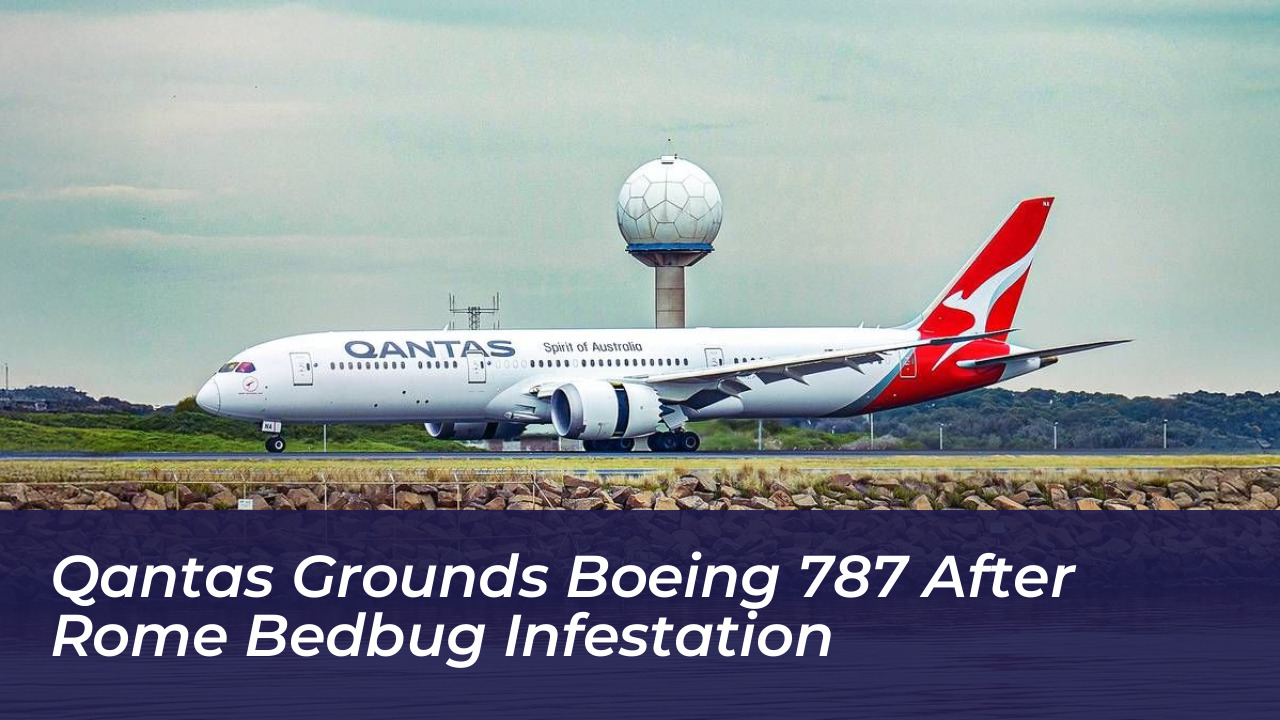

An international travel disruption unfolded when Qantas grounded one of its flagship Boeing 787 Dreamliners following a bedbug infestation aboard a nearly 17-hour journey. The incident occurred on flight QF5, traveling from Perth, Australia, to Rome, Italy, on October 9, 2026. Multiple passengers seated in the forward section of the economy cabin reported active insect bites and encountered parasites crawling on clothing, blankets, and cabin surfaces.
Cabin crew distributed oral antihistamines to help travelers manage persistent itching and discomfort during the flight. However, medical supplies eventually ran out before the aircraft touched down. Upon arrival at Leonardo da Vinci-Fiumicino Airport at 7:33 AM local time on Saturday, October 10, 2026, technical teams inspected the cabin and confirmed pest activity within an isolated seating block.
Flight QF6 Cancellation and Operational Fallout
Rather than attempting a quick turnaround, Qantas took the widebody aircraft out of scheduled service. This mandatory withdrawal forced the abrupt cancellation of the return service, flight QF6 from Rome Fiumicino to Perth, which was originally scheduled to depart at 10:45 AM on October 10. The cancellation stranded hundreds of passengers in Italy, requiring the airline to provide emergency hotel accommodations and alternative rebooking options within a 48-hour window.
A Qantas spokesperson issued a formal statement regarding the disruption, noting that the flight cancellation was necessary to allow engineers and maintenance teams to perform a deep clean after an issue was identified on a small number of economy seats. The carrier extended a sincere apology to all affected customers.
Industry data revealed that the specific aircraft involved was a Boeing 787-9 registered as VH-ZNI. Instead of remaining grounded indefinitely, the airframe later departed Rome at 2:02 PM on October 10 under combined flight numbers QF7006 and QF6007, ferrying back toward Australia and eventually landing in Sydney more than six hours behind schedule.
Financial Impact and EC261 Regulatory Liability
The bedbug incident carried heavy financial consequences for the Australian flag carrier. Beyond the unbudgeted costs of hotel accommodations, meal vouchers, and specialized cleaning crews, the flight’s origin within the European Union exposed Qantas to significant regulatory penalties under European Commission Air Passenger Rights Regulation EC 261/2004.
Under EU261 rules, passengers experiencing flight cancellations without two weeks of advance notice on long-haul routes exceeding 3,500 kilometers are legally entitled to €600 in statutory cash compensation. With VH-ZNI configured to seat 236 passengers, potential cash compensation exposure alone could reach up to €141,600, not including ancillary care and rebooking expenses absorbed by the airline.
Expert Insights on Aviation Biosecurity
Parasitologists and aviation experts have highlighted the challenges of managing biosecurity hazards on ultra-long-haul commercial routes. Professor Michelle Power, a parasitologist at Macquarie University, explained that bedbugs are flightless insects that almost certainly enter aircraft cabins via contaminated passenger luggage or clothing after travelers visit infested hotel accommodations.
Unlike fixed structures like hotels or residential homes, commercial airliners cannot undergo standard gaseous fumigation. Pest control experts note that chemical fogs risk damaging the intricate electrical wiring and avionics conduits running throughout modern composite aircraft like the Boeing 787 Dreamliner. Consequently, airlines must rely on targeted manual cleaning, localized residual treatments, and intensive thermal inspections.
Health authorities advise travelers suspecting exposure to wash all travel garments and soft personal items at a minimum temperature of 60°C (140°F) and tumble-dry them on high heat for at least 30 minutes. Vacuuming luggage thoroughly and sealing non-washable items in plastic containers helps prevent hitchhiking pests from establishing secondary infestations in private residences.
Frequently Asked Questions
Why was Qantas flight QF6 cancelled on October 10, 2026?
Qantas cancelled flight QF6 from Rome to Perth after passengers on the inbound Perth-to-Rome flight (QF5) experienced bedbug bites. The airline grounded the Boeing 787-9 Dreamliner in Rome to conduct an intensive deep clean of the economy cabin.
Are passengers on the cancelled Rome flight entitled to compensation?
Yes. Because the flight was scheduled to depart from an airport within the European Union, passengers are protected under EU Regulation 261/2004. Eligible travelers can claim up to €600 in statutory cash compensation alongside hotel accommodations and meals.
How do bedbugs enter commercial aircraft cabins?
Parasitologists confirm that bedbugs are introduced primarily through human travel, hitchhiking inside passenger luggage, backpacks, or outer clothing from infested hotels and transferring into cabin upholstery seams.
What steps should passengers take if bitten during a flight?
Travelers should notify flight attendants immediately to ensure the incident is logged in the official flight report. Post-flight, wash all clothing immediately in hot water (at least 60°C) and thoroughly vacuum luggage.
How does Qantas clean its aircraft cabins normally?
Qantas maintains standard cabin cleaning protocols and applies specialized disinfectants every 50 days as a regular preventative measure across its long-haul fleet.