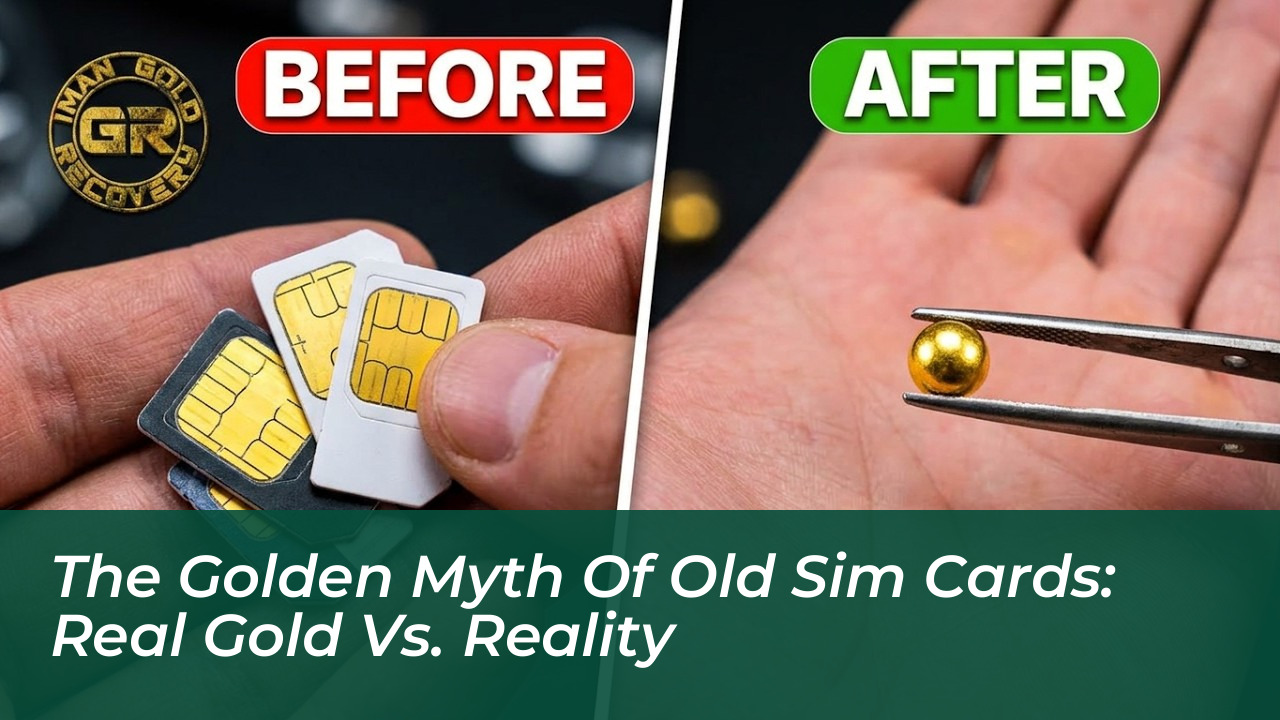

Every household likely has at least one disused mobile handset or a collection of old subscriber identity module cards gathering dust inside a cupboard. Driven by viral videos and digital urban-mining trends, a widespread myth has emerged that these discarded telecommunications relics harbor hidden fortunes. While it is true that mobile phone SIM cards contain genuine, pure gold, evaluating the financial and physical reality reveals a stark disconnect between social media hype and metallurgical truth.
Understanding what actually sits inside disused mobile technology requires a look at engineering design, exact mathematical yields, and the steep environmental and legal hurdles of attempting chemical extraction at home.
Why Telecommunications Hardware Demands Pure Gold
Mobile networks rely on instantaneous, uninterrupted data transfer under varying physical conditions. To achieve this reliability, microchip manufacturers plate electrical contact pins with gold rather than cheaper conductive metals like copper or aluminium.
Gold exhibits supreme resistance to corrosion and tarnish. This ensures that constant humidity, body heat, and mechanical friction inside a pocket or handset will not degrade the connection over years of operation. The gold layer found on SIM contacts is applied via electroplating over an underlying base layer of nickel and copper. Crucially, this coating is exceptionally thin-often measuring less than a single micron in depth. The surface sheen is real, 24-carat gold, but the physical mass remains microscopic.
Calculating the Real Yield: Milligrams Versus Mountains of Plastic
Evaluating the potential return from gold recovery requires strict mathematical precision rather than optimistic guesswork. Legacy full-sized and mini-SIM cards from earlier mobile eras carry significantly larger contact pads than the diminutive nano-SIMs found in contemporary smartphones.
- Vintage Mini-SIM Cards: Typically yield roughly 1 to 2 milligrams of reclaimable gold per card under optimal extraction conditions.
- Modern Nano-SIM Cards: Often yield substantially less than 0.5 milligrams due to aggressive component miniaturisation.
- Threshold for One Gram: Reaching a single gram of refined gold-valued at roughly £50 to £60 depending on fluctuating market spot rates-requires between 500 and 1,500 individual cards.
Collecting such massive volumes presents an immediate logistical hurdle for any amateur refiner. Without commercial partnerships with bulk electronics liquidators, accumulating sufficient material takes years of painstaking collection.
The Realities of Chemical Leaching and Environmental Safety
Extracting these minute traces is not a mechanical task. It requires potent chemical digestion to strip the gold layer away from plastic carriers and base metals. Refining practitioners generally rely on concentrated nitric to dissolve underlying copper and nickel, or hydrogen peroxide-based solutions to dissolve the gold into liquid chloride before chemical precipitation.
These volatile processes generate toxic nitrogen dioxide gas and leave behind hazardous metal salts that cannot simply be poured into domestic drains. Regulatory bodies strictly regulate hazardous waste management and the domestic disposal of toxic chemical effluents, establishing severe legal penalties for improper environmental discharge.
When factoring in the cost of high-grade laboratory glassware, protective equipment, and industrial chemicals, small-scale domestic processing almost always costs considerably more than the scrap gold itself is worth.
Industrial Urban Mining: How Large Recyclers Make It Pay
Where individual hobbyists face financial and environmental losses, licensed commercial processing facilities thrive through colossal operational scale. Professional electronics recyclers process obsolete telecommunications hardware by the metric tonne, sorting circuit boards, processors, and SIM card contacts simultaneously.
Certified industrial facilities employ automated sorting lines, closed-loop hydrometallurgical systems, and exhaust scrubbers that capture harmful vapours without threatening local ecosystems. Their operations fall strictly under regional Waste Electrical and Electronic Equipment (WEEE) directives, ensuring responsible material life cycles.
For everyday consumers, handing obsolete devices over to accredited recycling programmes or council-run e-waste centres remains the most practical contribution toward resource conservation.
Frequently Asked Questions
How much gold is actually in a single SIM card?
A single SIM card contains an imperceptible deposit of pure gold, typically yielding between 0.5 and 2 milligrams. Modern nano-SIM cards often yield less than 0.5 milligrams, worth just a fraction of a penny.
How many SIM cards do you need to get one gram of gold?
Reaching a single gram of refined gold requires collecting between 500 and 1,500 individual cards, depending on their age and size, as older legacy cards feature larger contact surfaces.
Is it profitable to extract gold from SIM cards at home?
No. Home extraction is financially and environmentally unviable. The cost of necessary chemical reagents, laboratory equipment, and safety gear far exceeds the market value of the tiny amount of gold recovered.
What chemicals are used to extract gold from electronics?
Professional and amateur refiners historically use harsh chemical solutions like aqua regia (a mix of hydrochloric and nitric acids) or hydrogen peroxide mixtures to dissolve base metals and precipitate gold.
Are there safety and legal risks to home gold extraction?
Yes. Chemical digestion releases toxic fumes such as nitrogen dioxide and produces hazardous metal salts. Improper disposal violates environmental regulations and carries severe legal penalties.
What is the best way to dispose of old SIM cards?
The safest and most environmentally responsible method is to drop off disused SIM cards and handsets at certified e-waste recycling facilities or authorized electronic take-back programmes.