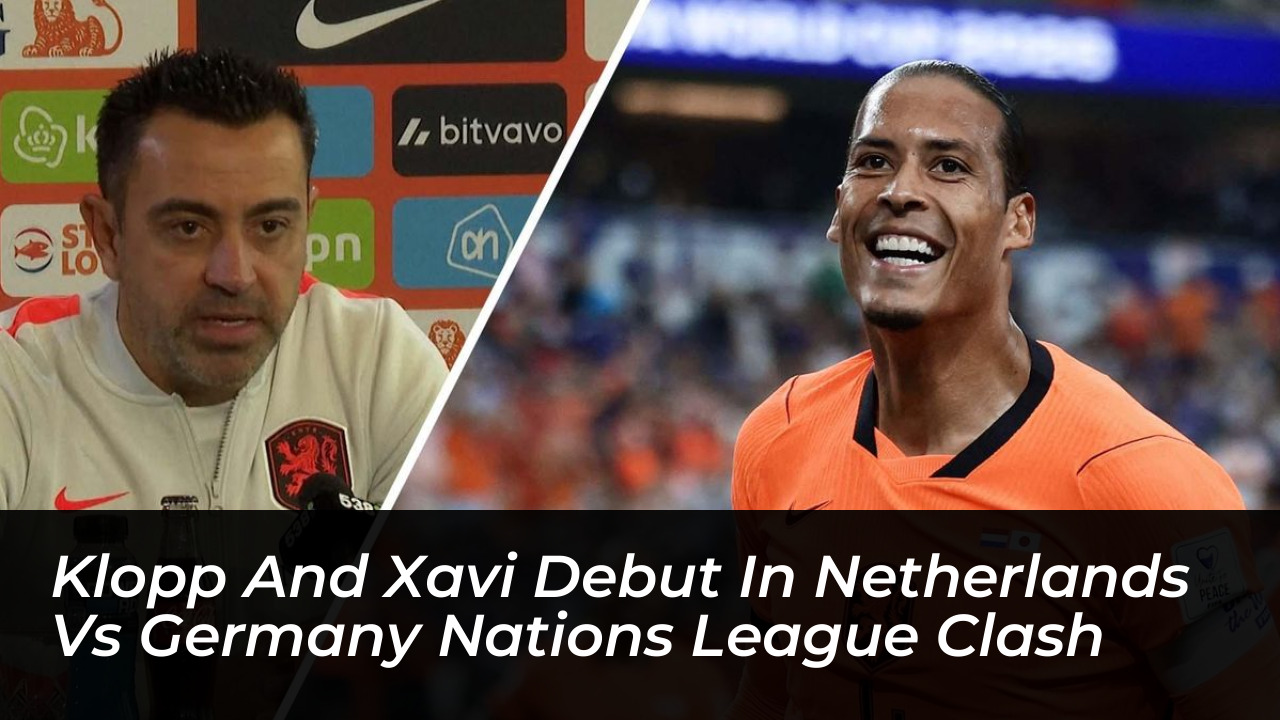

The Johan Cruyff Arena in Amsterdam prepares for a fixture carrying profound historical weight and fresh managerial intrigue. On Thursday, September 24, 2026, the Netherlands and Germany lock horns in a high-stakes UEFA Nations League Group A2 encounter. This match transcends traditional continental rivalries by marking the official international managerial debuts of Jürgen Klopp and Xavi Hernández. Both footballing powerhouses arrive at this watershed moment following underwhelming round-of-32 exits at the North American World Cup earlier in the summer. Those premature eliminations sealed the fates of former bosses Ronald Koeman and Julian Nagelsmann. Now, two tactical heavyweights step into the international arena with opposing philosophies, distinct roster strategies, and immediate pressure to restore national pride.
A New Era in Amsterdam: Xavi Restores the Oranje Identity
Xavi Hernández steps into the Dutch dugout with a clear mandate to revive an attacking, possession-heavy identity rooted in the Johan Cruyff school of thought. Following Koeman’s departure, the Royal Dutch Football Association targeted a manager capable of unifying the squad and maximizing technical proficiency. Xavi signed a contract running through the 2030 World Cup, signaling long-term faith in his project. The former Barcelona boss brings a strict positional discipline that demands rapid ball circulation and intelligent spatial occupation.
His maiden selection reflects both continuity and calculated adjustment. Virgil van Dijk retains the captaincy, anchoring a backline featuring Tottenham’s Micky van de Ven and Jan Paul van Hecke, alongside Real Madrid right-back Denzel Dumfries. Brighton goalkeeper Bart Verbruggen starts between the posts.
Notable omissions and recalls shape the Dutch setup. Memphis Depay, the all-time leading goalscorer for the Netherlands, was left out alongside Wout Weghorst and Stefan de Vrij. However, Xavi recalled Borussia Dortmund midfielder Joey Veerman after a two-year international absence to establish a stable midfield axis alongside Ryan Gravenberch and Tijjani Reijnders. Quinten Timber starts in midfield, while his brother Jurrien Timber misses out due to groin injury management. Up front, Sunderland star Brian Brobbey leads the attack, supported by Cody Gakpo and Crysencio Summerville. These tactical tweaks aim to inject fresh energy into a forward line that struggled to convert chances during the recent global tournament.
Klopp’s Radical 44-Player Reconstruction in Germany
Across the pitch, Jürgen Klopp begins his tenure as Germany manager with an unprecedented squad management experiment. Rather than relying on a tight core of 23 players, Klopp named a sprawling 44-player roster split into two distinct blocks for the international window. The first group tackles fixtures against the Netherlands and Greece, while the second group prepares for upcoming matches against Serbia and a rematch with Greece. This expansive evaluation pool allows the former Liverpool manager to test fringe talents without risking long-term squad cohesion.
Klopp deployed a 4-2-3-1 formation for his debut in Amsterdam. In goal, Marc-André ter Stegen claims the starting gloves following Manuel Neuer’s international retirement. The defensive unit features Freiburg debutant Philipp Treu at right-back, alongside Jonathan Tah, Nico Schlotterbeck, and Nathaniel Brown.
In midfield, captain Joshua Kimmich operates in a central role alongside Felix Nmecha. Jamal Musiala pulls the strings as the central number 10, flanked by Karim Adeyemi and Kevin Schade. Arsenal forward Kai Havertz leads the German frontline. Meanwhile, young sensation Florian Wirtz remains held in reserve for the second block of matches to manage his physical workload. Klopp demands relentless defensive tracking from his wingers to fuel rapid vertical transitions upon regaining possession.
Tactical Comparison: Possession versus Verticality
The tactical chess match in Amsterdam pits Xavi’s obsession with spatial control against Klopp’s demand for relentless, front-footed disruption. Xavi relies on his midfield trio to starve opponents of possession, utilizing short passing triangles and technical security. Klopp demands immediate ball recovery, vertical acceleration, and overwhelming physical output in the opponent’s half. This stylistic clash promises a fierce battle for central midfield dominance.
| Metric / Parameter | Netherlands (Xavi Hernández) | Germany (Jürgen Klopp) |
|---|---|---|
| Tactical Philosophy | Positional play, high possession, Cruyffista principles | Gegenpressing, vertical transitions, high-octane intensity |
| Squad Management Strategy | Traditional core squad with targeted midfield additions | Expanded 44-player rotation split across two fixture blocks |
| Captain & On-Field Leader | Virgil van Dijk (Central Defender) | Joshua Kimmich (Central Midfielder) |
| Primary Formation | 4-3-3 | 4-2-3-1 |
This stark tactical contrast guarantees a high-voltage spectacle. Every phase of play features a direct collision between methodical Spanish-influenced buildup and ferocious German gegenpressing.
The Group A2 Landscape and Nations League Stakes
Group A2 of the UEFA Nations League contains zero margin for error. Alongside the Netherlands and Germany, Serbia and Greece complete a brutal round-robin group. Both managerial appointments serve as the opening salvos for the 2028 European Championship qualifying cycle. Both teams suffered painful knockout exits in North America, with the Netherlands falling short in the round of 32 and Germany bowing out at the same stage.
Thursday’s clash serves as the ultimate litmus test. Fans and pundits will discover whether Xavi’s positional overhaul or Klopp’s mass-evaluation experiment yields immediate competitive dividends.
Uniquely Positioned: What the Data Misses
While mainstream coverage focuses heavily on the tactical pedigree of both managers, two critical dynamics often escape general analysis:
The Psychological Rebound
Both managers assumed control of squads suffering from severe tournament fatigue and public apathy. Klopp’s public advocacy for positive patriotism in Germany mirrors Xavi’s refusal to dwell on past setbacks, shifting collective mindsets from trauma to reinvention.
Club Relationship Management
Klopp’s 44-player strategy is an ingenious diplomatic masterclass. By distributing international minutes across an enormous pool, he appeases Bundesliga sporting directors terrified of player burnout during an expanded football calendar.
Conclusion
The Johan Cruyff Arena matchup represents a rare convergence of managerial royalty taking their first steps in international management simultaneously. Whether Xavi’s refined passing game or Klopp’s chaotic energy prevails, European football enters a fascinating new tactical epoch.
Frequently Asked Questions
When is the Netherlands versus Germany Nations League match?
The match takes place on Thursday, September 24, 2026, with kickoff scheduled for 20.45 CEST at the Johan Cruyff Arena in Amsterdam.
Why did Jürgen Klopp name 44 players in his Germany squad?
Klopp selected an expanded 44-player roster to evaluate a broad talent pool across four fixtures. He split the squad into two groups to manage player workloads and assess new prospects without relying on a fixed A or B designation.
Who are the new head coaches for the Netherlands and Germany?
Xavi Hernández manages the Netherlands following Ronald Koeman’s departure, while Jürgen Klopp manages Germany following Julian Nagelsmann’s exit.
Where can viewers watch the match?
In Spain, the match broadcasts free on Teledeporte and RTVE Play. In the Americas, coverage is available via ESPN, Disney+, and regional streaming partners.
What is the format of the UEFA Nations League Group A2?
Group A2 features a double round-robin format where the Netherlands, Germany, Serbia, and Greece play home and away fixtures to determine qualification for the knockout rounds.