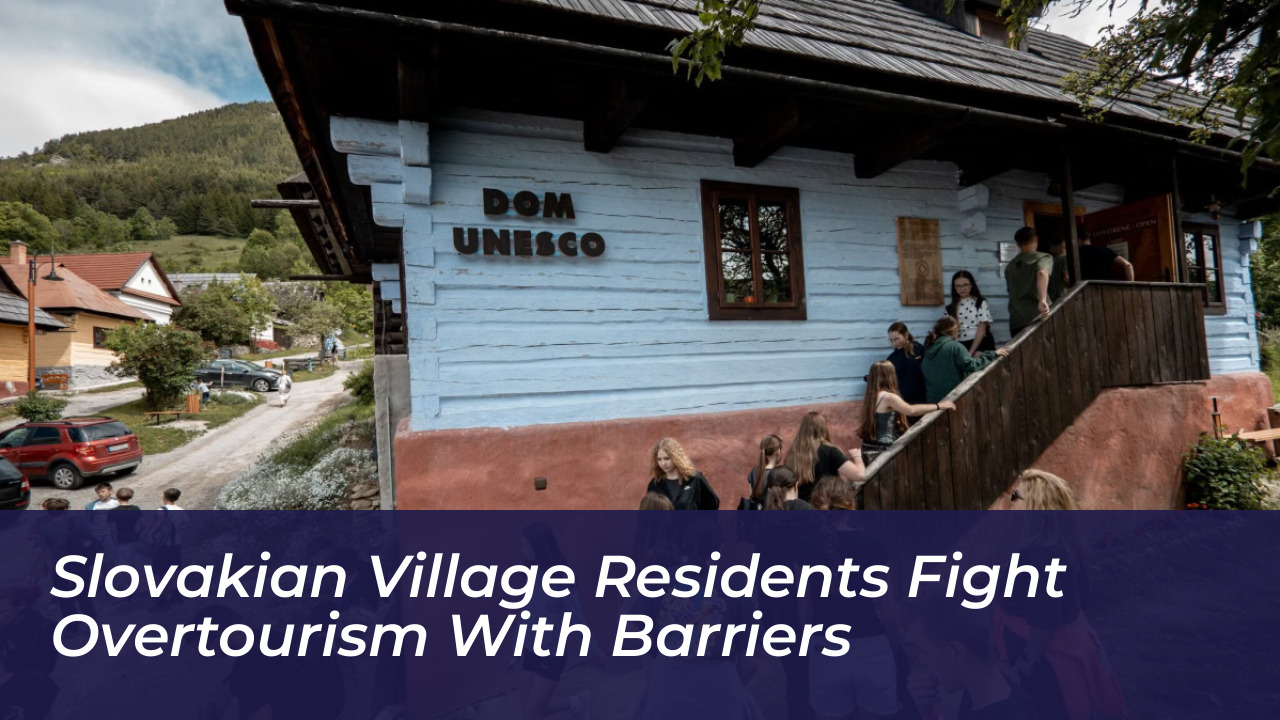
A quiet mountain morning in Vlkolinec usually begins with the crisp scent of pine and the sound of distant cowbells across the Slovakian hills. That serene atmosphere vanishes by mid-morning as tour buses rumble up the narrow winding road, disgorging waves of eager travelers clutching cameras. Seventeen permanent residents now find themselves sharing their historic mountain settlement with up to 1,000 visitors every single day during the peak summer season. This stark imbalance highlights the breaking point of global heritage overtourism, where prestigious preservation status clashes directly with the basic human right to privacy and peace.
- The Anatomy of Overtourism in Vlkolinec
- From Communist-Era Reserve to UNESCO Landmark
- Living Inside a Living Museum
- Economic Disconnect and the True Cost of Heritage
- Paltry Subsidies Versus Harsh Winters
- The Absence of Local Economic Return
- Municipal Response and Infrastructure Solutions
- Ruzomberok Administration Strategy
- Proposed Capital Improvements
- The Legal Reality of UNESCO Status Removal
- Why Voluntary Withdrawal Is Nearly Impossible
- Historical Precedents of UNESCO Removals
- Comparative Analysis: Overtourism in Small Communities
- Global Scale of the Rural Heritage Crisis
- Frequently Asked Questions
- Why did residents erect barriers in Vlkolinec?
- How many people live in Vlkolinec year-round?
- Can a village voluntarily leave the UNESCO World Heritage List?
- What financial compensation do residents receive for tourism disruptions?
The Anatomy of Overtourism in Vlkolinec
From Communist-Era Reserve to UNESCO Landmark
The transformation of Vlkolinec from a quiet agricultural community into an international tourist magnet spans several decades. Authorities initially designated the settlement as a Folk Architecture Heritage Reserve in 1977 during the Communist era, aiming to protect its collection of traditional log houses. International recognition followed in 1993 when the site earned prestigious UNESCO World Heritage status. That inscription thrust the remote village onto global travel itineraries, accelerating a shift from a functioning agricultural settlement into a heavily commercialized tourism hotspot.
Visitors arrive by the thousands daily, frequently forgetting that real families inhabit the centuries-old wooden structures. The architectural beauty that draws travelers from across the globe simultaneously serves as domestic quarters for people trying to live ordinary lives. Tour groups wander uninvited onto private porches, treating residential homes like exhibits in an open-air theme park.
Living Inside a Living Museum
The mathematics of the situation reveal an unsustainable population imbalance. With only 17 year-round residents facing up to 1,000 daily visitors, the local ratio reaches extreme proportions. To put this into perspective, if a major metropolitan area like Barcelona matched this visitor density, the Spanish city would host 100 million people every single day, completely overwhelming its municipal infrastructure.
Lifelong resident Anton Sabucha experiences this disruption firsthand on a daily basis. Stepping out into his private yard for a quiet morning coffee often triggers an immediate invasion of privacy. Strangers routinely walk up to ask intrusive questions or peer through windows. Despite polite requests and posted warnings, tourists frequently cross property lines to secure the ideal vacation photograph. This relentless wave of visitors has also eroded local demographics. Decades ago, roughly 200 people called Vlkolinec home. Today, only a handful of elders remain, struggling to maintain historical properties and preserve traditional farming practices while managing endless streams of sightseers.
Economic Disconnect and the True Cost of Heritage
Paltry Subsidies Versus Harsh Winters
While regional tourism boards generate revenue from the influx of travelers, local homeowners see very little financial return from the activity. Municipal ticket sales yield an average annual payout of roughly 400 euros per homeowner. This modest sum barely covers the cost of a single pallet of heating briquettes required to survive the bitter mountain winters. Maintaining centuries-old wooden architecture demands specialized labor and expensive materials, yet financial assistance remains severely inadequate.
The individuals and agencies that profit most from the tourism trade often live outside the village boundaries, leaving local residents to shoulder the burdens alone. Elderly homeowners manage exhausting property upkeep without community support, facing structural deterioration accelerated by heavy foot traffic and environmental wear.
The Absence of Local Economic Return
Traditional agricultural practices have virtually disappeared from the landscape as residents focus entirely on coping with the daily tourist rush. Surrounding meadows remain uncut, and historical agricultural terraces grow wild because the aging population lacks the physical capacity to farm while managing hundreds of daily visitors. The economic model operating in Vlkolinec extracts value from the community while leaving residents with higher maintenance costs, damaged property, and fractured daily routines.
Municipal Response and Infrastructure Solutions
Ruzomberok Administration Strategy
Miro Parobek, who oversees tourism for the town of Ruzomberok, acknowledges the severe challenges brought by mass tourism. Municipal officials maintain that better visitor management represents the correct path forward rather than attempting to revoke UNESCO protection. The local government has initiated several corrective measures to ease the strain on locals, including replacing massive festivals with smaller cultural gatherings to prevent sudden overcrowding.
Authorities also established a dedicated resident working group to foster direct communication between homeowners and municipal leaders. Entrance tickets now feature prominent stamps stating clearly that Vlkolinec is an inhabited village rather than an open-air museum. The town provides older residents with twice-weekly transport into nearby Ruzomberok to help them manage essential errands away from the tourist crowds.
Proposed Capital Improvements
Ruzomberok is actively pursuing international funding, including Norwegian grants, to upgrade local infrastructure and redirect visitor traffic. Proposed capital improvements feature a hillside park-and-ride facility located well below the historic settlement to keep personal vehicles out of the residential core. Additional plans involve upgrading footpaths, improving drainage systems, restoring traditional barns, and converting the former village school into a dedicated community center for local residents.
The Legal Reality of UNESCO Status Removal
Why Voluntary Withdrawal Is Nearly Impossible
Frustrated by the endless wave of trespassers, Anton Sabucha has openly expressed a desire to strip the village of its UNESCO status to regain personal peace. However, legal experts emphasize that a community cannot simply vote to leave the registry. UNESCO guidelines maintain strict criteria for designation, and no legal framework currently exists for a living population to drop its status voluntarily due to social friction or overcrowding.
Historical Precedents of UNESCO Removals
UNESCO has stripped or removed designations only three times since the program began in 1978. The Dresden Elbe Valley in Germany lost its status in 2009 following the construction of a modern bridge. The historic Liverpool waterfront in the United Kingdom was removed in 2021 due to large-scale modern redevelopment. Finally, the Arabian Oryx Sanctuary in Oman lost its designation in 2007 after the government reduced the protected reserve area by 90 percent. Each historical removal occurred because the sites suffered irreversible physical destruction, leaving no precedent for communities seeking relief from tourism pressure.
Comparative Analysis: Overtourism in Small Communities
Global Scale of the Rural Heritage Crisis
Vlkolinec is far from alone in facing the mathematical impossibility of small rural populations hosting massive crowds. Similar pressures impact heritage destinations across the globe, forcing municipalities to rethink how they balance preservation with community habitability.
| Location | Permanent Population | Annual Visitors | Primary Infrastructure Challenge |
|---|---|---|---|
| Vlkolinec, Slovakia | 17 | 100,000 | Narrow access roads, zero public restrooms, trespassing |
| Giethoorn, Netherlands | 2,800 | 1,000,000 | Canal congestion, pedestrian bottlenecks, lack of roads |
| Santorini, Greece | 15,500 | 2,000,000+ | Cruise ship overload, water scarcity, waste management |
Frequently Asked Questions
Why did residents erect barriers in Vlkolinec?
Lifelong resident Anton Sabucha and other locals installed barriers wrapped in caution tape and posted strict warning signs because tourists routinely trespass into private yards, trample gardens, and peer into windows without respecting personal privacy.
How many people live in Vlkolinec year-round?
Only 17 permanent residents remain in the historic mountain settlement throughout the year, while daily visitor counts climb as high as 1,000 people during peak summer months.
Can a village voluntarily leave the UNESCO World Heritage List?
There is no legal mechanism or precedent for a community voluntarily removing its UNESCO status due to overtourism. UNESCO has only ever revoked designations due to irreversible physical destruction or unauthorized modern development.
What financial compensation do residents receive for tourism disruptions?
Homeowners receive approximately 400 euros annually from municipal ticket sales, which covers only a tiny fraction of their annual heating and property maintenance costs.