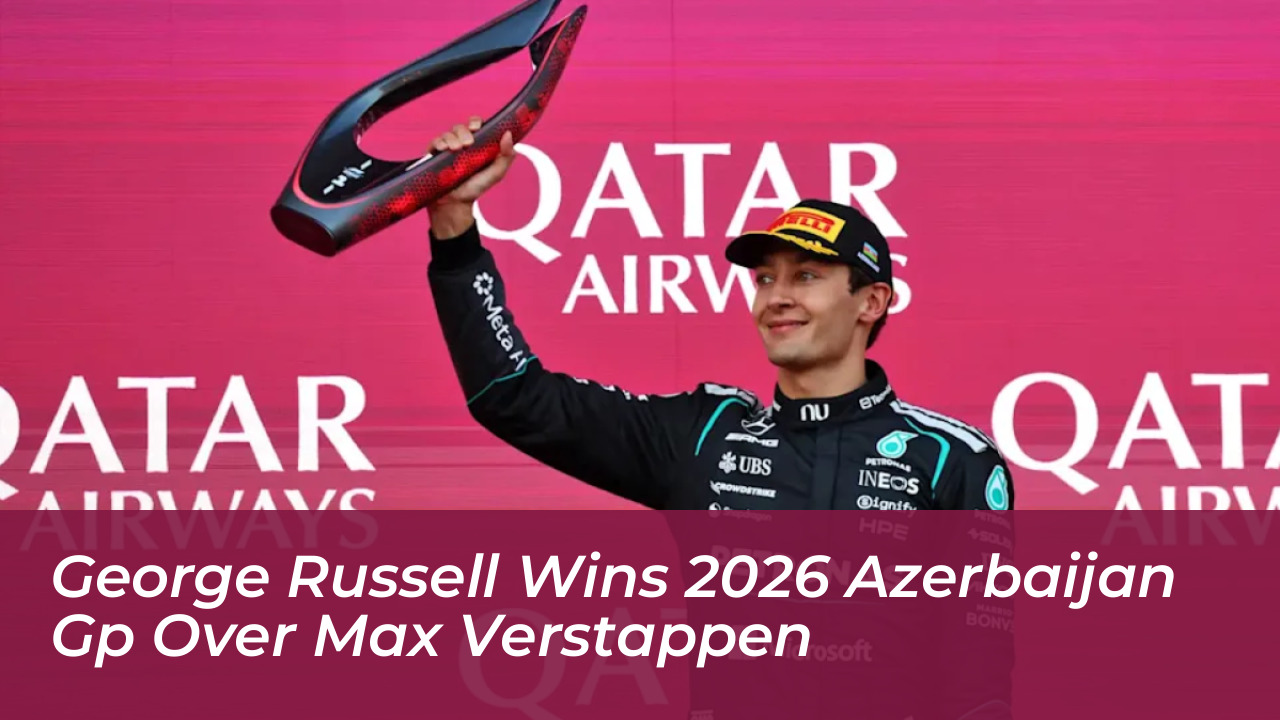
The 2026 Azerbaijan Grand Prix delivered one of the most heart-stopping finishes in recent Formula 1 history. Mercedes driver George Russell converted pole position into a brilliant victory at the Baku City Circuit, holding off Red Bull star Max Verstappen by a microscopic margin of just 0.196 seconds. Despite dominating the majority of the weekend from the front, Russell faced a harrowing defense in the closing laps following a late safety car intervention. The victory marks Russell’s third win of the season and the eighth of his career, breathing new life into his championship ambitions.
- Race Strategy and Tactical Breakdown
- The Safety Car Chaos and Restart Carnage
- Key Driver Performances
- George Russell: Clinical Precision Under Pressure
- Max Verstappen: Maximizing Red Bull’s Package
- Isack Hadjar: A Stunning Podium Return
- Kimi Antonelli: Damage Limitation Masterclass
- Official 2026 Azerbaijan Grand Prix Classification
- Uncovering Technical Gaps: ERS Overheating and Power Unit Dynamics
- Championship Standings Outlook With Eight Rounds Remaining
While Russell celebrated his masterclass on the Caspian Sea coast, the race behind him erupted into chaos, tactical battles, and dramatic championship swings. Red Bull secured a double podium finish as returning driver Isack Hadjar claimed third place. Meanwhile, championship leader Kimi Antonelli staged a remarkable recovery drive from 16th on the grid to finish fifth, minimizing damage to his points lead with eight rounds remaining in the 2026 season.
Race Strategy and Tactical Breakdown
Baku City Circuit is notoriously unforgiving, punishing the slightest misjudgment with concrete walls. The opening half of the race unfolded with relative tactical predictability. Russell maintained a comfortable gap at the front, dictating the pace and managing his tires efficiently. Behind him, Max Verstappen struggled initially with the medium compound tires on his Red Bull, yet he expertly defended his position against teammate Isack Hadjar and McLaren driver Oscar Piastri.
The strategic dynamic shifted dramatically on lap 28 when Williams driver Alex Albon crashed into the barrier, deploying the first safety car. This neutralisation wiped out Russell’s commanding advantage and compressed the field, setting the stage for high-stakes sprint racing through the narrow medieval streets of Baku. Teams were forced to react instantly on the pit wall, balancing track position with the threat of late-race incidents.
Tire management dictated the early narrative as drivers tried to stretch their stints before the inevitable chaos arrived. The long straights allowed cars to run in close proximity, but the technical sections demanded absolute precision to keep rubber temperatures in the optimal window. When the neutralisation occurred, the tactical chess match ended and pure survival instinct took over the grid.
The Safety Car Chaos and Restart Carnage
Restarts in Baku consistently generate volatility due to the massive slipstream effect down the 2.2-kilometer straight. As the race resumed, the midfield boiled over. Alpine driver Franco Colapinto misjudged his braking zone into Turn One, locking his front tires and collecting teammate Pierre Gasly. The resulting chain reaction eliminated McLaren driver Lando Norris from the race, shattering his lingering title defense hopes and drawing a stern ten-second penalty for Colapinto.
A second safety car period was triggered later in the race following Valtteri Bottas’s late-race crash in the old town section. This secondary interruption proved nearly fatal to Russell’s victory bid. As the British driver slowed down for waved yellow flags, he lost turbo boost and engine power momentarily. Verstappen instantly capitalized on the loss of speed, diving into Russell’s gearbox and nearly snatching the victory line by line.
Key Driver Performances
George Russell: Clinical Precision Under Pressure
George Russell delivered a career-defining performance on Saturday, leading every single lap from pole position to the checkered flag, a feat he had never previously accomplished in Formula 1. After struggling with early-season car adaptations under the 2026 regulations, Russell felt fully re-aligned with the Mercedes machinery following the summer break. His ability to manage tire degradation and absorb relentless pressure from Verstappen showcased elite racecraft.
When his power unit stuttered under the final yellow flag, Russell relied on quick thinking to protect his position. Managing the ERS deployment while fending off an aggressive world champion required absolute focus. This drive cements his status as a legitimate title contender heading into the final stretch of the season.
Max Verstappen: Maximizing Red Bull’s Package
Starting eighth on the grid after a challenging qualifying session, Max Verstappen extracted every ounce of performance from a Red Bull car that currently lacks outright top-end speed compared to Mercedes. By keeping his nose clean during the Turn One restart chaos and slicing past Oscar Piastri, Verstappen maneuvered into second place without sustaining any bodywork damage.
His furious chase in the final ten laps, clocking fastest laps and applying maximum psychological pressure on Russell, demonstrated why the four-time world champion remains the benchmark of the grid. Verstappen pushed his machinery beyond its nominal limits, nearly stealing a victory that seemed entirely out of reach on Friday afternoon.
Isack Hadjar: A Stunning Podium Return
Returning from a six-week injury layoff due to a wrist fracture, Red Bull’s Isack Hadjar produced a flawless drive to claim the final step of the podium. Securing third place on pure race pace around a grueling street circuit highlights the young Frenchman’s rapid maturation. He managed his tires brilliantly through multiple safety car restarts.
His double podium finish alongside Verstappen marks a major morale boost for the Milton Keynes squad. Hadjar proved that his early season speed was no fluke, handling the intense physical demands of the Baku circuit despite his recent medical absence.
Kimi Antonelli: Damage Limitation Masterclass
Championship leader Kimi Antonelli experienced his most difficult weekend of the 2026 campaign. A high-speed crash during Friday qualifying forced the 20-year-old Italian to start down in 16th place. Rather than resorting to reckless overtaking, Antonelli adopted a calculated, risk-averse approach.
He navigated the Turn One melee with exceptional reflexes and climbed methodically through the field to finish fifth, limiting Russell’s points gain. This mature approach proves that Antonelli possesses the strategic mindset required to win a world championship, even when the car setup fails to cooperate.
Official 2026 Azerbaijan Grand Prix Classification
The official points-scoring finishers and notable race results from the streets of Baku display a heavily mixed grid:
- P1: George Russell (Mercedes)
- P2: Max Verstappen (Red Bull Racing)
- P3: Isack Hadjar (Red Bull Racing)
- P4: Charles Leclerc (Ferrari)
- P5: Kimi Antonelli (Mercedes)
- P6: Lewis Hamilton (Ferrari)
- P7: Arvid Lindblad (Racing Bulls)
- P8: Esteban Ocon (Haas)
- P9: Oliver Bearman (Haas)
- P10: Carlos Sainz (Williams)
Uncovering Technical Gaps: ERS Overheating and Power Unit Dynamics
Standard sports journalism covered the top-line podium results and post-race quotes, but mainstream coverage overlooked several critical technical realities from the Baku weekend. Telemetry analysis reveals that the exact power loss under yellow flags experienced by Russell was caused by energy recovery systems (ERS) overheating. When drivers lift off abruptly at low speeds in high ambient track temperatures, modern F1 units experience severe thermal spikes.
This technical limitation poses upcoming challenges for the championship fight. Mercedes confirmed that Russell requires a fresh power unit component for the upcoming race in Malaysia. His narrow victory in Baku will immediately face an FIA grid-drop hurdle at the Sepang International Circuit, adding immense pressure to his title campaign.
Championship Standings Outlook With Eight Rounds Remaining
The 2026 World Drivers’ Championship has tightened considerably following Russell’s victory. The psychological battle between rookie leader Kimi Antonelli and veteran challenger George Russell intensifies as the paddock heads to Malaysia. While Antonelli maintains his points buffer, the momentum clearly favors the Mercedes garage.
Teams must now pivot development focus toward reliability and high-temperature cooling packages. With eight rounds remaining, every single point matters, and execution under pressure will determine who hoists the trophy at the end of the season.