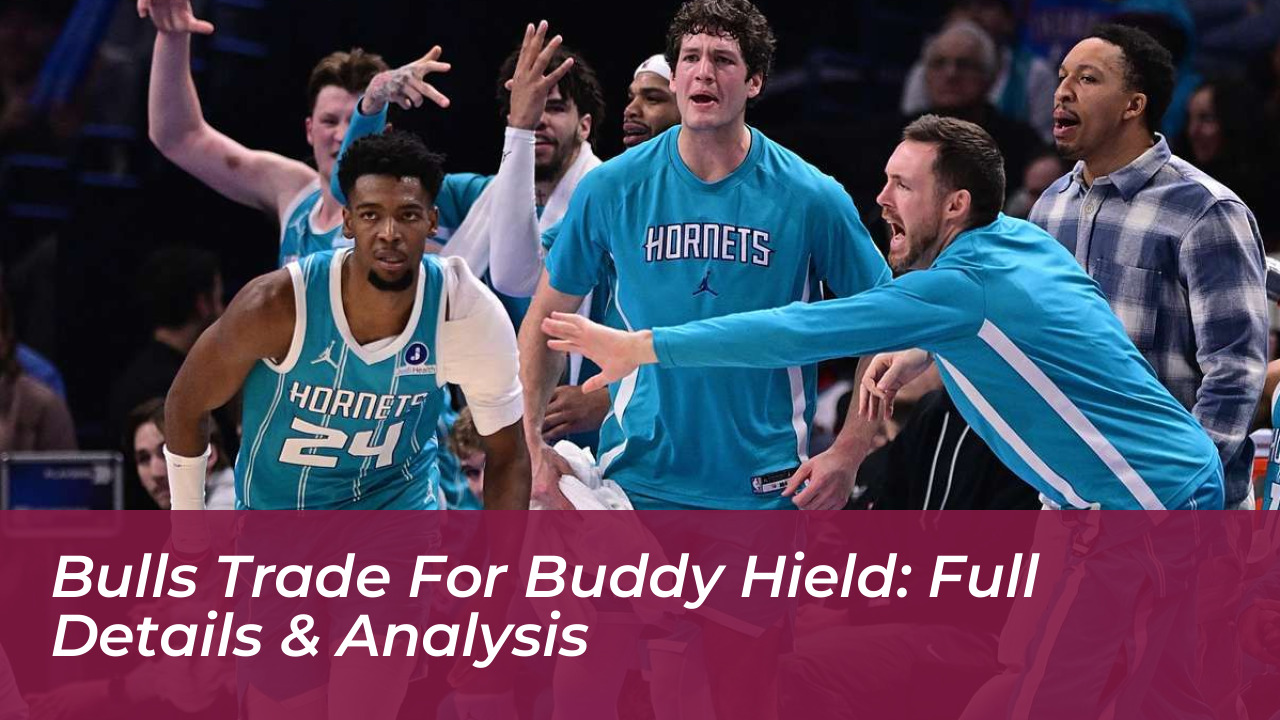
The Chicago Bulls made a splash over the weekend by acquiring veteran sharpshooter Buddy Hield and cash considerations from the Charlotte Hornets in exchange for young guard Rob Dillingham. ESPN insider Shams Charania broke the news on Saturday, setting off a wave of activity across the league. This transaction marks a whirlwind week for Hield, who finds himself changing uniforms for the second time in just four days following a brief stint with the Atlanta Hawks. Both front offices moved quickly to execute a deal that reflects entirely different organizational timelines as training camp approaches.
- Trade Overview: Bulls and Hornets Swap Guards
- Financial Mechanics and Trade Exceptions
- What Buddy Hield Brings to Chicago
- Bench Scoring and Head Coach Integration
- Rob Dillingham Seeks a Fresh Start in Charlotte
- Strategic Impact on the Eastern Conference Playoff Picture
- Frequently Asked Questions
- Who was involved in the trade between the Chicago Bulls and Charlotte Hornets?
- How many teams has Buddy Hield played for in his career?
- What draft pick was Rob Dillingham?
- Why did the Charlotte Hornets make this trade?
Trade Overview: Bulls and Hornets Swap Guards
The trade brings an experienced perimeter threat to the Windy City while sending a former lottery selection to a rebuilding squad in Charlotte. Front office operational timelines dictated the urgency of the deal. Chicago wants immediate floor spacing and veteran stability for their rotation, whereas Charlotte prioritizes asset accumulation and financial maneuverability.
Hield experienced a rapid transition over a 96-hour window. After the Hawks initially brought him in, the Hornets flipped the veteran guard to Chicago. This sequence highlights how quickly general managers work behind the scenes to balance roster spots and salary caps before the regular season tips off.
Understanding these roster moves helps fans grasp the overarching business strategy of modern basketball franchises. General managers often orchestrate multi-team agreements behind closed doors weeks before public announcements occur.
Team executives evaluate player performance metrics daily to ensure optimal salary cap health.
Financial Mechanics and Trade Exceptions
Salary matching rules require precise adjustments due to contract discrepancies between the incoming veteran and the outgoing young player. Hield carries a much larger salary than Dillingham for the upcoming season. To bridge this monetary gap and satisfy league trade regulations, the Charlotte Hornets included cash considerations in the package.
For Charlotte, the financial payoff is substantial. The maneuver generates a lucrative trade exception valued between $9.4 million and $9.6 million. This flexibility allows the Hornets to absorb additional salary later in the season if opportunities arise. Roster saturation presented an immediate hurdle for Charlotte, as the team needed to trim standard contracts before officially entering training camp.
Cap specialists work tirelessly to construct deals that comply with strict collective bargaining agreement guidelines. Every dollar matters when luxury tax thresholds loom over competitive franchises.
What Buddy Hield Brings to Chicago
Hield enters his 10th NBA season seeking a stable home after bouncing through several organizations in recent years. During the previous season, split between the Golden State Warriors and the Atlanta Hawks, Hield appeared in 51 games. He posted 7.6 points per contest while shooting 34.9 percent from beyond the arc. That accuracy sits below his career average of roughly 39.5 percent, yet opponents still guard him tightly at all times.
Defenses must respect his elite volume shooting regardless of minor efficiency slumps. The Bulls feature exciting young playmakers and forwards like Josh Giddey and Matas Buzelis. Hield provides gravity that stretches the defense, clearing driving lanes for slashing teammates who thrive in the paint.
Spacing the floor effectively forces opposing defenses to make difficult rotational decisions on the perimeter. Shooters of his caliber change defensive schemes instantly upon stepping onto the hardwood.
Bench Scoring and Head Coach Integration
Head coach Tiago Splitter plans to utilize Hield as a primary offensive weapon coming off the bench. The second unit lacked consistent punch last year, and Hield solves that issue immediately. His ability to run off screens and fire quickly from deep gives the Chicago offense a reliable safety valve.
Integrating a veteran scorer into a young rotation requires clear communication from the coaching staff. Splitter intends to use Hield not only as a spot-up shooter but also as a vocal leader in the locker room for the younger members of the squad.
Establishing reliable bench production remains a vital objective for coaching staffs aiming for postseason berths. Veterans often stabilize second-quarter lapses through smart shot selection.
Rob Dillingham Seeks a Fresh Start in Charlotte
Rob Dillingham is navigating his third professional stop early in his career. Selected eighth overall in the 2024 NBA Draft, the 21-year-old guard struggled to carve out consistent minutes in Minnesota before his brief stop in Chicago. During his time with the Bulls, Dillingham averaged 9.6 points and 2.8 assists per game, though his three-point percentage dipped to 30 percent.
Charlotte offers a guard-heavy developmental environment where Dillingham can compete for backcourt minutes and rebuild his confidence. While the Hornets manage 15-man roster limits, adding the young prospect represents a low-risk, high-upside gamble for a franchise focused on long-term growth.
Developing raw talent requires patience and dedicated individual workouts from player development coaches. Charlotte provides an ideal landscape for young guards to play through mistakes without immediate pressure.
Strategic Impact on the Eastern Conference Playoff Picture
Neither team enters the year as an immediate title threat, but this trade alters rotation depths across the board. The Chicago Bulls prioritize veteran competence over long-term project minutes. This approach signals a clear desire to fight for a spot in the Eastern Conference play-in tournament.
Hield plays on an expiring contract, giving the Chicago front office maximum flexibility to flip him to a contender if the season goes sideways by the trade deadline. Meanwhile, Charlotte uses financial agility to cultivate a balanced, youthful core that will mature together over the coming years.
Conference standings often shift dramatically based on minor roster tweaks executed during the late summer months. Front offices monitor early-season results closely to determine whether to buy or sell assets.
Frequently Asked Questions
Who was involved in the trade between the Chicago Bulls and Charlotte Hornets?
The Chicago Bulls acquired veteran guard Buddy Hield and cash considerations. In return, the Charlotte Hornets received young guard Rob Dillingham.
How many teams has Buddy Hield played for in his career?
Hield has played for multiple franchises across his 10-year NBA career. This trade makes the Chicago Bulls his seventh distinct organization.
What draft pick was Rob Dillingham?
Rob Dillingham was selected No. 8 overall in the 2024 NBA Draft before beginning his professional basketball career.
Why did the Charlotte Hornets make this trade?
The Hornets initiated the move to create financial flexibility, shed salary, generate a trade exception worth approximately $9.4 million, and acquire a promising young prospect.