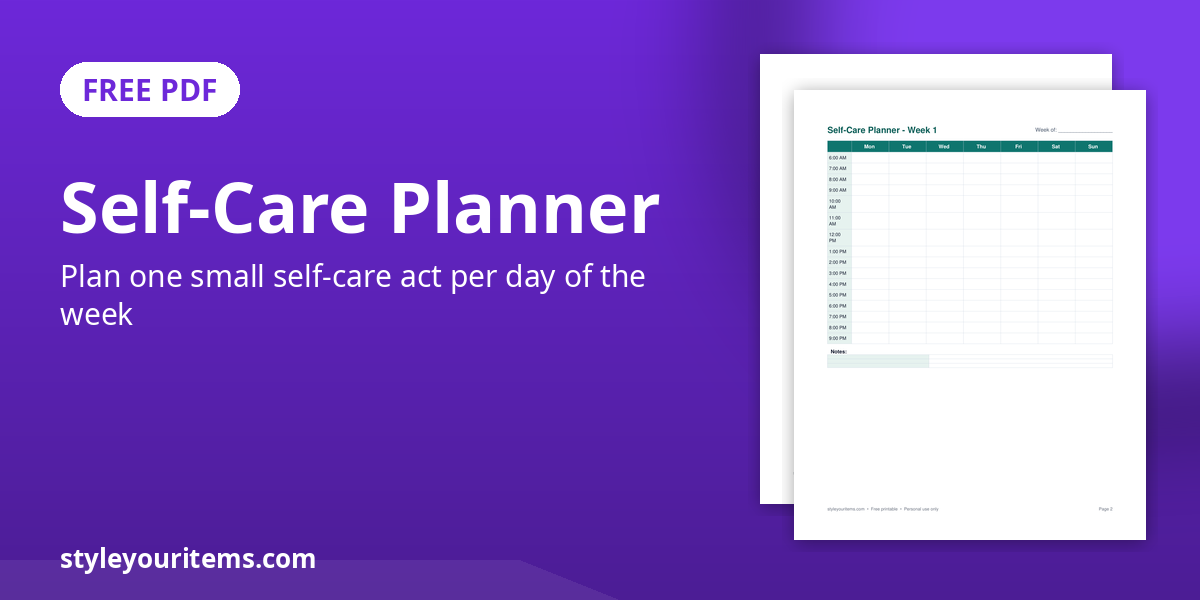
Most self-care lists fail in the same quiet way. You tick the boxes for a week, life gets busy, and the list sits untouched until you feel guilty enough to look at it again. This free printable self-care planner works differently. It does not ask you to tick off a list. It asks you to plan one small self-care act for each day of the week, in advance, so the act is already decided before the busy day arrives.
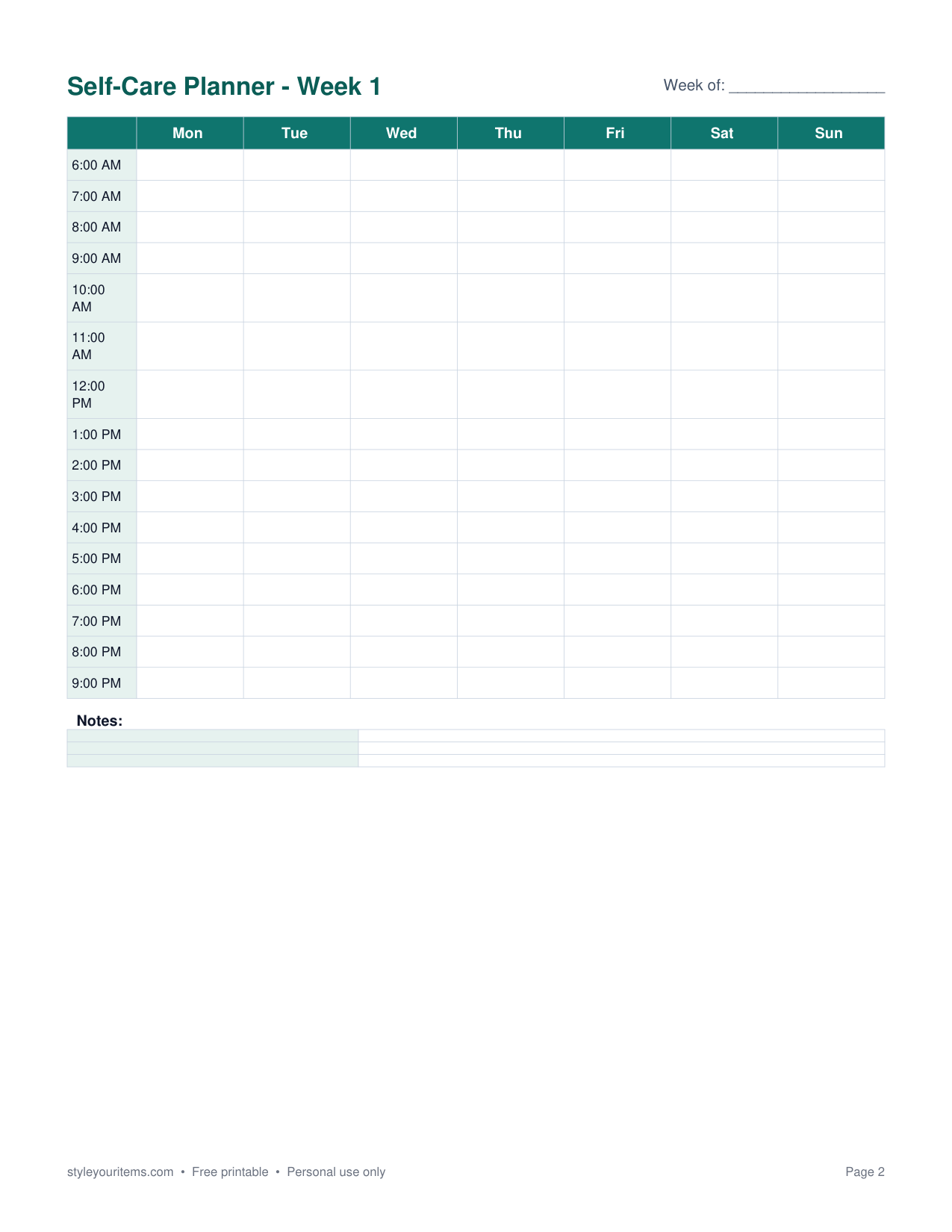
The PDF has five pages: a cover and four weekly spreads. Each spread has Monday to Sunday columns with hourly lines from 6 am to 10 pm and a notes strip, so one small act sits inside a real day instead of floating on a list. Print the four weeks, plan on Sunday evening, and live the week you planned. If you like ticking things off as well, our self-care checklist is the companion sheet: the planner decides the week, the checklist keeps the daily score.
Inside the planner
The planner is built around one idea: a small act, planned in advance, beats a big plan that never happens. Four weekly spreads give you a full month of planning, and every spread works the same way.
| Page | What is on it |
|---|---|
| Cover | Self-Care Planner title and the one-line promise: plan one small self-care act per day of the week |
| Week 1 | Monday to Sunday columns with hourly lines, 6 am to 10 pm, and a notes strip for the week |
| Week 2 | The same spread, a fresh week, so last week’s plan never leaks into this one |
| Week 3 | The same spread again, for the third week of the month |
| Week 4 | The same spread for the fourth week, closing the month with four planned weeks |
Each day column is a normal day, not a self-care day. Work, meals, errands and appointments all go in the hourly lines, and the self-care act goes in with them, at a real time, like any other commitment. That is the difference between this planner and a list: the act has a time attached to it, so it actually happens. Our daily routine planner works the same way for the rest of the day, if you want the whole routine on paper.
A sample week of small acts
Here is one planned week, to show how small the acts can be. Nothing here takes more than thirty minutes, and nothing costs anything. The point is the plan, not the size of the act.
| Day | Small act | When |
|---|---|---|
| Monday | Ten-minute walk after lunch | 1:00 pm |
| Tuesday | Read ten pages before bed | 10:00 pm |
| Wednesday | Call a friend on the way home | 6:00 pm |
| Thursday | Stretch for ten minutes in the morning | 7:00 am |
| Friday | Cook a favourite meal, slowly | 7:30 pm |
| Saturday | One hour in the garden, no phone | 10:00 am |
| Sunday | Plan next week, then an early night | 8:00 pm |
Notice that every act has a time. “Walk more” is a wish. “Walk at 1:00 pm on Monday” is a plan, and the planner is where the wish becomes the plan. If an act is missed, it stays visible in its time slot, and next week’s plan can move it to a better hour instead of quietly dropping it.
Printing and starting in five steps
- Print the four weekly spreads on Letter or A4. One print gives you a full month.
- On Sunday evening, sit down with Week 1 and write one small act for each day, at a real time, in the hourly lines.
- Keep the acts small. Ten to thirty minutes is right. An act that needs an hour will be skipped, and a skipped act teaches you to skip the next one.
- Each evening, look at tomorrow’s act. A quick look tonight is what makes tomorrow’s act happen.
- At the end of the week, read the spread back. Circle the acts that worked, cross out the ones that did not, and plan next week with what you learned.
The same planning habit works for the rest of your health routines. Our sleep tracker shows whether early nights are actually happening, and the monthly goals planner is the place to put the bigger goal this small daily habit is building towards. You will find them all in the Health, Habits and Wellness collection.
Ideas when your mind goes blank
- Move gently. A ten-minute walk, ten minutes of stretching, or a slow lap around the block after dinner.
- Rest properly. An early night, a phone-free hour, or twenty minutes with your feet up and nothing to do.
- Connect. A call to a friend, tea with a neighbour, or a proper conversation at dinner instead of two people on two phones.
- Make something. Cook a favourite meal slowly, draw for twenty minutes, or fix the small thing that has been annoying you for a month.
- Go outside. Sit in the garden, walk to the park, or eat lunch somewhere with sky above you.
- Write it down. Three lines in a journal, a note about the week, or a list of three good things from today. Our gratitude journal is built for exactly this.
- Do nothing on purpose. Ten minutes of sitting still, no phone, no task. It counts, and it is often the hardest one to keep.
Frequently asked questions
How is this different from a self-care checklist?
A checklist asks whether you did something today. This planner asks what you will do, and when, before the day starts. The checklist is the scorecard; the planner is the plan. They work best together, and both are free here.
What counts as a self-care act?
Anything small that is done for you, on purpose, at a planned time. A walk counts. An early night counts. Scrolling on the sofa does not, because it was not planned and it is not really rest.
What if I miss a day?
Leave the slot as it is and plan the next day. The planner is a month of weeks, not a chain that breaks. Missing one day out of twenty-eight is a good month, and the spread will show you that.
Can I reuse the same four weeks every month?
Yes. Print a fresh copy each month so last month’s plans do not carry over by accident. A fresh spread each month is part of the habit: Sunday evening, new week, new plan.