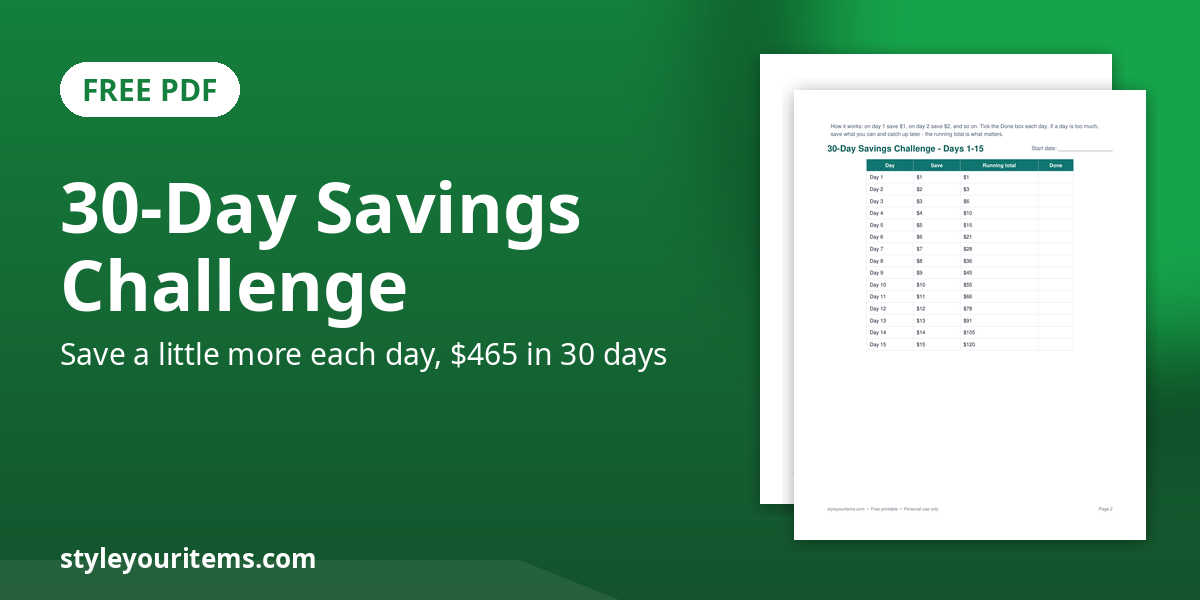
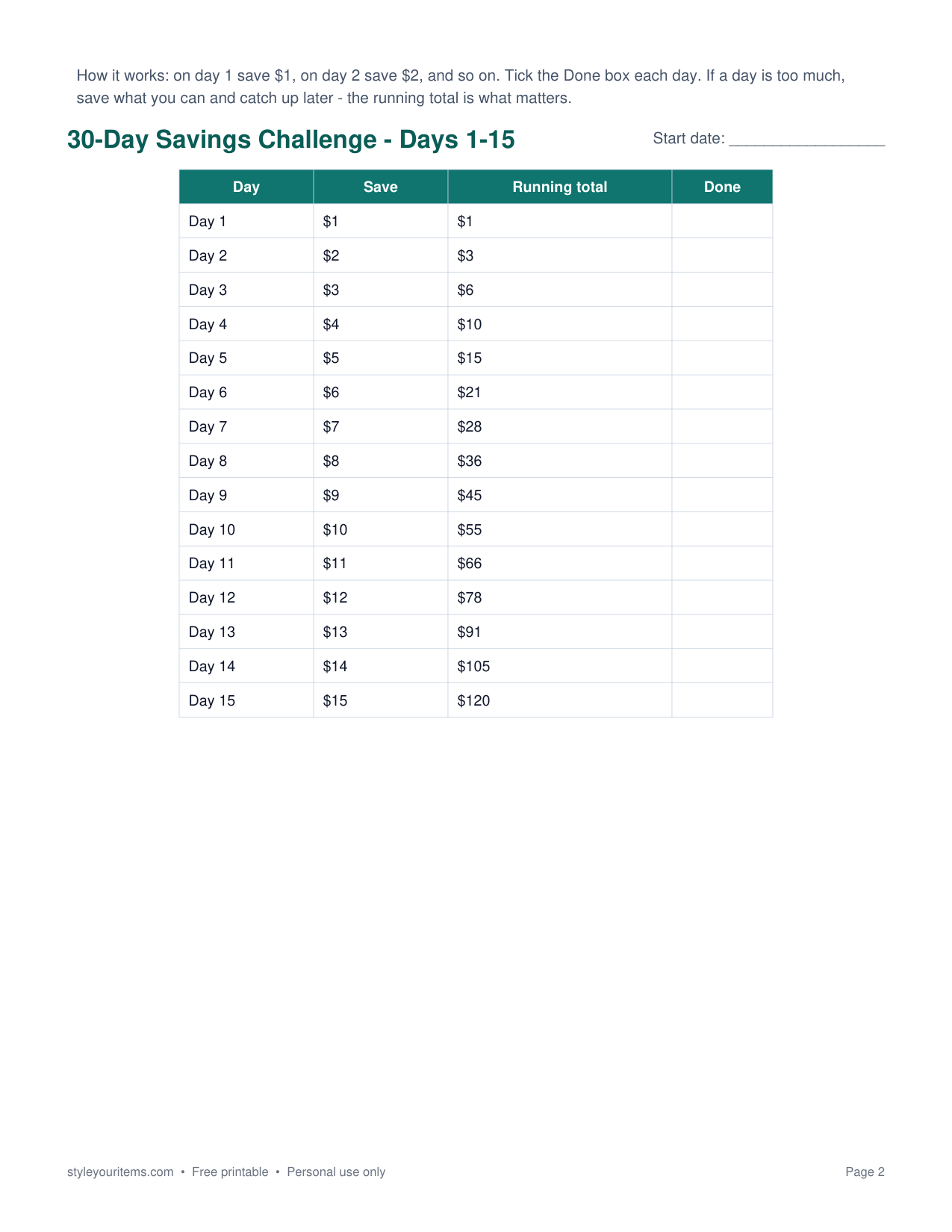
The 30-day savings challenge works because the amounts start tiny. On day 1 you save $1. On day 2 you save $2. The amount grows by one dollar a day, and by day 30 you are saving $30. Add it all up and you will have saved $465 in a single month, without ever facing a big payment on one day.
This free printable tracker runs the challenge for you. Each of the 30 days has its own line with the amount to save, a running total column, and a tick box. Two challenge pages cover days 1 to 30, and a notes page at the end has space for what you will do with the $465. It prints on Letter or A4, free for personal use.
It is a short challenge on purpose. Thirty days is long enough to build the habit and short enough to finish, which is why it suits a first savings goal. If you want a longer game after this one, our 100 envelope challenge tracker runs to $5,050, and you can find the whole set in our Money and Budget collection.
Week by week: where the total stands
The first week feels almost too easy. That is the point. By the fourth week the daily amounts are real money, but by then the habit is set and the total is already worth protecting.
| Stretch | Days | Saved in this stretch | Running total |
| Week 1 | Days 1 to 7 | $28 | $28 |
| Week 2 | Days 8 to 14 | $77 | $105 |
| Week 3 | Days 15 to 21 | $126 | $231 |
| Week 4 | Days 22 to 28 | $175 | $406 |
| Final days | Days 29 to 30 | $59 | $465 |
Read the table from the bottom up and the shape of the challenge is clear: the first two weeks build $105, and the last two weeks add $360. The running total column on the tracker shows this as you go, so a slow start never feels like failure. It is just how the maths works.
Five ways to keep going when a day feels steep
Days 25 to 30 ask for $25 to $30 each, which is real money. These five habits get most people through the last week.
- Save in the morning. Move the money before the day starts, while the decision is still easy. Evenings are for spending; mornings are for saving.
- Move it the same day. Put the cash in an envelope or move it to a savings account the day it is due. Money left in the main account has a habit of disappearing.
- Pair it with a daily habit you already keep. If you track something daily already, such as water on our water tracker, tick the savings box at the same moment. One routine carries the other.
- If you miss a day, do not restart. Just do it the next day. A missed day plus a restart is how challenges die. A missed day plus a catch-up is how they finish.
- Plan the reward now. Decide before day 1 what the $465 is for. A named goal beats a vague pile of money every time.
After day 30: what the $465 can do
Thirty days of saving leaves you with $465 and a habit. The notes page at the back of the PDF is for deciding what happens next, before the money drifts away.
- Start an emergency cushion. $465 covers a car repair, a broken phone or a surprise bill without touching a credit card.
- Fund a gift or a trip. Put a name on it: a birthday, a holiday, or a Christmas fund that starts in January instead of December.
- Roll it into a bigger challenge. The 100 envelope challenge starts at $1 again, and $465 is a strong head start toward $5,050.
- Keep the daily habit going. Our savings tracker has a thermometer and a deposits page for whatever goal comes next.
Questions about the 30-day savings challenge
What if I miss a day? Catch up the next day by saving two days at once, or add the missed amount to the end. The challenge counts the total, not the streak.
Can I start on any date? Yes. Write your start date at the top of the first page and count thirty days from there. The tracker does not assume a month or a payday.
Is $465 exact? Yes, if every day is filled. The amounts 1 to 30 add up to 465. If you save extra on a good day, write the real amount in and keep the running total honest.
Where the $465 usually comes from
A dollar on day 1 is easy to laugh at, until day 28 asks for $28. The trick is not to find new money on the steep days. It is to notice the small money that already slips away on ordinary days, and to move it to the tracker before it is spent. Most people who finish do not earn more in that month. They simply spend a little less on things they will not miss, and they write the saving down the same day.
- A takeaway coffee or drink you buy out of habit, not because you wanted it.
- A delivery fee for food you could have collected or cooked at home.
- A snack bought at a shop counter while you were waiting for something else.
- A subscription or app charge you forgot you were paying for, until you checked.
- Loose change at the bottom of a bag or in a coat pocket, gathered at the end of the week.
None of those on its own pays for day 25. Together, over a week, they often cover two or three of the steep days. That is why the notes page matters. Write down where the money came from, not just that you saved it. Next month, the list is already written for you.
A steadier way to reach day 30
The challenge is built as a straight climb, $1, then $2, all the way to $30, and the running total column shows you exactly where you stand. If a week gets expensive, do not wait for a quiet day to catch up. Work through the days in this order, and the total will still land on $465.
- Save the small days first, even if you are behind. Days 1 to 10 together are only $55, and clearing them gives you a full row of ticks.
- Then pay the day you are on, even if yesterday is still missing. Staying current matters more than catching up perfectly.
- Fill the missing days in pairs, two a day, instead of trying to clear a whole week at once.
- On the last two days, save $29 and $30 in the morning, before anything else can claim that money.
By day 30, the point is not the $465 alone. It is the proof that a small daily amount, repeated for a month, turns into a sum you can actually use. Keep the finished sheet. When the next saving goal feels too big, that sheet is the reminder that it started with $1.