A dollar in the first week feels like nothing. That is exactly why this challenge works. Instead of asking you to save a big amount on day one, the 52-week savings challenge starts with the smallest amount possible and grows so slowly you barely notice it, until one day you look at the running total and realise you have saved $1,378 without ever feeling squeezed.
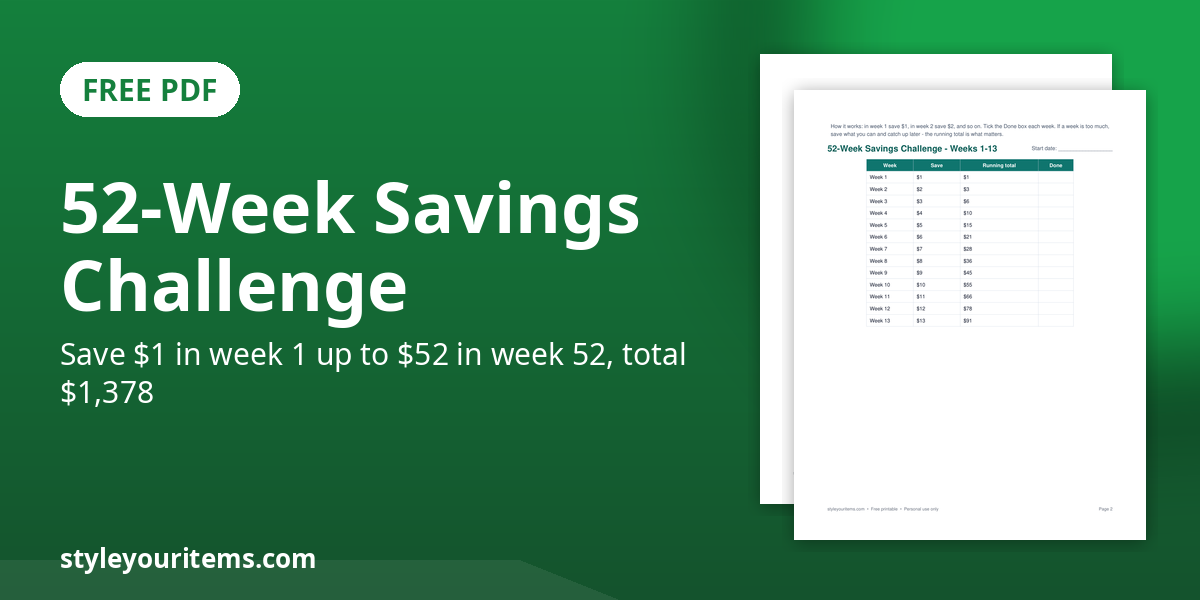
The rule is simple. In week 1 you save $1. In week 2 you save $2. In week 3 you save $3, and you keep going until week 52, when you save $52. Every week has a tick box and a running total column, so you always know exactly where you stand. If a full year feels too long to commit to, the 30-day savings challenge tracker is a shorter version of the same idea. You can also browse the full money and budget collection for other ways to build the habit.
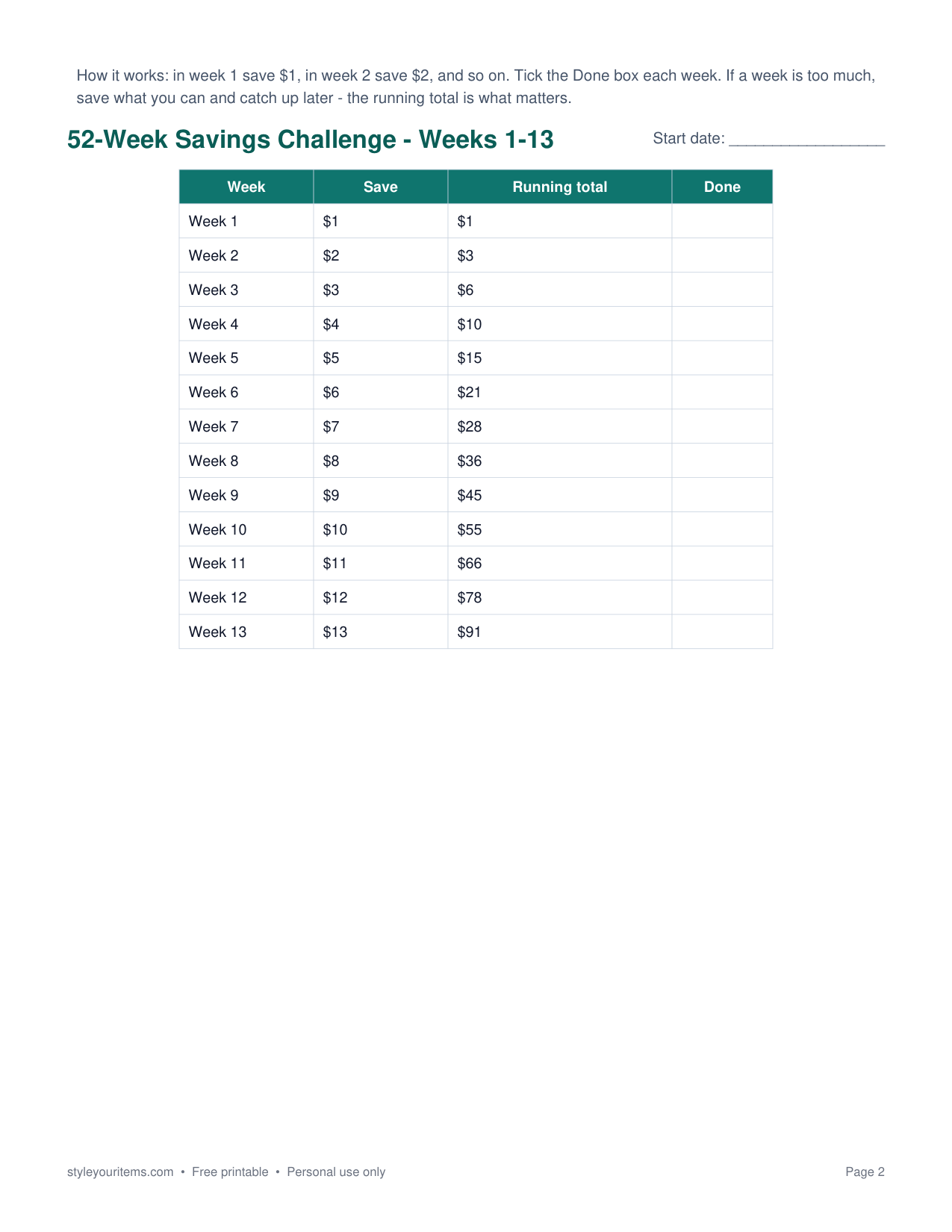
How the 52-week challenge works
- Pick a start date and write it on the first page of the tracker. Any Monday works, and the first week of a month is the easiest to remember.
- Each week, put the week’s amount aside in a jar, an envelope or a separate savings account, the same day you get paid if you can.
- Tick the Done box for that week and check the running total column, so the progress is visible every single week.
- If a week is too much, save what you can and catch up later. A missed week is not a failed challenge, it is just a week to make up.
- At the end of each 13-week block, add up what you have saved and write it on the notes page, so the year has four small finish lines instead of one big one.
A finished year, in numbers
The amounts look tiny at the start and serious at the end, and that is the whole design. Here is what the running total looks like at five points in the year:
| Week | You save | Running total |
|---|---|---|
| Week 1 | $1 | $1 |
| Week 13 | $13 | $91 |
| Week 26 | $26 | $351 |
| Week 39 | $39 | $780 |
| Week 52 | $52 | $1,378 |
The middle of the year is where most people quit, because the weekly amounts have grown past pocket money and the end still feels far away. That is why the tracker shows the running total on every row: at week 26 you have already saved $351, and that number is a better motivator than willpower. The 100 envelope challenge tracker works the same way, with a different shape, if you want a second challenge running alongside this one.
Five ways to keep going when a week is tight
- Save on payday, not on Sunday. Move the week’s amount the day money arrives, before spending starts, and the challenge takes care of itself.
- Run it in reverse. Start at $52 in week 1 and work down to $1. The hard weeks come first, when motivation is highest, and the last weeks feel easy.
- Pair it with a no-spend week. A week where you buy nothing except essentials frees up the exact amount the challenge needs. The no-spend challenge tracker is built for that.
- Keep the tracker where you see it. On the fridge, inside your wallet or next to your bank app. A challenge you cannot see is a challenge you forget.
- Save with someone else. A partner, a friend or a child with their own jar turns a lonely habit into a small weekly ritual, and nobody wants to be the one who stops first.
What is inside the PDF
| Page | What is on it |
|---|---|
| Cover | Title and a list of everything inside the PDF |
| Weeks 1 to 13 | Week, save amount, running total and Done box per week |
| Weeks 14 to 26 | The same table, running total up to $351 |
| Weeks 27 to 39 | The same table, running total up to $780 |
| Weeks 40 to 52 | The same table, finishing at $1,378 |
| Notes page | Total saved, and what you will do with the $1,378 |
Questions people ask
Can I start in any week of the year?
Yes. The tracker is undated, so write your own start date on the first page and count 52 weeks from there. January is popular, but a birthday or payday works just as well.
What if I miss a week?
Just carry on the next week and add the missed amount when you can. The running total column shows exactly how much you are behind, so catching up is simple maths, not guesswork.
Where should I keep the money?
A separate savings account is the safest place, because money in a jar gets spent. If you use cash, a labelled envelope per month keeps it organised, and the monthly habit tracker can remind you to move the money every week.