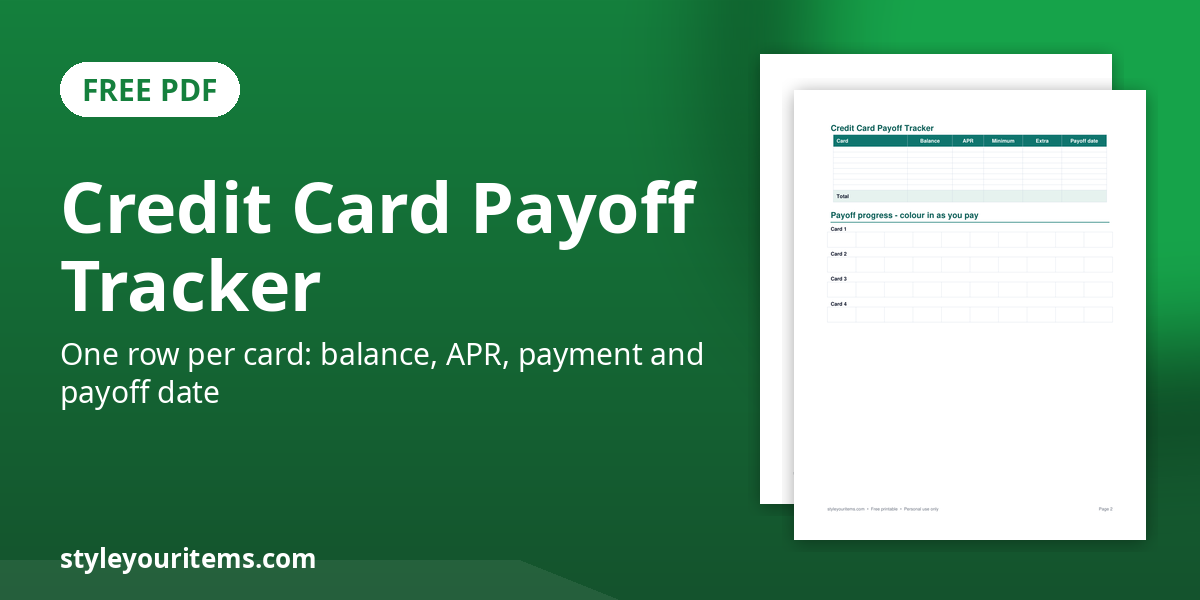
Credit card debt is easy to ignore because it lives in five different places: an app for one card, a paper statement for another, a balance you only half remember for a third. This free printable credit card payoff tracker PDF puts every card on one page, with the four numbers that decide how fast each one disappears: the balance, the APR, the minimum payment, and the extra payment you can add. When the numbers sit side by side, the plan writes itself.
The PDF has 3 pages. Page 1 is the cover. Page 2 is the payoff tracker itself, with room for 8 cards and a total row at the bottom, plus four payoff progress bars you colour in as each balance falls. Page 3 is a monthly payoff log with one row per month, where you write the total you paid and the balance left. Print it on Letter or A4, at 100% (Actual size), and fill it in with a pen.
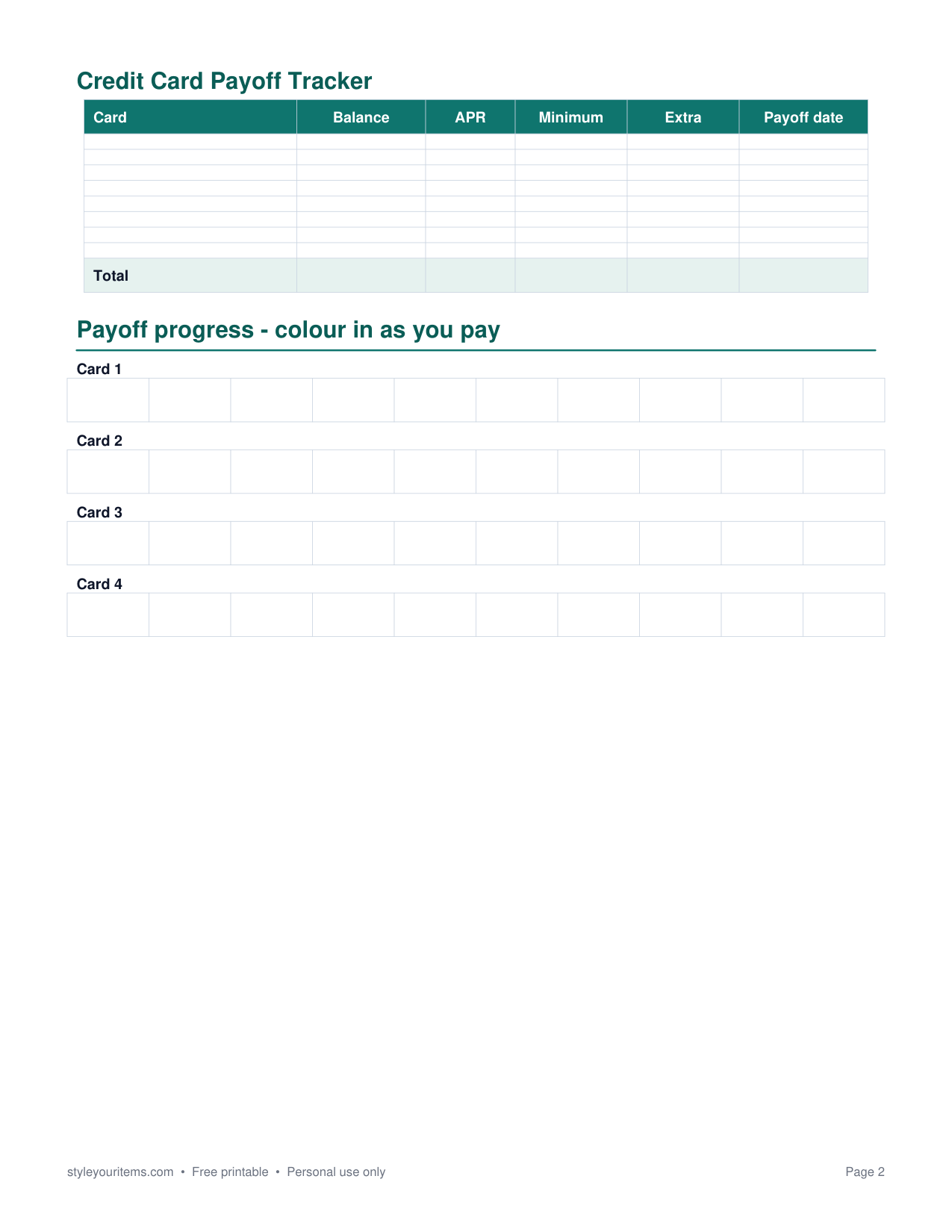
A Filled-In Card Table, So You Can See How It Works
Here is what the tracker looks like with three real cards filled in. The numbers are an example, but the method is the whole point: list every card, write the APR next to the balance, and decide the extra payment before the month starts.
| Card | Balance | APR | Minimum | Extra | Payoff date |
|---|---|---|---|---|---|
| Everyday Visa | $3,850 | 19.99% | $95 | $100 | March 2027 |
| Store card | $1,240 | 24.99% | $35 | $50 | October 2026 |
| Bank Mastercard | $620 | 0% until Jan 2027 | $25 | $0 | December 2026 |
| Total | $5,710 | $155 | $150 |
In this example the household pays $305 a month toward cards: $155 in minimums plus $150 extra. The store card gets the biggest extra payment even though its balance is smaller, because its APR is the highest at 24.99%. Every dollar of extra payment on a 24.99% card saves more interest than the same dollar on a 19.99% card. The Mastercard gets no extra payment at all while its 0% offer lasts, because extra money earns nothing there until January 2027. When the store card is paid off in October, its $85 a month ($35 minimum plus $50 extra) rolls straight into the Visa, and the payoff date for the Visa moves closer without the household finding a single extra dollar.
That rollover is why the Payoff date column matters. It turns a vague hope into a date you can check. If the date slips, you can see it on the next monthly log and adjust the extra payment. If the date holds, the progress bars on page 2 show it: colour in one box for every tenth of a card paid off, and a card that looked endless starts to look finishable. Pair this tracker with the free printable debt payoff tracker if you also carry a loan or a store plan, and use the free printable monthly budget planner to find the extra payment in the first place.
Which Card Do You Attack First?
- Highest APR first. This is the cheapest order in pure maths. List your cards by APR, highest at the top, and put every spare dollar on the top card while paying minimums on the rest. Use this order if you can stick to a plan for months without needing a quick win.
- Smallest balance first. This is the fastest order for motivation. Pay off the smallest card completely, feel the win, then roll its payment into the next smallest. Use this order if past plans have died because the first payoff felt too far away.
- Expiring 0% offer first. A card at 0% is only free until the offer ends. Write the end date in the Payoff date column in pen, and make sure the balance is zero before that date, or the rate jumps to the standard APR overnight.
- Never skip a minimum. The extra payment is a choice; the minimum is not. A missed minimum adds a late fee, can raise your APR, and can damage your credit record. The tracker has a Minimum column so the non-negotiable number is always visible.
- When a card hits zero, do not close it in a hurry. Closing a card can shorten your credit history and raise how much of your available credit you are using. Keep the card open with a zero balance unless it charges an annual fee you cannot justify.
Five Minutes a Month Keeps the Tracker Honest
- On the 1st of the month, write the new balances. Open each card app or statement and copy the balance into the tracker. Do not guess; a guessed balance makes the payoff date a guess too.
- Write the total you paid on the monthly log. Page 3 has one row per month. Total paid and balance left, month after month, is the only honest record of progress.
- Check the payoff dates. If a date has slipped by more than a month, ask why: a missed extra payment, a new charge, or an APR rise. Fix the cause, not just the date.
- Colour in the progress bars. One box per tenth paid. It takes ten seconds and it is the part of the tracker you will actually look at on a hard day.
- When a card reaches zero, cross it off page 2 and roll its payment forward. The total you pay each month stays the same; only the card it lands on changes. That is how a $305 month finishes a $5,710 debt. Write the final payoff date in your free printable yearly goals planner too, so the debt-free date sits next to your other goals for the year.
Questions People Ask Before They Print
Is the PDF really free?
Yes. The PDF is completely free, with no sign-up, no email address, and no account needed.
What if I have more than 8 cards?
Print page 2 twice and split the cards across two sheets. The total row on each sheet still works; add the two totals together for the full picture.
Does this tracker work for store cards and credit cards together?
Yes. A store card is a credit card with a shop’s name on it. Put it in the same table and order it by APR like any other card. The store card in the example above is the most expensive debt in the household precisely because its APR is the highest.
Can I use it for a personal loan too?
You can write a loan in the table, but a loan has a fixed payoff date and a fixed payment, so the APR and extra columns matter less. The debt payoff tracker is built for mixed debts; this sheet is built for cards.
Does it print on A4 as well as Letter?
Yes. The PDF is designed for both US Letter and A4 paper, at 100% (Actual size).
Details
- Format: free PDF download
- Paper size: US Letter and A4
- Pages: 3 – 1 cover page + 1 payoff tracker sheet (8 card rows: Card, Balance, APR, Minimum, Extra, Payoff date, plus 4 progress bars) + 1 monthly payoff log (12 months: Total paid, Balance left, Notes)
- Cost: free – no sign-up, no email, and no account needed
- Print as many copies as you like, for personal use
Finding an Extra Payment When the Budget Already Feels Full
Most payoff plans fail on the same quiet day, the day a card statement arrives and the extra payment you promised yourself has already been spent on groceries, fuel, or a school trip. That does not mean the plan was wrong. It means the extra payment was treated as whatever was left over, and leftovers are the first thing a busy month eats.
Try the order the other way round. On payday, move the extra payment first, even if it is only $25, and let the rest of the month fit around what remains. A small amount paid every month beats a large amount paid twice a year, because interest is charged every month and because a habit you can keep is worth more than a promise you keep breaking. The example earlier in this post shows $150 extra on $5,710 of card balances, but the tracker works just as well with $25 or $40. The payoff dates will simply be further away, and they will still move closer each month you pay.
If even $25 feels out of reach, look for money that is already leaving the house in small pieces. A subscription you forgot, a delivery fee you pay twice a week, or a top-up you buy out of habit can add up to the extra payment without any change to how you live. Cancel one, keep the receipt, and write that amount in the Extra column for one month. Seeing it work once makes it much easier to keep.
| Situation | A practical next step |
|---|---|
| No spare money this month | Pay every minimum on time and write $0 in the Extra column. A zero month still counts if the minimums were paid. |
| One card is at 0% | Pay its minimum only and send the extra to the card with the highest APR instead. Check the 0% end date first. |
| Your extra amount changes | Use the lowest amount you can pay every month as your usual extra, and add more only in good months. |
Four Checks to Run Before You Print a Fresh Sheet
- Check the balances first. Copy each balance from the statement or app on the same day you fill in the sheet, so the sheet matches reality and the payoff dates stay honest.
- Check the APR column. If a rate has risen after a missed payment or a promotion has ended, the order you attack the cards in may need to change.
- Check the monthly log on page 3. One row per month is enough to see whether the balance left is falling. If it is not falling, something new is being charged to a card.
- Check the progress bars. Colour one box for each tenth paid. When a card is half coloured, you have proof the plan is working, and that proof is what keeps you paying.
None of this needs a new budget or a new spreadsheet. It needs five minutes, the sheet you already printed, and the habit of looking at it before the month gets away from you. Do that, and the tracker stops being a record of what you owe and starts being a record of how much of it is already gone.
More Free Printables
Looking for more free printables? Browse the full Money & Budget collection, or try these popular downloads: