Money goals fail for a simple reason: they live in your head as one big number. “Save for a holiday” feels impossible at $900, but the same goal at $90 a month for ten months is a plan you can actually follow. The trick is to split the goal into a target, a deadline and a monthly amount, and then watch the monthly amount happen.
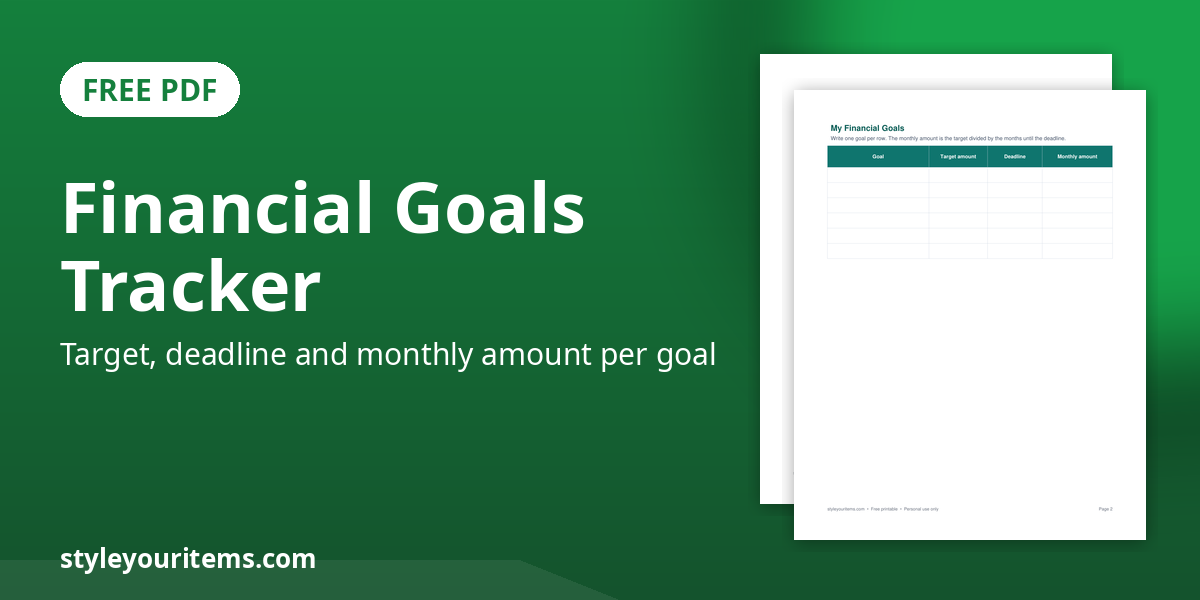
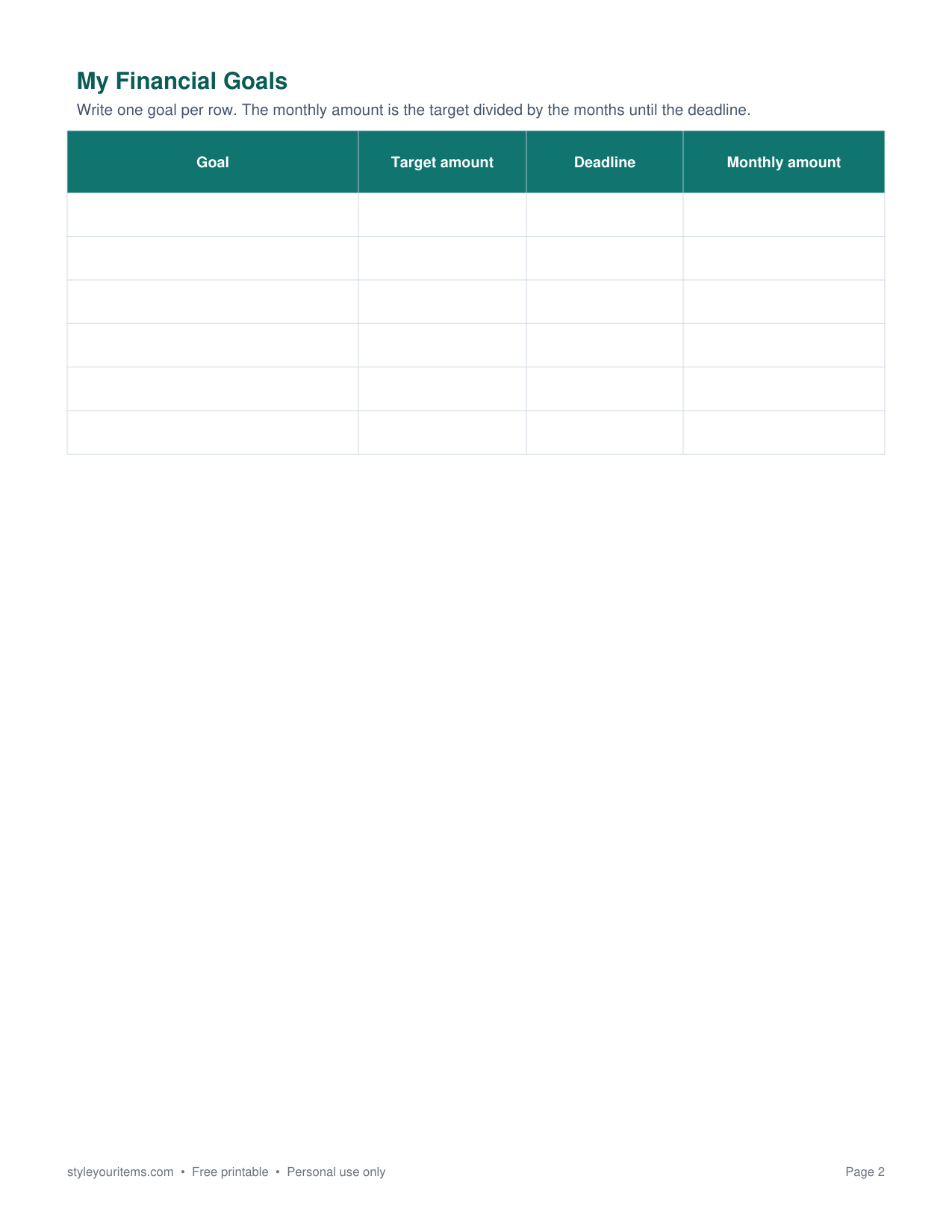
This free printable financial goals tracker does exactly that. The goals page gives you six rows, one per goal, with columns for the target amount, the deadline and the monthly amount you need to set aside. A monthly deposits page keeps the running total honest, and a progress bars page lets you colour in one box for every 10% of each goal you reach. A finished page at the back records the goals you reached and the total you saved. It pairs well with our free printable savings tracker, and you can browse the full Money & Budget collection for more.
A filled-in example: three goals, one page
Here is how the goals page looks when it is filled in. Three goals, three deadlines, and one monthly total that fits the household budget.
| Goal | Target amount | Deadline | Monthly amount |
|---|---|---|---|
| Emergency fund | $1,200 | July 2027 | $100 |
| Holiday in Spain | $900 | May 2027 | $90 |
| New laptop | $600 | January 2027 | $100 |
| Total per month | $2,700 | $290 |
The maths is the whole method. Divide the target by the number of months until the deadline, and the monthly amount appears: $1,200 over 12 months is $100 a month, $900 over 10 months is $90, and $600 over 6 months is $100. The three goals together need $290 a month, which is a number you can check against your pay before you commit. If $290 is too much, move a deadline, not the goal: pushing the holiday from May to August cuts its monthly amount from $90 to $70. The free printable monthly budget planner shows where that $290 comes from in the household budget, and the free printable yearly budget planner keeps the same goals visible across the whole year.
Five habits that keep goals moving
- Move the money on payday, not at month end. The monthly amount leaves the current account the day the pay lands. What is left is spending money, and the goal is already funded.
- Colour the progress bar the same day. Ten boxes per goal, one per 10%. Colouring a box after each deposit makes progress visible, and visible progress is what keeps you going in month four.
- Write the deposit on the deposits page every month. Date, amount, running total. The running total is the number that matters, and it only stays true if you write it down.
- Review the deadlines every three months. A goal with a missed deadline needs a new monthly amount, not guilt. Divide what is left by the months that are left, and write the new figure in.
- Celebrate the small finishes. The laptop goal finishes in six months, long before the emergency fund. Mark it on the finished page, enjoy it, and start a new goal in its row the same week.
Big one-off savings challenges use the same idea at a different scale. Our free printable 100 envelope challenge tracker turns 100 envelopes into $5,050, and the free printable 30-day savings challenge tracker builds $465 in a single month, one day at a time.
How to use the deposits page
- Write the month and the deposit on the day you move the money. One line per month, twelve lines for the year. Do not wait until the end of the month to fill it in from memory.
- Update the running total on the same line. Add this month’s deposit to last month’s total. If the total does not match the bank balance, the difference is a deposit you forgot to write down.
- Use the notes column for the story. “Sold the old bike, $80 extra” or “Car repair, skipped this month”. The notes explain the total when you look back in six months.
- Split one deposit across goals when you need to. If you can only put $200 aside in a tight month, write how it splits: $100 to the laptop, $60 to the holiday, $40 to the emergency fund. The goals page still balances.
- Start a fresh deposits page each year. The PDF has one deposits page with twelve lines. Print a fresh copy every January, carry the running totals forward, and keep last year’s sheet behind it as the record.
Goals work best when they sit next to the bigger plan, so the free printable yearly goals planner is a good partner for the non-money goals that share the same year, such as health or learning.
Questions people ask
How many goals should I track at once?
Six at most, and three is better. The sheet has six rows because six is the most anyone can fund at once. Start with your three most important goals and leave the other rows empty until one finishes.
What if I cannot afford the monthly amount?
Move the deadline further away and divide again. A $600 goal over 12 months is $50 a month instead of $100 over 6 months. A smaller monthly amount that actually happens beats a bigger one that never does.
Should I save for the emergency fund first?
Yes, if you do not have one yet. A small emergency fund of $500 to $1,000 comes before holidays and gadgets, because the next broken washing machine will not wait for your holiday to be saved.