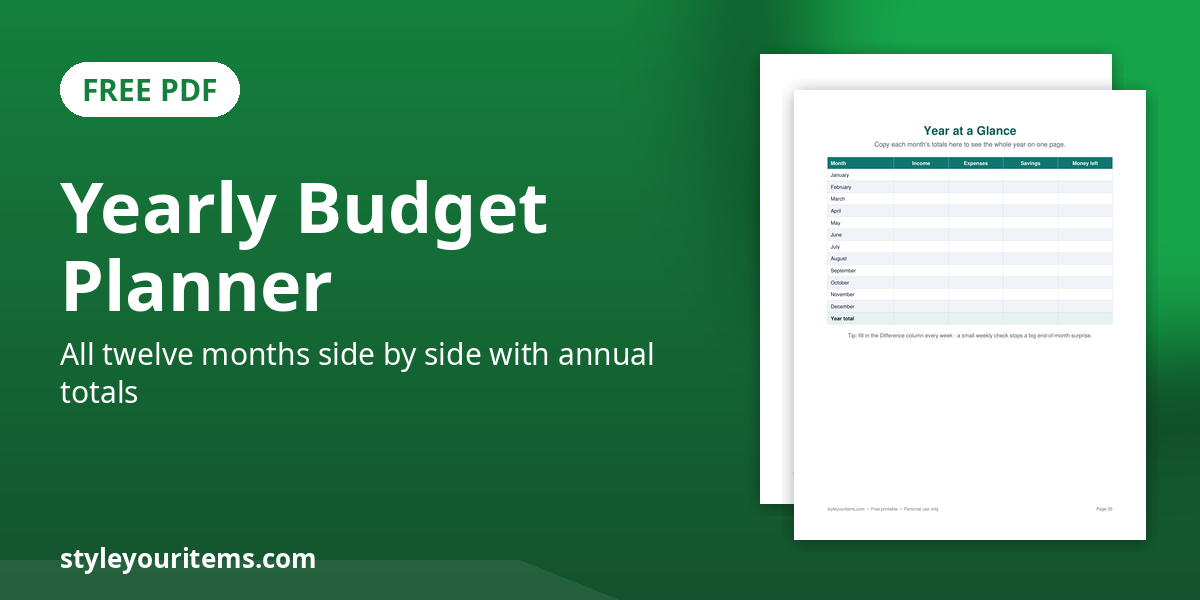
A monthly budget tells you how this month went. A yearly budget tells you whether the year is going the way you meant it to. Most money problems are not monthly problems at all: they are a slow drift across six or seven months that nobody notices until December. This free printable yearly budget planner PDF stops that drift. It gives you twelve monthly spreads, one for every month, plus a year-at-a-glance page where each month’s totals sit side by side, so the whole year of money is visible on one spread.
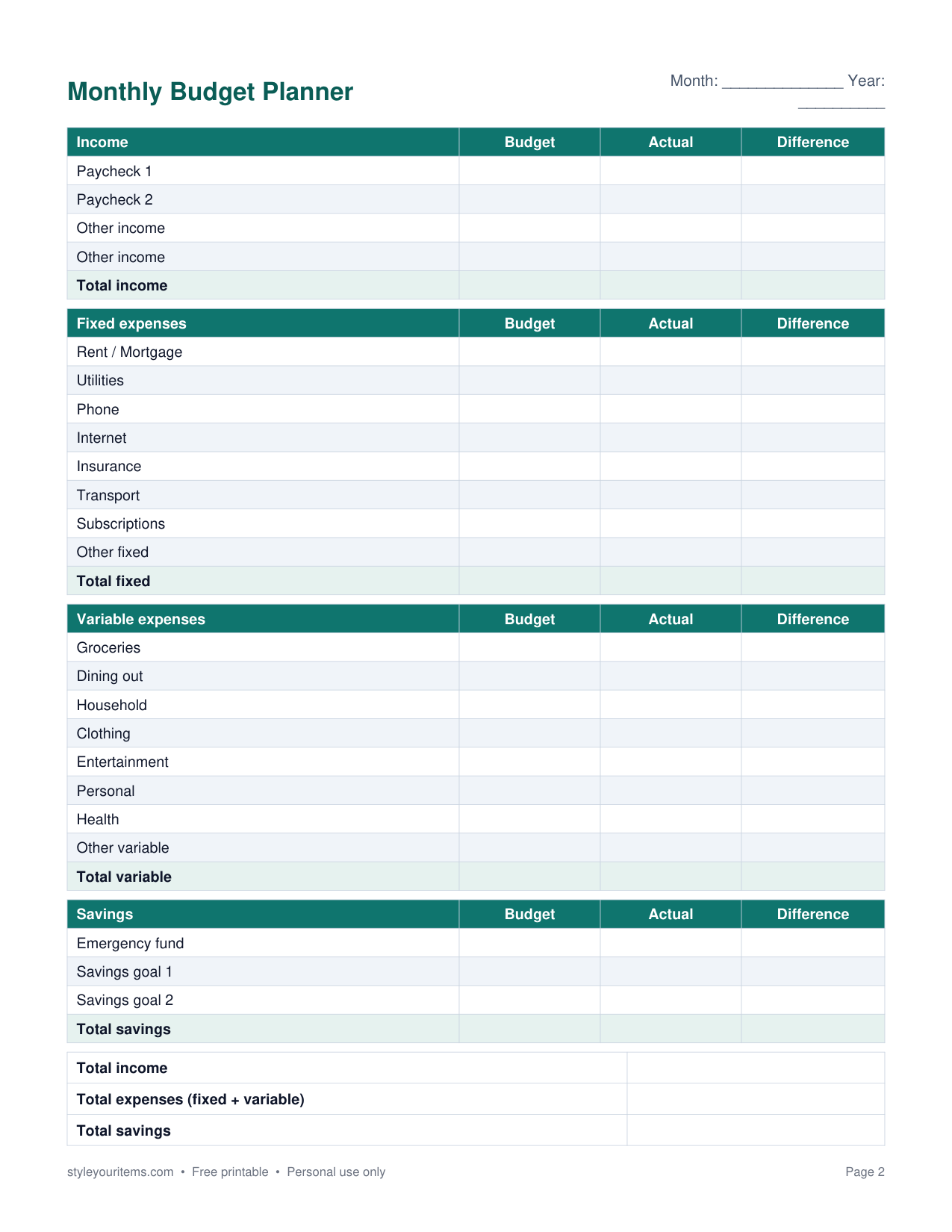
The PDF has 26 pages. Page 1 is the cover. Pages 2 to 25 are the twelve monthly spreads: each month gets two pages, a budget spread with Budget, Actual and Difference columns for income, fixed expenses, variable expenses and savings, and a money-left page that works out what is left after income minus expenses minus savings. Page 26 is the year-at-a-glance sheet, where you copy each month’s totals to see income, expenses, savings and money left for all twelve months in one table. Print it on Letter or A4, at 100% (Actual size), and keep it in a binder for the year.
What the Year Looks Like When It Is Filled In
The year-at-a-glance page is the heart of this planner, so here is what it looks like after six months of honest use. The numbers are an example, but the story they tell is the reason the page exists: a household that earned the same money every month and still ended some months with nothing left.
| Month | Income | Expenses | Savings | Money left |
|---|---|---|---|---|
| January | $4,200 | $3,450 | $400 | $350 |
| February | $4,200 | $3,380 | $400 | $420 |
| March | $4,200 | $3,910 | $200 | $90 |
| April | $4,650 | $3,520 | $600 | $530 |
| May | $4,200 | $3,990 | $200 | $10 |
| June | $4,200 | $3,610 | $400 | $190 |
| Half-year total | $25,650 | $21,860 | $2,200 | $1,590 |
Look at March and May. Income was the same as every other month, but expenses jumped by about $500 in each, and savings were cut in half to cover it. Without the glance page, March feels like a bad month and May feels like another bad month, and the link between them stays invisible. With the glance page, the pattern is obvious in one look: two months in six blew the budget, and the reason is worth finding. April tells the other half of the story: a $450 tax refund arrived, expenses stayed normal, and the household saved $600 instead of $400. A yearly view does not just catch problems; it catches the good months too, and shows exactly what made them good. The free printable monthly budget planner works the same way for a single month, and the free printable budget binder holds a full year of these sheets together with goals, bills and savings pages.
A Monthly Routine That Takes Twenty Minutes
- On the 1st, write the budget column. Copy last month’s real numbers into the Budget column for the new month, then change only the lines you know will move: a higher electricity bill in summer, a birthday in the family, a car service due.
- During the month, write the actual column as you spend. Do not save receipts for a month-end marathon. Ten seconds per purchase, written the same day, is the only version of tracking that survives real life.
- On the last day, fill in the Difference column and the money-left page. The Difference column is the lesson: where the plan was right, where it was wrong, and by how much. The money-left page turns those differences into one number.
- Copy the four totals onto the year-at-a-glance page. Income, expenses, savings, money left. Four numbers, one row, once a month. After three months the glance page starts to speak; after six it starts to warn.
- Once a quarter, read the glance page like a report. Which month was best, which was worst, and what was different? Change next quarter’s budget based on the answer, not on a feeling.
Where Each Kind of Money Goes
- Income: paychecks, plus any other income such as a side job or a refund. Write each source on its own line so a missing paycheck is visible at once.
- Fixed expenses: rent or mortgage, utilities, phone, internet, insurance, transport, subscriptions. These change slowly, so a sudden jump here means something changed and deserves a look.
- Variable expenses: groceries, dining out, household, clothing, entertainment, personal, health. This is where most budgets leak, because every line feels small on its own and large only when added up.
- Savings: emergency fund and savings goals. Savings is a line in the budget, not whatever is left over. If it is only what is left over, it will be zero most months.
- Money left: income minus expenses minus savings. If this number is negative, the month was funded by debt or by savings, and the glance page will show it plainly.
If a yearly view feels too big to start with, the free printable monthly budget worksheet is a single-page version of the same idea, and the free printable yearly goals planner pairs a money year with a goals year on the same shelf.
Questions People Ask Before They Print
Is the PDF really free?
Yes. The PDF is completely free, with no sign-up, no email address, and no account needed.
How is this different from the monthly budget planner?
The monthly planner is one month on its own. This planner is twelve monthly spreads plus a year-at-a-glance totals page, so you can compare months and watch the year as a whole. If you only want one month, use the monthly planner; if you want the year, use this one.
What if my income changes every month?
Write the income you actually received in the Actual column and the income you expected in the Budget column. The Difference column then shows how far off the expectation was, and after three months you will know your real average income, which is the number to budget from.
Do I need to print all 26 pages at once?
No. Print the cover and the year-at-a-glance page now, then print each monthly spread when the month starts. The planner works just as well one month at a time.
Does it print on A4 as well as Letter?
Yes. The PDF is designed for both US Letter and A4 paper, at 100% (Actual size).
Details
- Format: free PDF download
- Paper size: US Letter and A4
- Pages: 26 – 1 cover page + 12 monthly spreads (2 pages each: Budget, Actual and Difference columns for income, fixed and variable expenses and savings, plus a money-left page) + 1 year-at-a-glance totals page
- Cost: free – no sign-up, no email, and no account needed
- Print as many copies as you like, for personal use
The first month with this planner feels tidy. The second month is where it earns its place, because by then the Budgeted column is no longer a guess and the Actual column has started to argue back. That argument is the whole point of the planner: not to scold you, but to show you where your money actually went while you were busy living.
Reading One Month the Way the Planner Wants You To
Pick any finished month and read it across, category by category, instead of down the page. The Difference column is the only column that asks a question, and the question is always the same: was this a one-off, or is it the new normal? A single overrun on dining out is a story. Three in a row is a budget that was set too low. Take the made-up March below as an example.
| Category | Budgeted | Actual | Difference |
|---|---|---|---|
| Groceries | $400 | $460 | -$60 |
| Transport | $120 | $95 | +$25 |
| Dining out | $80 | $140 | -$60 |
| Subscriptions | $45 | $45 | $0 |
Read the example the way you would read your own page. Groceries and dining out both ran over by 60, but they are not the same problem. Groceries over by 60 with prices rising is a budget to raise; dining out over by 60 three months running is a habit to look at. Transport came in under, which is not free money, it is the money that covers the groceries gap. That is what the Difference column is for: moving money between categories on paper, before the month ends, instead of discovering the gap when the account is empty.
Four Habits That Keep the Planner Honest
- Write expenses in weekly, while the receipts are still in your pocket. A month reconstructed from memory always looks cheaper than it was.
- Fill in the Actual column before you look at the Budgeted column. If you look at the budget first, you will round the actuals toward it without noticing.
- Give every dollar a category on the day it is spent, even the small ones. Money with no category becomes money left, and money left that was never real is how a month quietly goes over.
- When a category is over, write the reason in the margin that same day. A month later, why is the one thing the numbers cannot tell you.
None of this needs a new system. The planner already has the columns, the months and the summary page; the habit is simply returning to them on the same day each week, and letting the numbers, not the feeling of the month, decide what changes next.
More Free Printables
Looking for more free printables? Browse the full Money & Budget collection, or try these popular downloads: