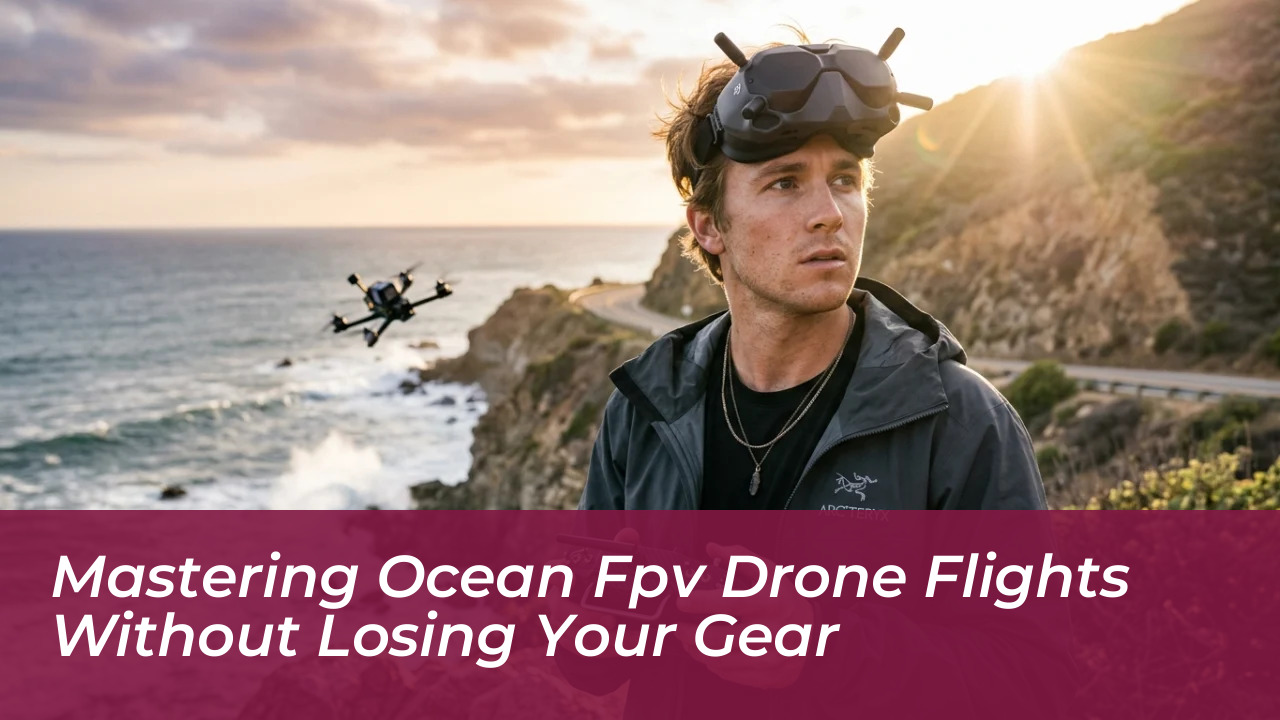


Piloting an FPV drone over the open sea delivers breathtaking coastal visuals, but it leaves zero room for technical error. When aerial creators push custom quadcopters out across ocean swells, the resulting footage reveals what happens when high-speed manual flight meets dynamic open water: an exhilarating ride where a single split-second mistake guarantees total aircraft loss. Operating a first-person-view rig over crashing breakers presents distinct physics challenges that dry-land flying never introduces, testing pilot nerve and radio frequency reliability simultaneously.
The High Stakes of Ocean FPV Cinematography
Flying across the ocean surface removes every standard optical marker a pilot relies on over land. Without trees, buildings, or stationary terrain to gauge altitude, visual depth perception inside an FPV headset warps instantly. Ocean swells rise and fall unpredictably, turning what looks like a smooth straight line into a sudden wall of saltwater. That reality forces the pilot to read wave rhythm rather than merely tracking the horizon line.
Flying over open saltwater is an unforgiving endurance test where a single signal dropout or battery voltage sag turns a routine pass into an unrecoverable dive. Saltwater acts as a conductor that destroys microelectronics on contact. While a crash over grass or sand often yields salvageable motors and camera boards, an ocean crash is almost always an outright write-off.
Radio Link Integrity and Failsafe Realities
Water surfaces reflect and absorb radio frequency signals in ways solid dirt does not. When an FPV drone drops low to skim the water, the radio link between the transmitter and the onboard receiver experiences severe multipathing. In the United States, federal airspace operating standards emphasize maintaining a visual observer when pilots fly with enclosed video goggles. Beyond legal safety baselines, having a spotter on the shoreline provides an essential second set of eyes to monitor shoreline drift, rising winds, and nearby marine traffic.
Myth vs. Reality: Flying Drones Over Open Water
A widespread assumption among casual pilots is that automated return-to-home systems provide an infallible safety net over the sea. In practice, that assumption frequently leads to submerged electronics.
- The Myth: Built-in GPS rescue features will reliably hover or return the craft to the pilot if video transmission fails over open waves.
- The Reality: Strong maritime offshore winds often push a lightweight aircraft faster than automated rescue algorithms can compensate. If the home coordinate was established on a drifting boat or an unstable shoreline marker, the aircraft may attempt an automated descent straight into the surf.
Open Sea Flight Reality Check
Before launching any mission over deep water, evaluate these core operating factors:

- Battery Discharge: Fighting constant headwinds drains cell capacity substantially faster than hovering over land.
- Signal Propagation: Water surface reflections induce video static and control link packet loss at low elevations.
- Hardware Recovery: Saltwater causes rapid chemical corrosion, rendering unwaterproofed components unrecoverable.
- Altitude Perception: Uniform wave textures make altitude estimation through analog or digital goggles deceptive.
Essential Precautions Before Flying Over the Ocean
Pilots who capture smooth coastal runs follow disciplined technical routines before throttle-up. Taking a high-performance FPV drone out over deep swells demands strict pre-flight discipline:
- Conformal Coating: Applying protective silicone or acrylic layers across the flight controller, electronic speed controller, and receiver boards guards against airborne salt mist.
- Battery Voltage Management: Initiating return flights at higher cell voltage thresholds ensures sufficient reserve power to fight sudden ocean downdrafts.
- Dynamic Home Point Verification: Checking satellite lock counts and verifying return-point coordinates prior to flying past the surf line prevents GPS navigational errors.
- Shoreline Wind Assessment: Reading local wind gusts at surface level rather than relying solely on inland weather reports keeps aircraft within controllable operational limits.
Handling Emergency Landings and Water Damage
If your drone experiences a failure and goes into freshwater, recovery and restoration are occasionally possible if acted upon instantly. However, an ocean immersion requires an immediate response to salvage any mechanical or optical parts:
- Retrieve the Drone Immediately: Seconds count when recovering electronics from a marine environment.
- Disconnect Power: Remove the battery instantly to halt electrical shorts across conductive saltwater paths.
- Rinse and Clean: Flush exposed components with distilled water or high-purity isopropyl alcohol to mitigate rapid salt crystallization and copper corrosion.
Handling open water takes technical preparation and calm stick precision under pressure.