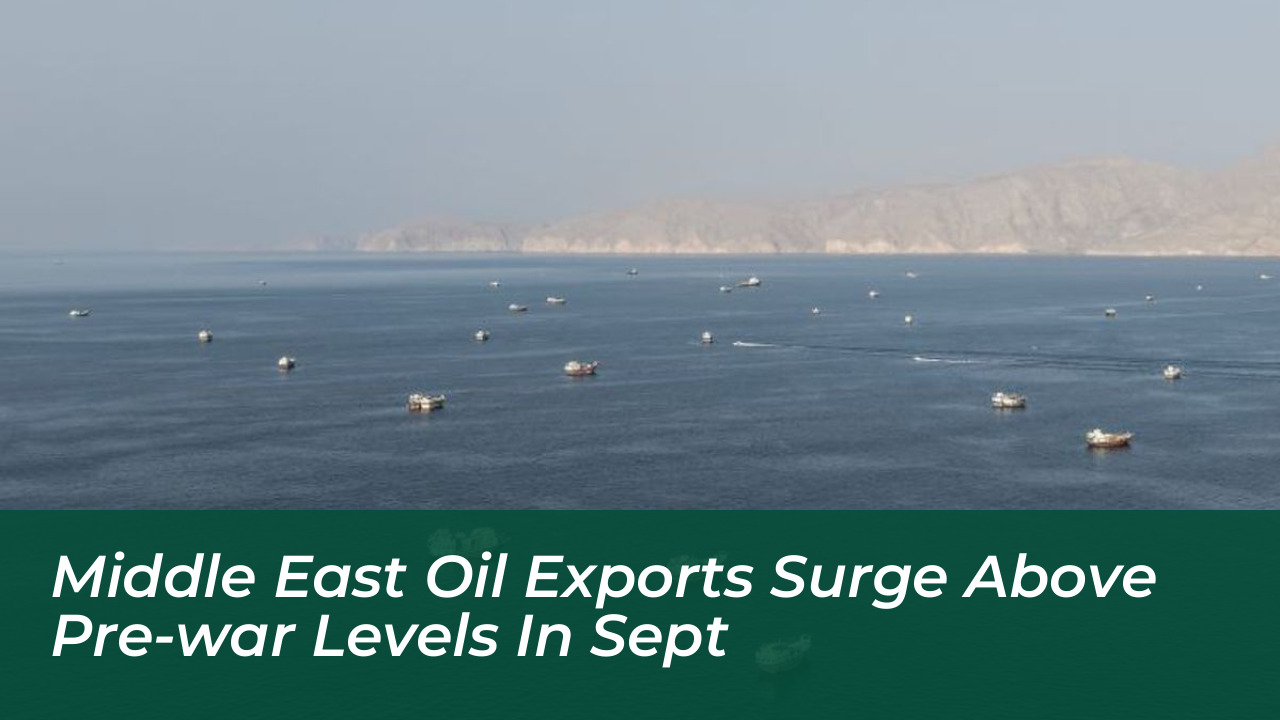



Crude oil exports from the Middle East surpassed pre-war levels on multiple days during the final week of September. This demonstrates unexpected resilience across regional shipping corridors despite ongoing military conflicts and security risks.
Provisional ship-tracking data from maritime analytics firm Kpler shows that regional crude shipments climbed to between 19.5 million and 22.5 million barrels per day (bpd) on September 24 and from September 27 to 29. Before the regional war involving the United States, Israel, and Iran, exports maintained a steady average of 18 million bpd from March 2025 to February 2026.
Data Breakdown and Alternative Logistics
Data compiled by Kpler indicates that the seven-day moving average for overall crude, oil products, chemicals, and non-gas liquids reached 22.4 million bpd by September 30. By October 1, crude exports stabilized at a seven-day moving average of 18.5 million bpd. This movement occurred across multiple transport channels, including the Strait of Hormuz, the Red Sea, direct terminal exports, and ship-to-ship transfers in the Gulf of Oman.
Investment bank JPMorgan estimated September flows at approximately 17.5 million bpd for crude alone, representing roughly 98 percent of pre-war levels. Analysts attribute this robust rebound to producers and shippers leveraging strategic infrastructure:
- Bypass Pipelines: Saudi Arabia utilized its East-West pipeline to pump crude directly to the Red Sea port of Yanbu, circumventing the Strait of Hormuz. The United Arab Emirates similarly relied on its pipeline network terminating at Fujairah on the Gulf of Oman.
- Shuttle Tankers and Transfers: Industry operators employed smaller shuttle vessels to navigate closer to the Omani coastline along patrolled routes. They subsequently transferred cargoes onto larger tankers safely within the Gulf of Oman.
- Risk Acceptance: Higher transport volumes reflect a broader market trend where commercial shipping operators have factored ongoing regional security hazards into daily operational costs.
Persisting Geopolitical and Refining Challenges
Despite the notable recovery in crude volumes, logistical bottlenecks and safety incidents continue to challenge the broader energy supply chain. The United Kingdom Maritime Trade Operations (UKMTO) agency has reported at least one security incident or attack per day in the Strait of Hormuz or the Gulf of Aden since October 2. On September 30, three Liberian-flagged tankers were struck by unknown projectiles while transiting the vital waterway.

Senior Islamic Revolutionary Guard Corps (IRGC) commander Ali Fadavi dismissed the active oil traffic moving through routes under U.S. supervision as negligible during a televised interview. He claimed that regular transits remain far below historical norms. Meanwhile, Iranian officials stated that the Strait of Hormuz would remain restricted until international diplomatic conditions are met.
While crude exports have bounced back, regional refined-product supplies remain constrained. The International Energy Agency (IEA) noted that as much as 3 million bpd of Middle East refining capacity has been disrupted or rendered unavailable due to direct strikes and conflict-related shutdowns. This keeps global diesel inventories tight and pump prices elevated worldwide.