

Mike Flanagan has addressed major creative changes and shocking revelations in his new eight-episode Carrie adaptation, which is currently streaming on Prime Video. The series expands significantly upon Stephen King’s original 1974 debut novel. It introduces notable twists, including Margaret White’s hidden telekinetic abilities and a completely altered fate for Carrie White following the destruction of Chamberlain.
The Genetic Roots of Telekinesis and Margaret White’s Powers
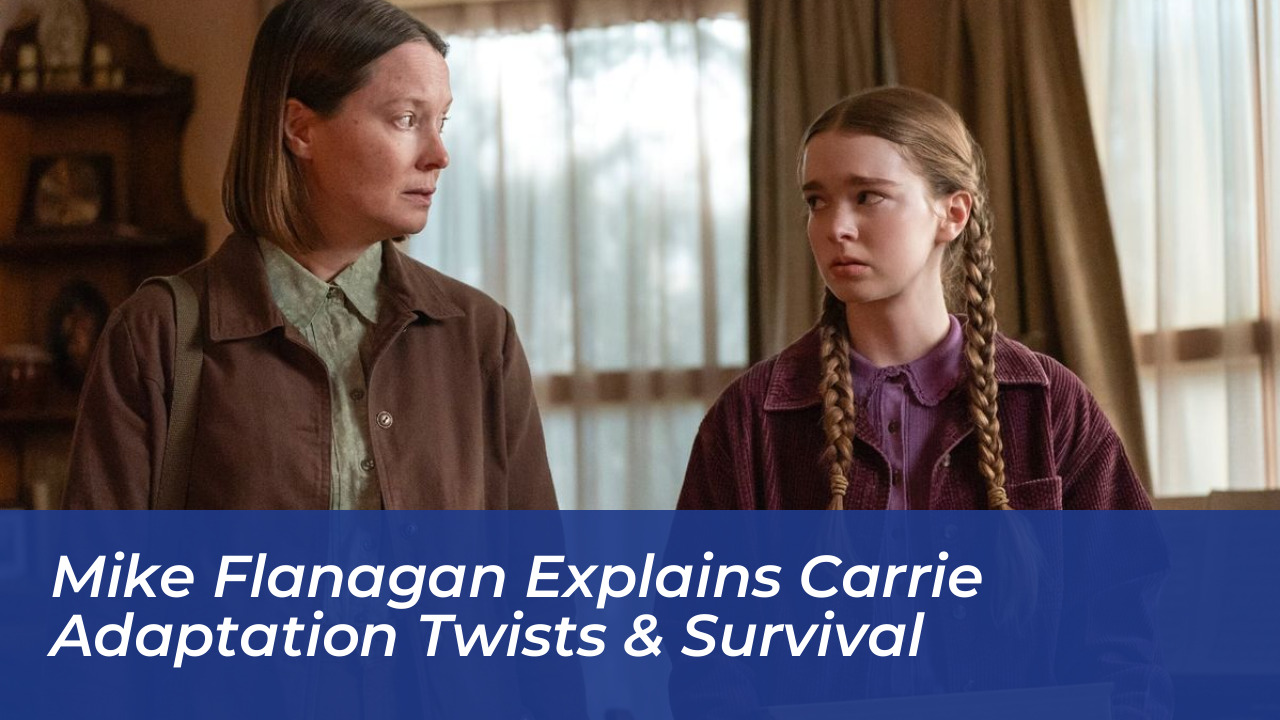
One of the biggest narrative departures in Flanagan’s series is the revelation that Margaret White, played by Samantha Sloyan, secretly possesses weak telekinetic powers. While her abilities pale in comparison to Carrie’s destructive gifts, Margaret admits in the series that she understands firsthand what her daughter is experiencing.
According to Flanagan, the conceptual foundation for inherited telekinesis is rooted directly in Stephen King’s book. The novel hints that the “TK gene” can skip generations and that Carrie’s grandmother may have been gifted. In interviews discussing the adaptation, Flanagan explained that the creative team wanted to explore the intersection of genetics, generational trauma, and parent-teenager friction.
“We talked a lot about the genetic component of this … how genes express themselves, and we also talked about the reality of parents and teenagers today, especially-and parents in general-that, when there’s friction, sometimes it’s because a parent sees something in their kid that they have in themselves that they haven’t learned how to deal with, and that kind of creates the fear,” said Mike Flanagan.
Samantha Sloyan echoed this sentiment in separate discussions. She noted that Margaret’s intimate understanding of the power dynamic fueled her strict, overprotective parenting. Knowing the reality of the terror gave her intense justification in her mind for locking Carrie away from a hostile world.
Why Carrie White Survives the Destruction of Chamberlain
Another monumental deviation from King’s text and previous screen adaptations is the survival of the titular character, played by Summer H. Howell. Rather than perishing in the fiery ruins of the burning prom venue and her collapsing family home, Flanagan’s version of Carrie escapes Chamberlain to start a completely new life.
Flanagan noted that he knew from the inception of the project that his version of Carrie needed to make it out alive. While the creator has expressed hope for a three-season arc overall, he purposely crafted the conclusion of the eighth episode to function as a definitive, satisfying endpoint if the series did not return.
“We had to end this so that if the last frame of video in episode eight is the last time we ever see this version of Carrie, that had to be right, that had to work,” Flanagan explained. “If this is the end of Summer H. Howell’s tenure as Carrie White, I wanted to send her off into the world we thought she deserved.”
Navigating the Challenging Prom Finale
Bringing Stephen King’s iconic climax to life on screen proved to be a massive logistical undertaking. Episodes 7 and 8 flow seamlessly together like a feature film, utilizing abrupt audio cuts, such as fading to black on lingering screams, to maximize the psychological horror before the credits roll.
The technical demands of the prom sequence required ten grueling days of shooting. It featured practical special effects combining fire, water, stunts, and specialized wirework. The production faced unexpected obstacles behind the scenes as well, including an outbreak of COVID-19 among the cast and crew. Despite having to navigate safety protocols, PPE, and N95 masks during intense late-night shoots, the ensemble delivered critically acclaimed performances that elevated the material.
All eight episodes of Carrie are currently available to stream on Prime Video.