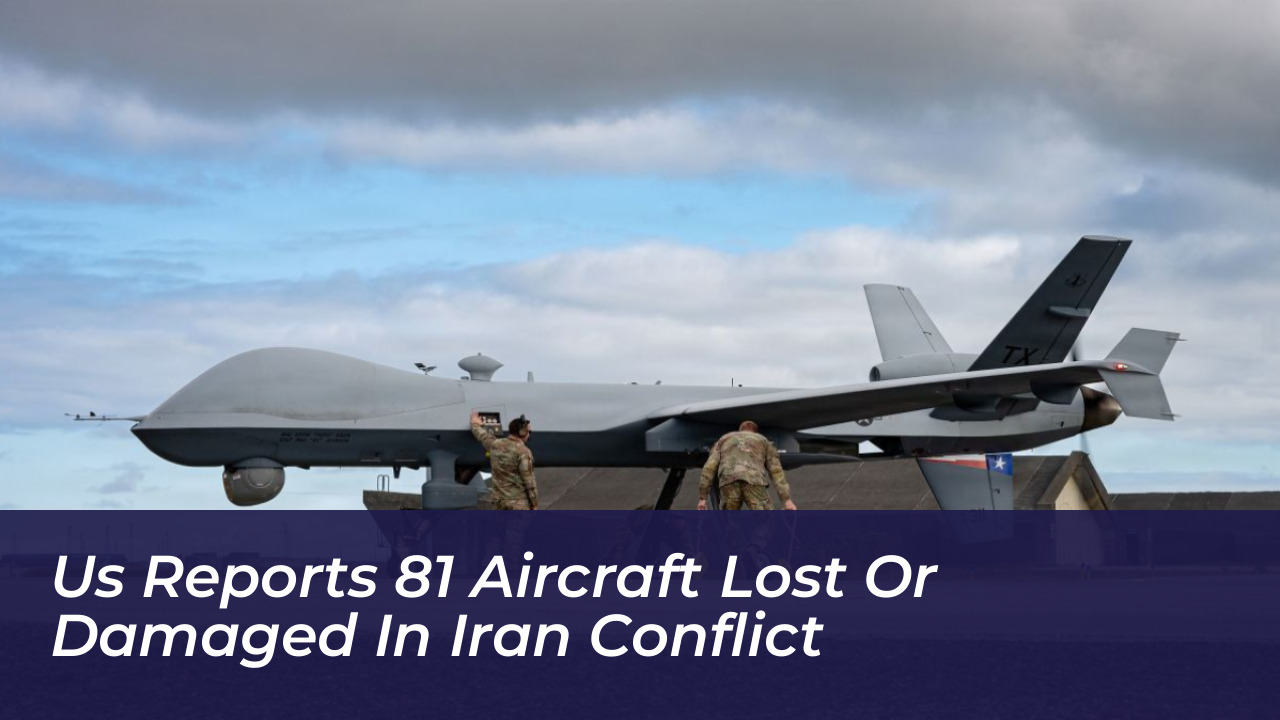


The United States military has lost or sustained damage to 81 aircraft since Operation Epic Fury began against Iran on February 28, 2026. According to an updated Congressional Research Service (CRS) report released on October 5, 2026, these figures highlight mounting equipment costs and strategic risks as lawmakers examine capability gaps outside the Middle East.
The revised tally nearly doubles the 42 aircraft counted in a previous assessment released in May 2026. The substantial increase stems from newly integrated data, which includes September damage reports at a US base in Jordan, additional helicopter losses, and a higher count of MQ-9 Reaper drones.
Researchers noted that the 81 listed assets are not entirely destroyed, as several damaged airframes have successfully returned to service or are undergoing repairs. The CRS relies primarily on public statements from the Department of Defense and US Central Command (CENTCOM), findings from inspector general reports, and verified open-source news reporting.
Breakdown of Crewed Fixed-Wing and Support Aircraft Losses
The conflict has impacted a wide range of fixed-wing aircraft, including frontline fighters, tankers, and specialized transport units. Among the most notable incidents detailed in congressional reporting are twelve F-15 Strike Eagles. This figure includes three aircraft shot down by friendly fire over Kuwait on March 2, 2026-with all six crew members ejecting safely-and an F-15E shot down near Isfahan. The remaining eight F-15s sustained light damage during an Iranian strike on Muwaffaq Salti Air Base in Jordan and were swiftly restored to operational status.
Other tactical aircraft affected include a single F-35A fighter jet, which sustained damage from Iranian fire before the pilot safely landed. Two A-10 Thunderbolt II “Warthogs” were also impacted; one was lost in combat during rescue operations, while another suffered severe ground damage at Muwaffaq Salti Air Base.
Tanker and airborne warning assets also suffered hits. A mid-air collision involving two KC-135 Stratotankers resulted in the tragic loss of one aircraft and all six crew members, marking the only confirmed personnel fatalities linked directly to the reported aircraft incidents. A second KC-135 survived with a sheared tail section. Five additional KC-135 tankers were damaged on the ground during a missile and drone strike at Prince Sultan Air Base in Saudi Arabia.
Additionally, a rare and aging E-3 Sentry Airborne Warning and Control System (AWACS) aircraft was struck while parked on an unprotected taxiway at Prince Sultan Air Base. Open-source assessments suggest this airframe may be beyond economic repair. Two specialized MC-130J Combat Shadow II aircraft were intentionally destroyed in place to prevent capture after becoming stuck during the recovery of downed F-15E aircrews.
Helicopter and Unmanned Drone Casualties
Unmanned aerial systems and rotary-wing aircraft account for a substantial portion of the overall numerical tally. Over half of the reported losses comprise at least 45 MQ-9 Reaper drones, reflecting their heavy deployment rates and high operational tempo throughout the campaign.
Helicopter losses include:
- An HH-60W Jolly Green II combat search and rescue helicopter damaged during extraction efforts.
- A US Army AH-64 Apache attack helicopter shot down over the Strait of Hormuz, with its crew rescued via autonomous surface vessels.
- A US Navy MH-60 Sea Hawk maritime helicopter that crashed in a separate mishap over the Arabian Sea.
- Four AH-6 Little Bird light attack helicopters destroyed in place after the loss of their MC-130J transport aircraft prevented conventional extraction.
Additional drone attrition includes a single US Navy MQ-4C Triton lost in a mishap, alongside at least three older MQ-1 Predator drones operated by CENTCOM.
Financial Impact and Strategic Capability Concerns
A Congressional Budget Office (CBO) estimate released in September indicated that replacing total equipment losses incurred through August 1 ranges between $1.9 billion and $3.3 billion, depending on finalized Pentagon procurement strategies. While expenses remain relatively moderate compared to wider munitions expenditures, lawmakers have raised concerns over long-term capability impacts.
The loss of specialized, low-density platforms such as the E-3 Sentry creates immediate capability strains, given the shrinking operational fleet and lack of immediate replacements. Conversely, analysts note that the impact of other losses is partially offset by the scheduled downsizing of legacy fleets, such as older A-10 Warthogs and specific Apache variants already earmarked for reserve storage or retirement.
Security concerns stemming from ground attacks have also triggered defensive postures elsewhere. On October 4, 2026, the US Air Force withdrew its B-1B Lancer strategic bombers from RAF Fairford in the United Kingdom back to domestic US bases following intelligence regarding potential threats.