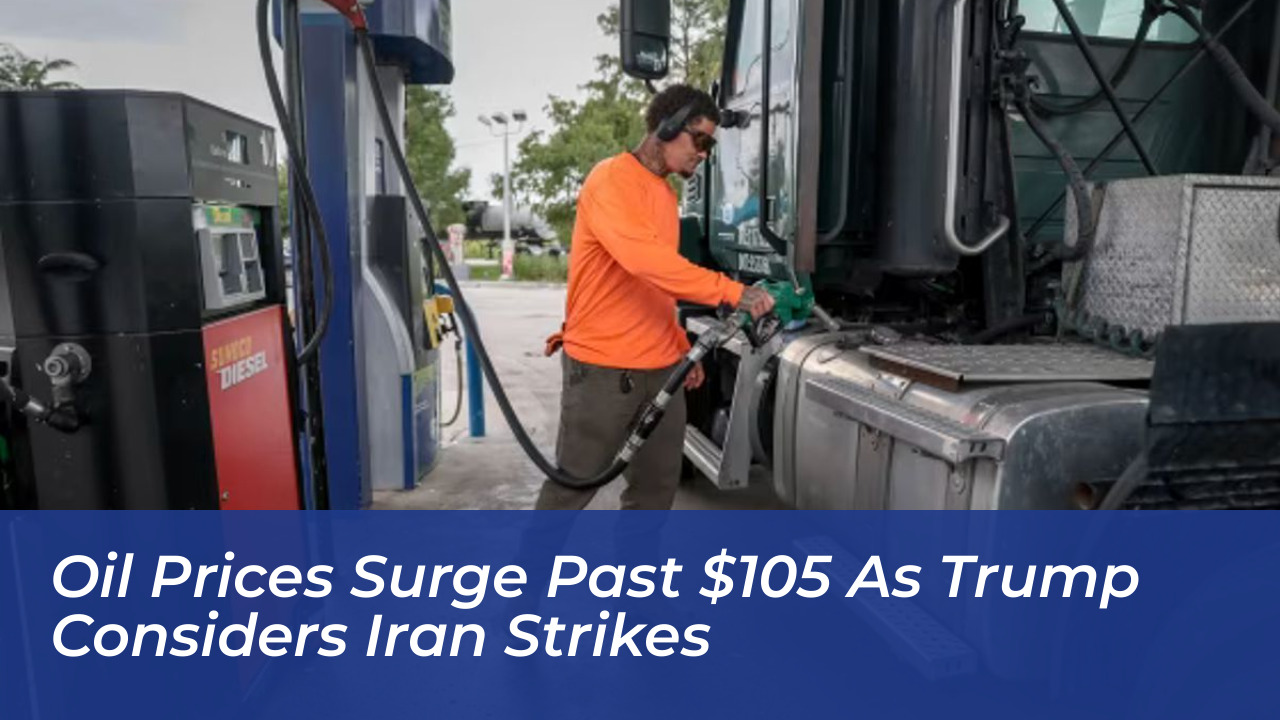


Global energy markets experienced a sharp disruption as President Donald Trump weighed resuming large-scale U.S. military operations against Iran in the coming weeks. The development sent Brent crude surging above $105 per barrel, drove up borrowing costs across international bond markets, and pushed U.S. stock futures lower.
International benchmark Brent crude rose more than 5% to trade above $105 per barrel in early sessions, while U.S. West Texas Intermediate (WTI) crude gained nearly 5% to reach close to $93 per barrel, according to reports from NBC News and financial markets data. The upward pressure extended to refined products, with benchmark diesel futures increasing 4.5% in European trading and heating oil-often used as a proxy for jet fuel-climbing more than 4%.
The sudden escalation in energy prices also rattled broader financial markets. The U.S. 10-year Treasury yield climbed to 5.35%, reversing declines seen earlier in the week, while yields across other Treasury maturities ticked upward. U.S. stock futures reacted negatively, with S&P 500 futures falling 0.6%, Nasdaq 100 futures sliding 0.8%, and Russell 2000 small-cap futures dropping 1%.
Markets Respond to Potential Military Escalation
The White House reportedly asked the Pentagon to draw up options for a possible resumption of attacks on Iran before the upcoming midterm elections, according to sources familiar with the discussions. Although no final decisions have been made, a return to large-scale military operations would mark a significant end to the uneasy three-month stalemate between Washington and Tehran.
Discussions regarding potential military actions have circulated widely across government circles. The Atlantic first reported that the White House was reviewing strike options, noting that proponents within political circles argue a show of strength could influence voter sentiment ahead of the polls. However, critics and market analysts warn that any renewed conflict risks severe disruptions to crude oil supplies originating from the Middle East.
Strait of Hormuz and Global Supply Pressures
The oil market remains highly sensitive to security conditions in the Persian Gulf. Smaller-scale attacks on commercial shipping have sharply reduced traffic through the Strait of Hormuz-a critical maritime artery for global energy supplies-down to a fraction of pre-war levels. Data from MarineTraffic showed that daily traffic through the strait fell to an average of fewer than 23 ships per day during early October, compared to hundreds of daily transits before the conflict began.
Shipping costs have soared as a result. According to Bloomberg data sourced from the London Baltic Exchange, moving U.S. crude to Asia on a large carrier has spiked to $77 million, a steep contrast to the 2025 yearly average of just $9.2 million. Meanwhile, major shipping firms like Maersk have implemented emergency fuel surcharges to cope with rising bunker prices.
Broader Economic Impacts and Inflation Concerns
The sustained elevation in crude oil prices continues to filter down to consumers at the pump. The U.S. national average price for regular unleaded gasoline hovered at $4.36 per gallon, marking an increase of more than 45% since the U.S. and Israel initiated military actions against Iran on February 28. Diesel prices experienced even steeper gains, climbing nearly 70% to $6.28 per gallon amid concurrent pressures from the Russia-Ukraine conflict.
Economists and central bank officials are closely monitoring these commodity spikes for potential inflationary spillover. Bank of America’s head of global commodities, Francisco Blanch, previously warned that a broader conflict causing major energy infrastructure damage could drive Brent crude prices as high as $150 per barrel, keeping financial markets on high alert as developments unfold.