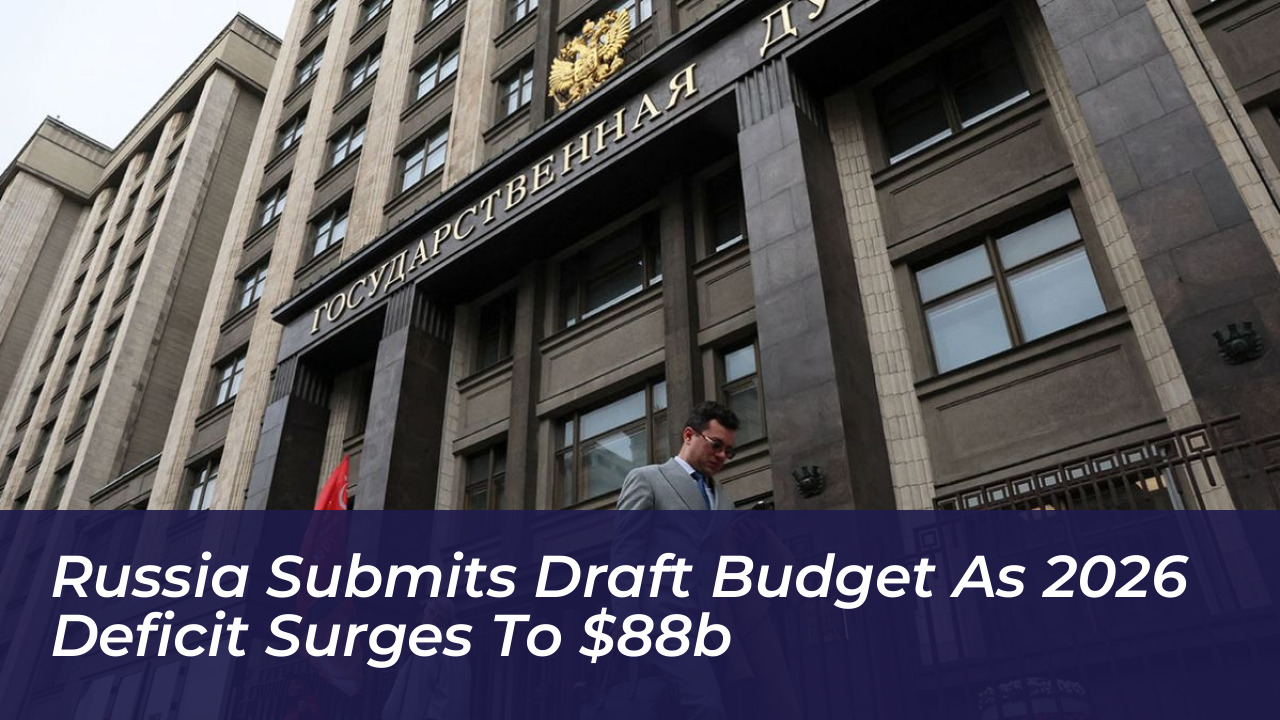
The Russian government submitted its three-year draft federal budget for the upcoming fiscal cycle to the State Duma on Wednesday, sharply revising its 2026 fiscal deficit forecast to a record 7.345 trillion rubles ($88 billion). The updated financial shortfall nearly doubles the previous target of 3.785 trillion rubles ($45 billion), escalating the expected deficit from 1.6% to 3.2% of gross domestic product (GDP).
The revised figures highlight mounting pressures on public finances as government expenditures continue to surge. Officials project subsequent fiscal gaps of 5.443 trillion rubles in 2027, 5.12 trillion rubles in 2028, and 5.245 trillion rubles in 2029. These shortfalls bring cumulative budget deficits over the three-year planning period to nearly 16 trillion rubles ($192 billion).
Long-Term Economic Planning and Revised Targets
To maintain long-term economic oversight, Russian officials have repeatedly adjusted figures upward after missing past deficit objectives. According to the submission, nominal GDP is projected to expand by 1.4% to reach 248.3 trillion rubles ($2.98 trillion) in 2027, eventually climbing to 281.7 trillion rubles ($3.38 trillion) by 2029.
The baseline macroeconomic assumptions underpinning the draft budget include a conservative oil price of $50 per barrel and an annual inflation target set strictly at 4%. While independent analysts note that budget deficits hovering around 3% to 4% of GDP remain technically manageable, the rapid expansion of unallocated or classified spending highlights persistent structural strains.
Key Budget Parameters for 2026-2029
- 2026 Deficit: 7.345 trillion rubles ($88 billion), or 3.2% of GDP.
- 2027 Projected Deficit: 5.443 trillion rubles (2.2% of GDP).
- 2028 Projected Deficit: 5.12 trillion rubles (1.9% of GDP).
- 2029 Projected Deficit: 5.245 trillion rubles (1.9% of GDP).
- Inflation Target: 4% annually across all periods.
Drivers Behind the Escalating Deficit
Russia’s broader fiscal situation has deteriorated during the conflict in Ukraine. To keep pace with expanding military and social obligations, the state has tapped its remaining fiscal reserve funds, increased domestic borrowing, and implemented targeted tax adjustments.
Reports surrounding secondary funding documents indicate that defense spending remains a primary driver of high federal expenditures. Defense allocations for 2027 are projected to rise significantly, representing more than a third of total federal spending, with substantial portions classified under secret administrative codes.
Next Steps in the State Duma
The draft federal budget bill now rests with the lower house of parliament. Andrei Makarov, chairman of the State Duma Budget Committee, confirmed that parliamentarians will convene for the first of three mandatory readings of the budget bill.
Despite the widening fiscal gap, senior leadership maintains that the current trajectory poses no critical macroeconomic destabilization risks. The government stated on Wednesday that the draft framework remains balanced overall, serving as a vital instrument for controlling domestic inflation and preserving financial stability through the end of the decade.