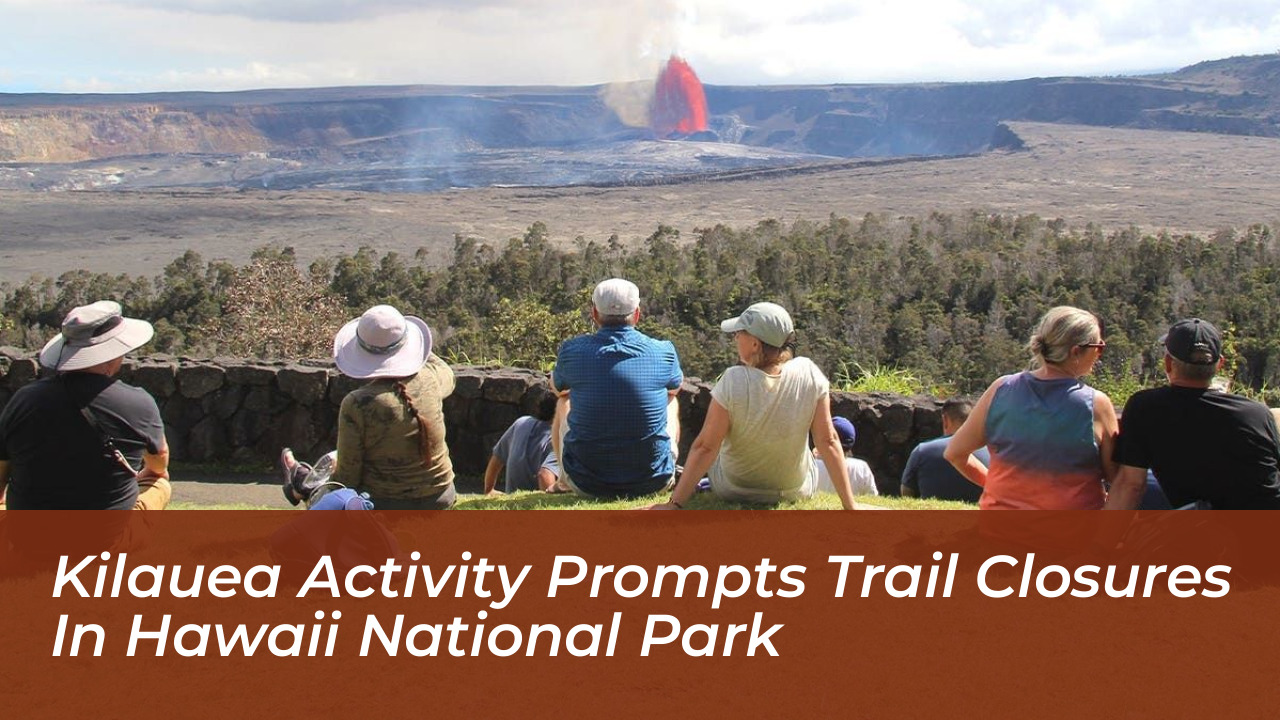


Rising seismic activity beneath Kīlauea has prompted temporary trail closures at Hawaiʻi Volcanoes National Park, where officials are warning visitors about rockfalls, high pressure, and other volcanic hazards. The National Park Service announced that the Halemaʻumaʻu Trail and part of the Byron Ledge Trail would close, affecting a combined 1.3 miles as activity increased near the summit.
The closures followed a week in which more than 200 shallow earthquakes occurred beneath Kīlauea’s summit, according to the National Park Service, citing data from the U.S. Geological Survey’s Hawaiian Volcano Observatory (HVO). A magnitude-3.4 earthquake on September 30 triggered small rockfalls along the caldera’s north wall.
The U.S. Geological Survey issued a volcanic activity notice following renewed spattering observed at two vents after underground activity. As of Thursday, Kīlauea remained at an ORANGE aviation color code, the second-highest level on the agency’s four-tier scale, indicating heightened volcanic activity and the potential for an eruption.
Volcanic Unrest and Magma Intrusions
Scientists reported that additional cracks opened on the caldera floor between Uēkahuna and Wahinekapu (Steaming Bluff) due to a short-lived magma intrusion in the area from September 30 to October 1. Thermal camera measurements taken on October 6 showed that some of these new steaming cracks reached temperatures of about 140 degrees.
Observatory scientists stated that lava fountains could resume inside Halemaʻumaʻu Crater from the north-south-west vent complex. It has been over 40 days since the last eruption episode on August 25, marking the longest period without fountains since the current eruptive cycle began in late December 2024.
“Forecast windows for episode 55 fountaining can no longer be modeled due to changes in conditions,” the USGS advisory noted, emphasizing the unpredictability of the highly pressurized summit system.
Visitor Safety and Park Hazards
Park officials have stressed that visitors must stay out of closed areas and remain away from unstable cliff edges, which can collapse without warning. In addition to rockfall dangers and potential gas emissions, authorities warned about small, glassy volcanic fragments that can be remobilized during windy conditions and cause skin and eye irritation.
Viewing areas on the Keanakākoʻi side of the caldera were also closed earlier for safety purposes, as the nearest parking area is about a mile from the overlooks, making rapid evacuation difficult. Hawaiʻi Volcanoes National Park remains a major destination, having recorded more than 1.8 million recreational visits in 2025 as tourists continue to monitor the dynamic volcanic conditions.