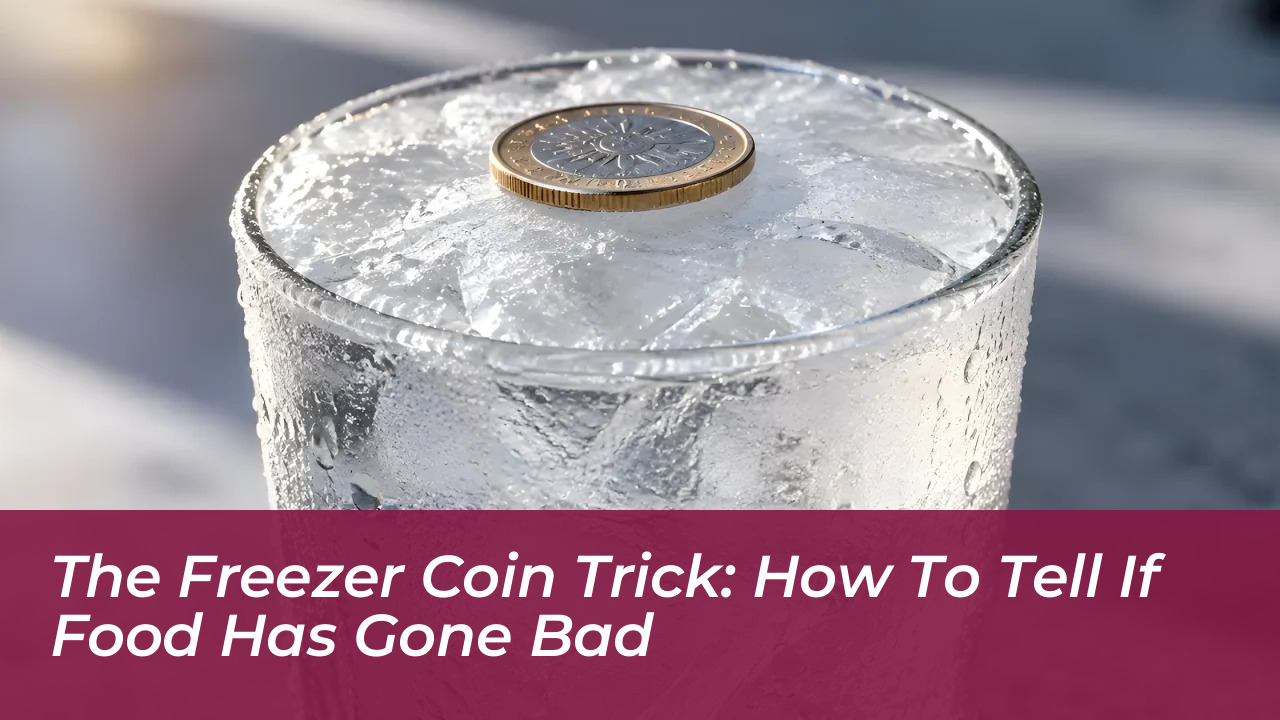

A prolonged power outage can quietly thaw the food inside your freezer and render it unsafe to consume. This happens even if power eventually returns and everything appears solidly frozen again. When you return home from a vacation or after a severe storm, it is often impossible to tell at a glance whether your perishables stayed safely frozen the entire time. To clear up this dangerous doubt, there is a simple, clever, and highly reliable household method known as the freezer coin trick.
What the Freezer Coin Trick Consists Of
The method is remarkably straightforward and requires only two basic items that you already have at home: a small freezer-safe container or glass, water, and a coin.
- Fill a glass or small container with cold tap water and place it in the freezer until the water completely solidifies into a block of ice.
- Once the water is frozen solid, place a coin directly on top of the surface of the ice.
- Put the glass back into the freezer. This is especially useful to set up right before you leave for a trip lasting several days or whenever a severe storm is forecasted that could knock out electricity.
What Does the Position of the Coin Mean?
When you return home, the coin acts as a silent witness to what happened inside your appliance while you were away. Checking its position takes only a second and reveals the history of your freezer’s internal temperature:
- The coin stays on top: If the coin is still resting on the very surface of the ice, your freezer maintained its cold temperature. The food remained completely frozen the entire time you were away, and in principle, your frozen goods are safe to eat.
- The coin sank to the middle or bottom: If the coin has migrated downward into the glass, it means there was a prolonged power outage. The ice melted completely, causing the coin to sink. Electricity later restored, refreezing the water with the coin trapped at the bottom. This indicates that your food likely thawed out completely during the outage and should be discarded immediately.
The coin permanently marks whether the ice melted at any point. This is a critical warning sign that remains completely invisible if the appliance simply turns back on and refreezes the contents before you inspect them.
What Do Official Guidelines Say About Frozen Food Safety?
While the freezer coin trick serves as an invaluable practical aid, your final decision regarding whether to keep or discard food should always align with established food safety recommendations, such as those from FoodSafety.gov:
- A full, closed freezer will maintain a safe freezing temperature for approximately 48 hours if the power goes out.
- A half-full freezer will hold a safe temperature for about 24 hours.
- The golden rule during any outage is to keep the freezer door tightly closed for as long as possible to preserve internal cold air.
- As a general guideline, foods that still contain ice crystals or that have maintained a temperature of 40 °F (about 4 °C) or lower can be safely refrozen or cooked and consumed.
When dealing with perishable items, never take unnecessary health risks. If you are ever unsure about the safety or temperature history of a particular item, remember the universal rule of thumb: when in doubt, throw it out.
Additional Food Safety Tips for Power Outages
Beyond the coin trick, maintaining awareness of the refrigerator and freezer temperature danger zone is vital for preventing foodborne illness. Your refrigerator should always be kept below 40 °F (4 °C), and your freezer must remain at 0 °F (-18 °C) or below under normal operating conditions.
When food enters the danger zone between 40 °F and 140 °F, harmful bacteria can multiply rapidly. Foods do not always thaw evenly. Items near the edges or in door compartments may warm up much faster than the dense center of a large cut of meat. Always err on the side of caution. Wrapping your frozen goods tightly and keeping your freezer well-stocked can also help extend the duration that items remain cold during an unexpected blackout.