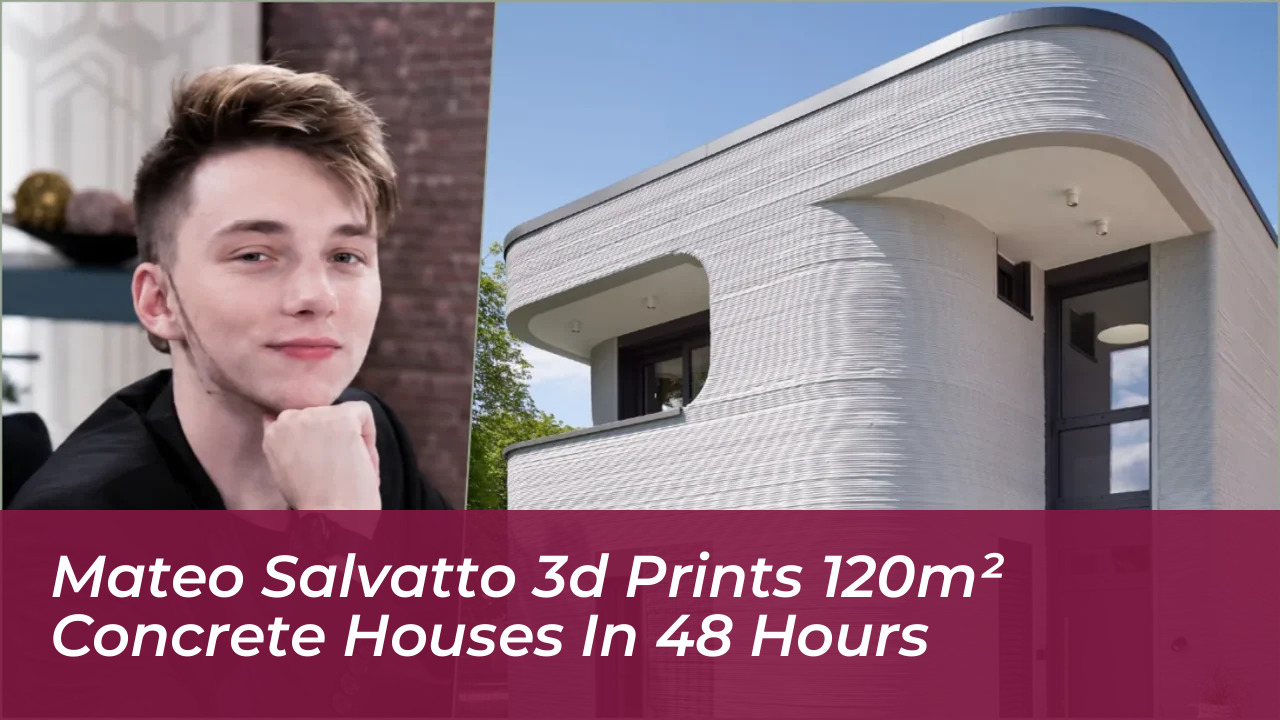

When 27-year-old entrepreneur Mateo Salvatto claims that a 120-square-meter concrete house can be put up in just 48 hours, the statement sounds like a futuristic pitch rather than standard construction. However, the true breakthrough lies not in waving a magic wand for a move-in-ready home in two days, but in revolutionizing the structural phase through large-scale 3D concrete printing.
Speaking with the newspaper La Nación, Salvatto-co-founder of Grondplek-explained that a 120 m² home can have its entire structural shell erected in 48 hours using specialized technology. The distinction is critical: the machine does not immediately deliver a finished house complete with utility hookups, interior carpentry, paint, or functional kitchens and bathrooms. Instead, it prints the core concrete structure-including walls, partitions, staircases, planters, and countertops-before traditional finishes and installations take over to complete the livable home.
How 3D Concrete Printing Operates on Site
Grondplek’s advanced system utilizes a massive gantry printer measuring approximately 11 meters by 11 meters and towering 7 meters tall. The printer operates using a specialized mixture of cement and custom additives, fed seamlessly from a compact batching plant through a pump and specialized hose directly to the printhead.
The material is deposited layer by layer, incorporating precise pauses between cycles to allow for proper curing and long-term structural stability. This method acts as the exact opposite of traditional construction workflows. Instead of building formwork, pouring concrete, waiting for it to set, stripping forms, and manually patching imperfections, the 3D printer places material strictly where the digital design calls for it.
According to Salvatto, this level of precision drastically minimizes material waste and accelerates a notoriously sluggish phase of building. , the company notes that its engineered system supports double walls with an integrated air cavity to enhance thermal and acoustic insulation, while maintaining earthquake-resistant structural integrity.
Cost Reduction and Logistics Revolution
The entrepreneur highlights an ambitious economic promise: a structural shell finished in one week with potential cost reductions of up to 30% compared to traditional market pricing. Naturally, final costs depend heavily on the specific land, architectural project scale, local finishes, and site conditions. Yet, the real appeal goes beyond cheaper housing; it automates the heaviest, slowest, and most repetitive elements of construction.
Salvatto describes the technology not as a gimmick, but as a “portable precast factory”-a system that can be transported to a site, leveled, and operational much faster than conventional methods. To bring this vision to life in Argentina, Uruguay, and Paraguay, Grondplek partnered with the Danish 3D printing pioneer COBOD and forged a strategic alliance with Techint Engineering & Construction.
Impact on Labor and the Future of Housing
Addressing common concerns about automation, Salvatto insists that 3D concrete printing is not designed to eliminate human workers. Rather, it shifts their labor toward operation, technical supervision, and fine-tuning finishes. While the printer removes grueling, repetitive physical tasks, it still requires human oversight, expert mix adjustments, and skilled laborers to finish everything outside the printed concrete shell.
While the technology still requires broader industry scaling, updated regulations, and long-term performance tracking, the direction is clear. In a notoriously change-resistant sector, 3D printing offers a glimpse into a future where structural housing shells can rise in 48 hours.
Frequently Asked Questions About Grondplek and 3D Concrete Printing
Who is Mateo Salvatto?
Mateo Salvatto is a 27-year-old entrepreneur and co-founder of Grondplek, a company specializing in bringing advanced 3D concrete printing technology to South America.
How long does it take to print a 120 m² house?
Using Grondplek’s large-format 3D printer, the structural shell-including walls, partitions, and stairs-can be printed in just 48 hours.
Does the 3D printer build a fully finished home?
No. The machine prints the core concrete structure. Final touches, plumbing, electrical utilities, carpentry, and painting must still be completed by human workers afterward.
What technology and partnerships power Grondplek?
Grondplek utilizes technology from the Danish company COBOD and operates in partnership with Techint Engineering & Construction across Argentina, Uruguay, and Paraguay.
Does 3D concrete printing replace construction workers?
No, the technology is designed to reduce heavy physical labor while shifting worker roles toward machine operation, supervision, mix adjustments, and finishing tasks.