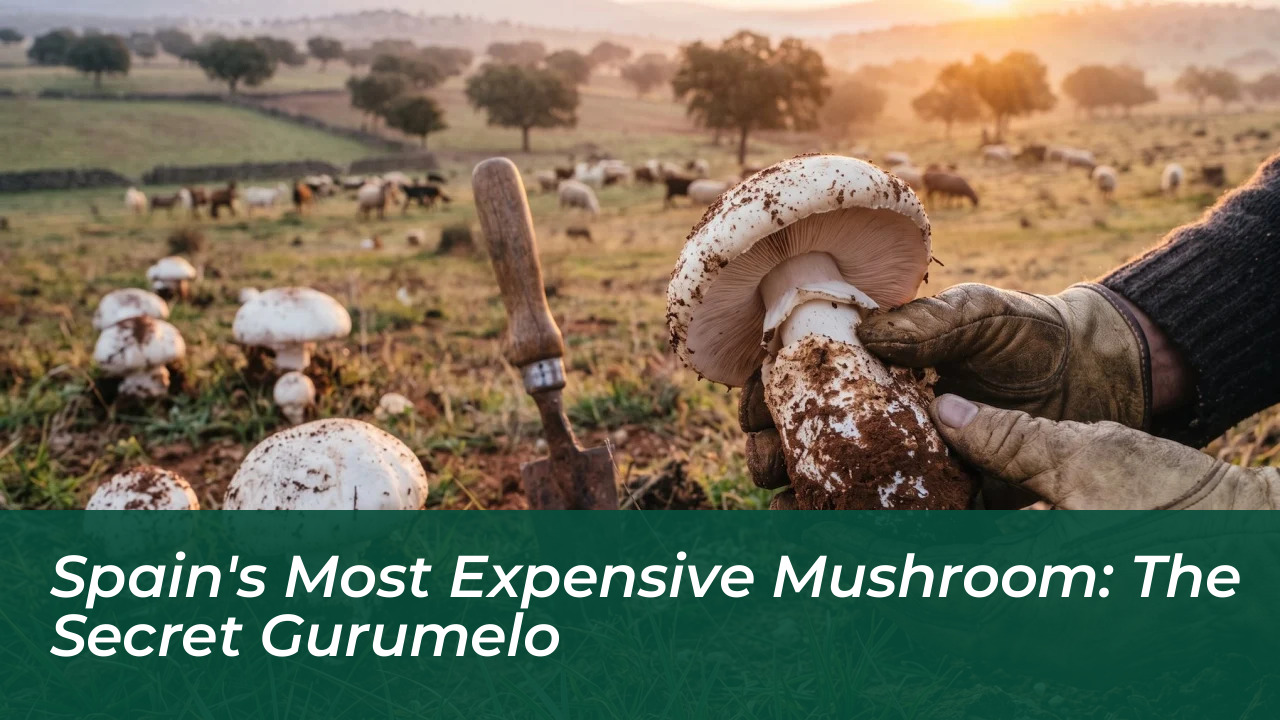

When it comes to Spanish cuisine, the western region of Extremadura is internationally famous for its cured ham and artisanal cheeses. Yet hidden beneath the soil of its ancient oak pastures lies a culinary secret that very few travelers or food enthusiasts know outside the region: the gurumelo. Fetching luxury-level prices across local markets, the Amanita ponderosa is one of the most expensive, prized, and heavily guarded wild mushrooms in all of Spain.
Growing entirely underground within the unique ecosystem of the *dehesa*-the sweeping oak pasturelands shared with neighboring Portugal-this elusive fungus forces expert foragers to rely on specialized techniques, deep ancestral knowledge, and keen observation to bring it to the surface each spring.
The Gurumelo: Spain’s Most Exclusive Underground Mushroom
The gurumelo stands out immediately for its robust physical size and dense, compact flesh. When it first begins to sprout underground, it resembles a misshapen potato or a lobed egg, completely covered by a thick, protective membrane with crusts of mineral-rich dirt clinging tightly to its surface.
As it matures, its cap measures between 6 and 18 centimeters (about 2.5 to 7 inches) in diameter. It starts out hemispherical before flattening entirely. The skin is dry and whitish, shifting naturally to ochre, pinkish, or reddish-brown tones upon exposure to the sun. Uniquely, the gurumelo is one of the very few mushroom species traditionally peeled before cooking.
The stem is thick and solid, anchored by a large, sturdy volva at the base that completely encases the lower part of the mushroom. By contrast, its ring is fragile and ragged, usually disappearing or remaining stuck entirely to the edge of the cap as it grows.
Foragers rely on two major indicators to distinguish the edible gurumelo from dangerous toxic white amanitas, such as Amanita verna:
- Color Transformation: The flesh of the gurumelo slowly turns a distinct wine-pink or salmon color when cut or bruised, a chemical reaction that deadly lookalikes do not share.
- Distinctive Aroma: It emits an intense, earthy scent reminiscent of damp clay, wet earth, or raw potato that experienced foragers recognize instantly.
How Foragers Locate the Elusive Gurumelero Habitat
Local foragers, known as gurumeleros, rely on decades of experience and an intimate, tactile understanding of the terrain to unearth a fungus that fruits entirely beneath the topsoil. The most vital visual clue is the *botonazo*-a small bump or star-shaped crack that appears on the surface of the clay soil when the growing mushroom pushes upward.
Once this subtle bump is spotted, foragers never dig blindly. Instead, they use a pinchu or gurumelero, a specialized wooden stick tipped with a curved iron point, to probe what lies beneath:
- If the probe hits something soft and spongy, they confirm the presence of the mushroom.
- If it strikes something hard and unyielding, they know it is merely a rock.
Using this exact tool, they carefully unearth the specimen without damaging its fragile volva. Ecologically, the gurumelo lives in strict symbiosis with the roots of holm oaks and cork oaks, frequently emerging alongside wild rockroses. Foragers memorize exact patches where the mushrooms reappear year after year, knowing that sun-facing slopes yield the season’s first prized specimens between February and April.
The Cross-Border Gurumelo Festival
Every spring, the town of Villanueva del Fresno in the province of Badajoz celebrates the Cross-Border Gurumelo Festival (*Festival Transfronterizo del Gurumelo*). Declared an event of Regional Tourist Interest in Extremadura, this vibrant gathering brings together thousands of Spanish and Portuguese visitors.
Because the dehesa ecosystem stretches seamlessly across the international border, the festival serves as a cultural celebration uniting two countries that share traditions, gastronomy, and foraging heritage. The multi-day event combines public mushroom tastings, local artisan markets, educational foraging workshops, and live musical performances.
Traditional Recipes for Cooking Gurumelo at Home
Because the gurumelo possesses a firm, dense flesh, it holds up exceptionally well to long cooking times without breaking down or turning mushy. Cooks across Extremadura and neighboring Andalusia prefer simple preparations to let the rich, earthy flavor shine through.
1. Grilled Gurumelo Caps
The purest preparation involves roasting the mushroom over charcoal or searing it on a flat griddle. Cooks separate the caps from the stems and place them top-down over hot coals or a smoking-hot griddle. They season them simply with coarse sea salt, extra virgin olive oil, and occasionally a few drops of lemon juice or a sprinkle of minced garlic and parsley.
2. Gurumelo Scramble (*Revuelto*)
A classic tavern dish during the spring season. Diced gurumelos are sautéed with garlic until they release their natural juices and lightly brown. Premium acorn-fed Ibérico ham (*jamón ibérico*) is folded in before farm-fresh eggs are gently set into the mixture over low heat, yielding a rich, juicy texture.
3. Traditional Gurumelo Rice (*Arroz con Gurumelos*)
This hearty one-pot dish begins with a rich sofrito base of onion, green bell pepper, garlic, and ripe tomato. Chopped gurumelos are added alongside wild game or savory Iberian pork ribs before short-grain rice and a rich bone broth are folded in to simmer.
4. Gurumelos with Garlic and Pork Belly (*Panceta*)
Sliced garlic and a fiery chili pepper are browned alongside diced Iberian pork belly (*panceta*). Sliced gurumelos are then tossed into the pan over high heat, cooking quickly until tender and infused with savory pork fat.
Frequently Asked Questions About the Gurumelo
What is a gurumelo?
The gurumelo (*Amanita ponderosa*) is a highly prized, expensive wild mushroom native to the dehesa oak pasturelands of Extremadura in southwestern Spain and parts of Portugal. It grows entirely underground.
When is the gurumelo season?
The gurumelo season runs during the spring months, typically from February through April, following winter rains and rising temperatures.
How do you tell a gurumelo from toxic mushrooms?
Unlike deadly white amanitas, the flesh of a true gurumelo slowly stains a distinct wine-pink or salmon color when cut. It also has a powerful, unmistakable aroma of damp earth and raw potato.
Where is the Cross-Border Gurumelo Festival held?
The festival is celebrated annually every spring in Villanueva del Fresno, a border town in the Spanish province of Badajoz.
How is the gurumelo traditionally cooked?
It is traditionally prepared very simply-either grilled over hot coals with olive oil and salt, scrambled into farm eggs with Iberian ham, simmered in rice dishes, or sautéed with garlic and pork belly.