
Canada celebrates Thanksgiving as a harvest holiday. It is deeply rooted in Indigenous traditions and European history. The national observance is officially held on the second Monday of October. The holiday reflects gratitude for the harvest, seasonal changes, and the country’s rich natural resources. Unlike the American celebration in late November, Canada’s shorter growing season brings harvest celebrations earlier. This timing aligns closely with agricultural cycles and winter preparation.
Historian Craig Baird, host of the Canadian History Ehx podcast, explained the seasonal connection during historical accounts of the holiday. “I think it does come down to the harvest with them and with it being later. Obviously, southern states, you’re not going to have winter like we do. So, in Canada, because our harvest is much earlier and we have a much shorter growing season, it really comes down to us having Thanksgiving much earlier because it is a celebration of the harvest,” said Baird.
Indigenous Traditions and Pre-Contact Gratitude
The history of giving thanks for food, successful harvests, and survival did not begin with European settlers. Long before Europeans arrived in North America, Indigenous peoples maintained sophisticated agricultural systems, hunting protocols, and spiritual traditions. These practices connected with harvesting, fishing, and seasonal changes.
There was and remains no single universal Indigenous “Thanksgiving.” First Nations, Inuit, and Métis peoples represent distinct nations and cultures. Each features individual ceremonies, dances, prayers, and protocols expressing gratitude for the land’s provisions. A complete understanding of Canadian Thanksgiving recognizes that these longstanding traditions predate European settlement by thousands of years.
Early European Explorers and Settler History
European influences added another layer to the holiday’s evolution. One of the earliest recorded European thanksgiving services in what would become Canada occurred in 1578. English explorer Martin Frobisher led an expedition into the eastern Arctic searching for the Northwest Passage. After surviving dangerous conditions and reuniting separated ships, the crew held a religious service to give thanks for their survival.
Decades later, during the winter of 1606-07 at Port-Royal in Acadia (modern-day Nova Scotia), Samuel de Champlain helped establish the Order of Good Cheer (L’Ordre de Bon Temps). Designed to combat scurvy and boost morale through shared meals, hunting, and entertainment, the community gathered with Mi’kmaq leaders like Membertou and Messamouet. This gathering foreshadowed the communal sharing that defines modern Thanksgiving.
How Thanksgiving Became a National Holiday
For much of early Canadian history, days of thanksgiving were declared sporadically by governments and churches. They marked military victories, royal occasions, or good harvests. Following Confederation, the first federal Thanksgiving proclamation occurred in 1872 to celebrate the recovery of the Prince of Wales from a serious illness.
An annual tradition finally took root in 1879, when November 6 was proclaimed a day of general thanksgiving for the harvest. However, the date shifted frequently over the following decades:
- 1921-1931: Parliament passed the Armistice Day Act. This act combined Thanksgiving and Armistice Day on the Monday of the week containing November 11. Veterans and citizens disliked combining solemn war remembrance with festive celebrations.
- 1931: November 11 was permanently established as Remembrance Day, separating it from Thanksgiving. Thanksgiving was subsequently moved to October.
- 1957: Governor General Vincent Massey issued a federal proclamation on January 31, 1957. It permanently appointed the second Monday in October as Thanksgiving Day.
Modern Traditions and Celebrations
Today, Canadians observe Thanksgiving through a blend of family gatherings, traditional meals, community events, and outdoor activities. The formal text of the 1957 proclamation spoke of giving thanks to Almighty God. For many people, the holiday functions as a secular celebration of community, family, and autumn.
The Thanksgiving Table and Symbols
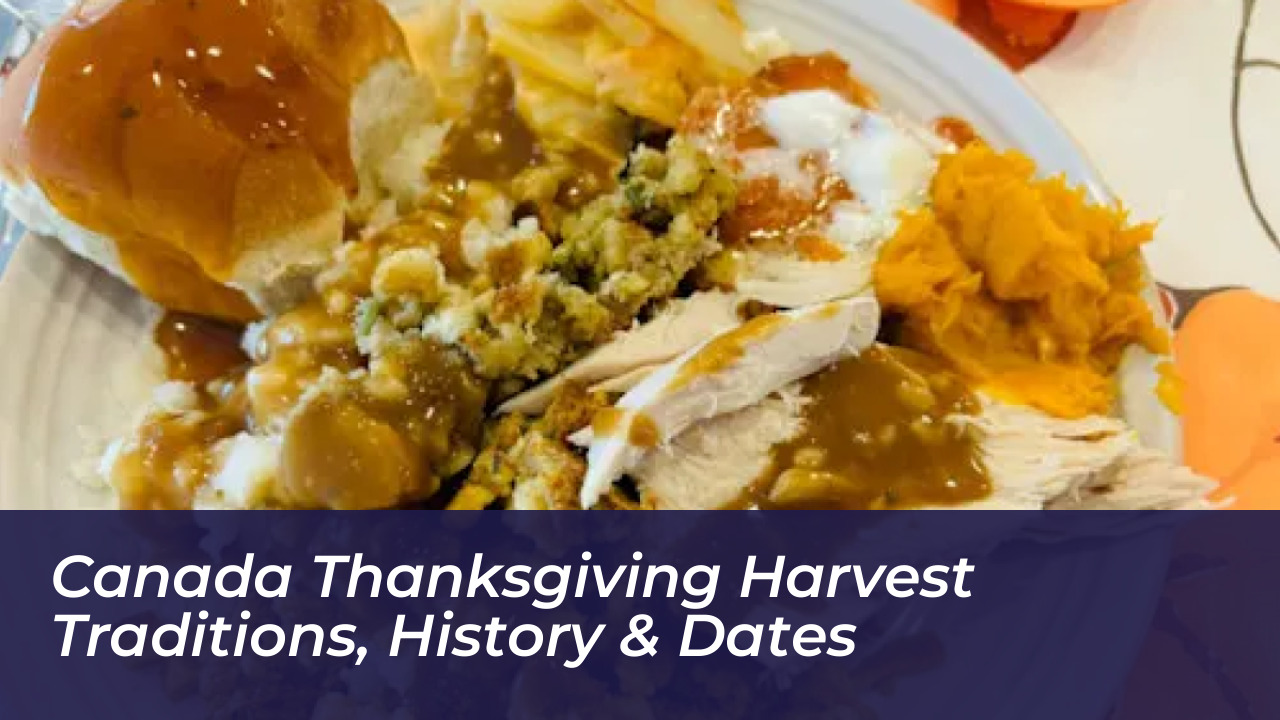
The centerpiece of the modern Canadian Thanksgiving table is typically roast turkey. It is accompanied by stuffing, mashed potatoes, squash, cranberry sauce, and pumpkin pie. Alongside food, autumn decorations such as colored leaves, cornucopias, wheat, and pumpkins dominate homes and farm stands. These symbols reflect the completion of the agricultural harvest before the arrival of winter.
Public Events and Long Weekend Culture
The holiday also supports major cultural events, such as the Kitchener-Waterloo Oktoberfest Thanksgiving Day Parade. This parade features marching bands and food drives supporting local food banks. Canadian Football League (CFL) games are another staple of the October long weekend.
“Before another Canadian winter arrives, gather together and be thankful for what you have. That may be why Thanksgiving continues to feel particularly at home in Canada.”
Frequently Asked Questions
When is Canadian Thanksgiving celebrated?
Canadian Thanksgiving is celebrated annually on the second Monday of October. In 2026, it falls on Monday, October 12.
Why is Canadian Thanksgiving earlier than American Thanksgiving?
Canada’s northern climate results in a shorter growing season and an earlier agricultural harvest. Consequently, Canadian Thanksgiving occurs in October, while American Thanksgiving is celebrated on the fourth Thursday of November.
Did Indigenous peoples celebrate Thanksgiving before Europeans arrived?
Indigenous nations had longstanding seasonal ceremonies, harvest practices, and spiritual traditions of gratitude connected to the land long before European contact. These practices varied by individual nation rather than forming a single unified holiday.
Was Martin Frobisher’s 1578 voyage the first Canadian Thanksgiving?
Frobisher’s 1578 Arctic expedition featured a religious service of survival and gratitude. This makes it an early European observance on Canadian soil, but it is not directly linked to the continuous annual harvest traditions of modern Canadian Thanksgiving.
Why did Thanksgiving and Remembrance Day share a date?
From 1921 to 1931, the Canadian government combined Thanksgiving with Armistice Day under the Armistice Day Act. Public dissatisfaction led Parliament to separate them in 1931. Parliament assigned Remembrance Day permanently to November 11 and moved Thanksgiving to October.