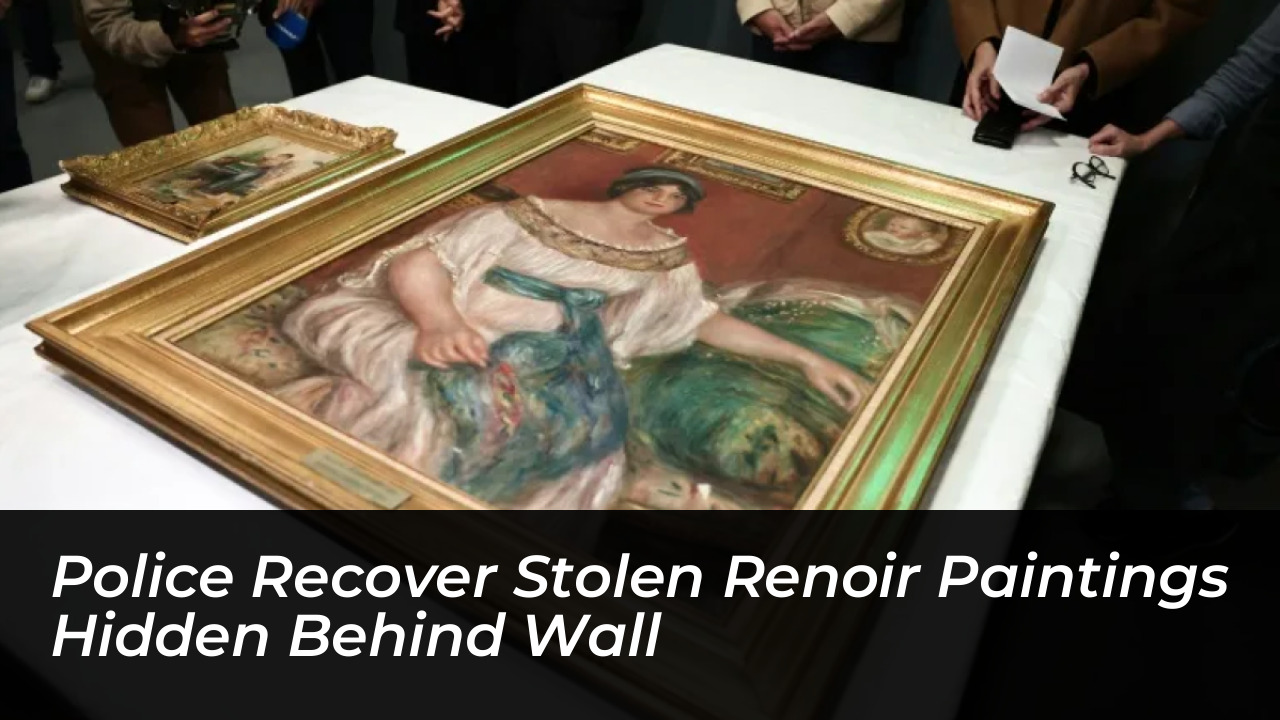

French investigators have successfully recovered two priceless paintings by impressionist master Pierre-Auguste Renoir that were stolen from a museum in southern France. Authorities announced on Friday, October 9, that the artworks were discovered concealed behind a solid cinder block wall inside a residential property in Clermont-l’Herault, following a series of coordinated arrests.
The recovered masterpieces are the 1910 work Portrait of Madame Colonna Romano and the 1886 piece Young Woman at the Well. Both pieces belong to Paris’s prestigious Musée d’Orsay and were on loan to the Renoir Museum in Cagnes-sur-Mer when the theft occurred. Prosecutors have estimated the combined value of the two recovered artworks at 4.2 million euros, roughly $4.7 million.
How the Renoir Museum Heist Unfolded
The daring theft took place in the early morning hours of September 8. Perpetrators breached the grounds of the Renoir Museum-located in the final home of the legendary French painter-by cutting a hole in a garden fence and entering through a ground-floor window.
According to Marseille prosecutor Nicolas Bessone, the thieves used an electric saw to detach four paintings from their display clips. However, their operation was abruptly interrupted when an alarm sounded and local police officers arrived at the scene within four minutes. The rapid police response caused the suspects to panic, forcing them to abandon two other stolen canvases-Madame Pichon and Coco Reading-in the museum gardens inside a protective sleeve as they fled.
DNA Evidence and Vehicle Tracking Lead to Arrests
Investigators quickly linked DNA left on the abandoned protective painting cover to a 29-year-old suspect already known to law enforcement in connection with a drug trafficking case. Police vehicle-tracking data and surveillance footage tracked the suspect, alongside a 41-year-old accomplice, traveling to the home of a third man shortly after the museum break-in.
Subsequent police monitoring revealed that the primary suspect had visited the Maeght Foundation modern art collection in Saint-Paul-de-Vence on October 3, meeting with a fourth individual who had prior convictions for art theft and forgery in 2001 and 2003. Fearing that another high-profile art heist was actively being planned, authorities mobilized approximately 50 police officers over three days to execute targeted searches and surveillance operations.
Discovery Behind a False Wall
On Thursday, October 8, police raided a residence in Clermont-l’Herault after arresting six suspects-five men and one woman-the previous day. While an initial inspection of the home yielded nothing, officers returned after the resident confessed that two thieves had brought the paintings to his property. He admitted to helping conceal them behind a plasterboard and cinder-block wall built beneath a staircase.
Marseille prosecutor Nicolas Bessone noted that the paintings were completely undetectable prior to the confession. When retrieved, both artworks showed minor signs of damage: Portrait of Madame Colonna Romano sustained a tear in its canvas, while the frame of Young Woman at the Well suffered minor wear. Officials confirmed that both pieces will require professional restoration work and were transferred to the Interdisciplinary Centre for the Conservation and Restoration of Heritage in Marseille.
Legal Actions and Security Concerns
Out of the six initially detained individuals, four men faced formal preliminary charges on October 10. The two main suspects accused of carrying out the museum theft were charged with organized theft and criminal association, and were remanded to prison. Two other men accused of handling and concealing the stolen property were placed under judicial supervision with travel restrictions. The remaining two suspects were released without charge.
The brazen museum robbery has reignited national anxiety regarding the security of France’s cultural heritage institutions. Senior law enforcement officials reported that French museums recorded 23 theft incidents in 2025 and approximately 10 incidents in 2026, prompting renewed calls for heightened security measures and international cooperation to protect invaluable artistic treasures.