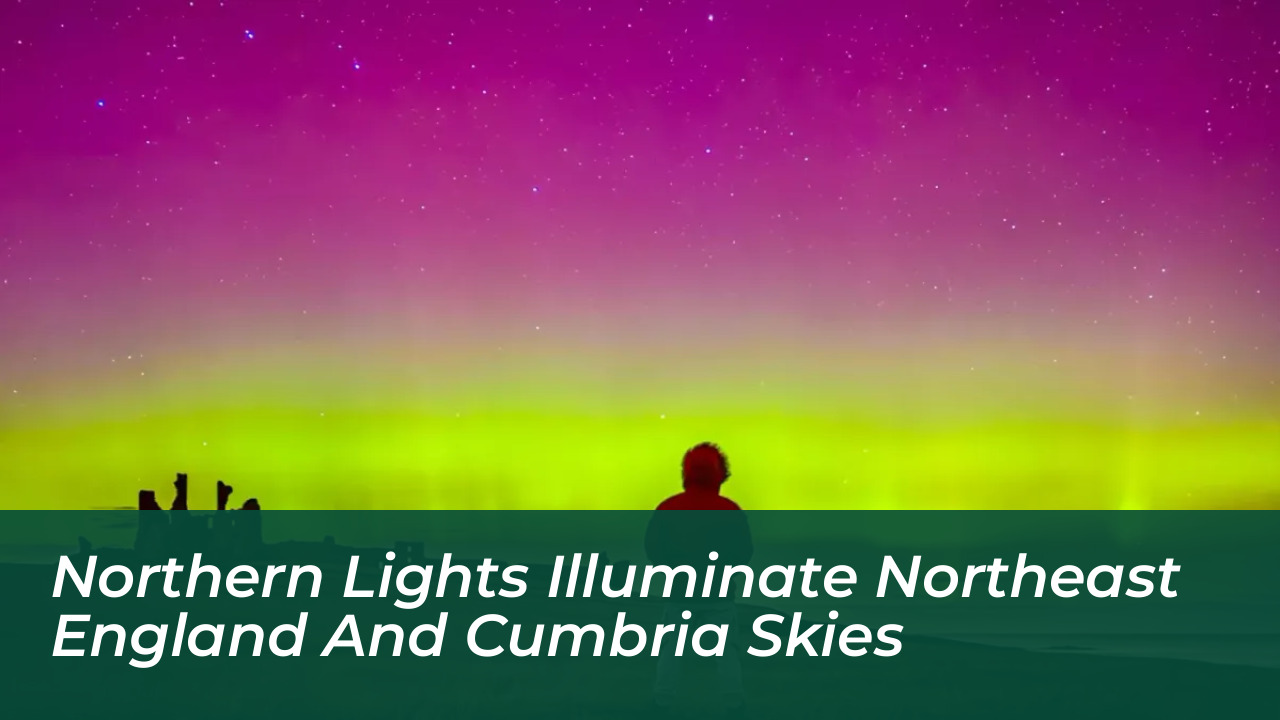

Vivid pink and green Northern Lights lit up the night sky across Northeast England and Cumbria on Saturday evening, attracting photographers, residents, and stargazers eager to witness the natural spectacle. The Met Office reported that further sightings could be possible through Tuesday as the aurora continued to offer favorable conditions for observation during clear skies.
The Science Behind the Aurora Borealis
The dazzling display, scientifically known as the Aurora Borealis, occurs when charged particles released by powerful solar eruptions travel toward Earth and interact with gases in the planet’s upper atmosphere. According to the Met Office, these events are triggered by coronal mass ejections from the sun.
When energetic particles collide with oxygen and nitrogen molecules in the atmosphere, they release energy in the form of colorful light. Oxygen typically produces green hues and rare red glows at higher altitudes, while nitrogen creates blue, purple, and pink tones.
UK-Wide Visibility and Solar Peak
Northern Lights occurrences are typically restricted to regions near the Arctic Circle and northern Scotland. However, heightened solar activity allowed the phenomenon to stretch far beyond its usual boundaries. During Saturday’s intense geomagnetic activity, levels reached 600nT (nanotesla), enabling sightings across Wales and as far south as Devon, Hampshire, and Kent.
Experts note that 2026 serves as a peak year for aurora-spotting. The sun is currently in a heightened state of activity as part of its natural 11-year cycle, known as the solar maximum. This phase produces an increased number of sunspots, solar flares, and coronal mass ejections.
Forecast and Viewing Tips for Stargazers
The Met Office indicated that while the signal for the aurora is not as strong for the coming nights, sightings may remain possible across Scotland and similar geomagnetic longitudes during clear skies through Tuesday.
For those hoping to catch a glimpse of the phenomenon, meteorologists and astronomy experts recommend following several best practices:
- Find a dark location away from bright streetlights and urban light pollution.
- Look toward the northern horizon for a faint glow or shifting colors.
- Use a mobile phone camera or digital camera for long-exposure shots, as modern sensors capture low-light colors and hues that human rod cells cannot perceive at night.
Although geomagnetic storms and solar flares can occasionally interfere with satellite technology and power grids, they pose no direct physical threat to humans. Earth’s atmosphere safely shields us while providing unforgettable nocturnal light shows.