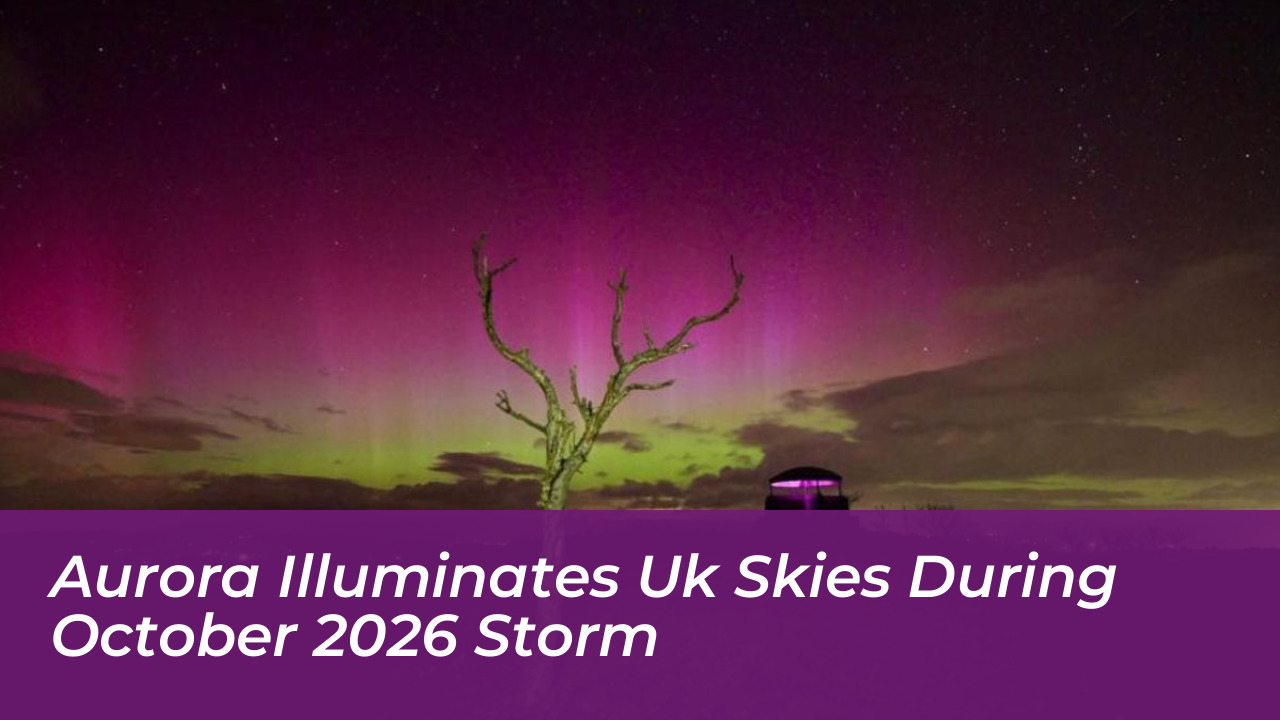

Residents across the United Kingdom witnessed vivid aurora displays on Saturday, 10 October 2026. Strong solar activity triggered a geomagnetic storm that pushed the Northern Lights far south across the country. Sky-watchers from Scotland down to regions as far south as Devon, Hampshire, Kent, Pembrokeshire, and Brecon reported striking colored light emissions.
The Met Office indicated that clear skies could allow further sightings to continue until Tuesday, 13 October 2026. Meanwhile, the US Space Weather Prediction Center confirmed that a coronal mass ejection (CME) arrived at Earth on 10 October, producing G2 moderate geomagnetic storm conditions.
The Solar Event and Geomagnetic Activity
The solar event was caused by coronal mass ejections erupting from the Sun, sending streams of charged particles hurtling through space toward Earth. When these high-energy particles interact with the planet’s magnetic field and upper atmosphere, they collide with oxygen and nitrogen molecules. This creates the luminous colored light displays known as aurorae.
The US Space Weather Prediction Center reported a G2-class geomagnetic storm. While categorized as moderate, this level of activity is strong enough to enhance auroral visibility across mid-latitudes. The UK Met Office noted that two glancing coronal mass ejections followed by a high-speed coronal hole stream combined to bring a daily chance of enhancing the auroral oval over the region.
- Coronal Mass Ejections (CMEs): Large expulsions of plasma and magnetic field from the Sun’s corona.
- Geomagnetic Storm (G2 Scale): Moderate level storm capable of pushing aurora displays further toward the equator.
- Atmospheric Interaction: Charged particles colliding with gases at 100 to 400 kilometers altitude, producing green, red, and violet hues.
Visibility and Where the Northern Lights Appeared
The aurora belt naturally occurs closer to high-latitude regions such as Norway, Iceland, and Greenland. However, moderate to strong geomagnetic storms frequently push the phenomenon far enough south to be visible from the UK. During Saturday’s peak, lucky residents in areas well south of the usual viewing zones-including Devon, Hampshire, and Kent in England, alongside parts of Wales-enjoyed clear views to the northern horizon.
Observers in rural areas experienced the most striking views. Light pollution severely washes out faint atmospheric phenomena. Stargazers who traveled to high ground, hills, and dark countryside locations away from urban centers secured the clearest glimpses of the natural spectacle.
Expert Tips for Observing and Photographing the Aurora
Space weather agencies and astronomy platforms emphasize that catching the Northern Lights requires specific environmental conditions and timing:
- Dark Horizons: Seek out locations with an open, unobstructed view toward the northern horizon, completely free from local light pollution.
- Timing: While solar storms do not strictly follow a schedule, peak activity often concentrates between 22:00 and 02:00 local time.
- Camera Sensitivity: Modern digital cameras and smartphone night modes gather light over several seconds. They often capture vivid green and red tones that human eyes perceive only as faint gray veils.
- Weather Check: Clear, cloudless skies remain an absolute prerequisite for successful ground-based observation.
As Solar Cycle 25 maintains higher-than-average activity levels through late 2026, forecasters advise keeping a close watch on real-time alerts from the Met Office Space Weather Operations Centre and the NOAA Space Weather Prediction Center for any subsequent windows of geomagnetic activity.
Frequently Asked Questions About UK Aurora Sightings
Can you regularly see the Northern Lights in the UK?
Yes, particularly during the peak years of the 11-year solar cycle. While vivid displays visible to the eye require moderate to strong geomagnetic storms, active years bring multiple opportunities across northern and central regions.
What causes the different colors in the aurora?
The colors depend on which atmospheric gases are struck by solar particles and at what altitude. Oxygen colliding lower down glows green, higher-altitude oxygen glows red, and nitrogen produces violet-blue shades.
Do I need a telescope to view the Northern Lights?
No. Telescopes are counterproductive because aurorae span vast areas of the night sky. The display is best enjoyed with the eye or captured using a wide-angle camera or smartphone set to night mode.
How do I know when a geomagnetic storm is happening?
You can track live planetary K-index readings and official forecasts through the Met Office Space Weather Operations Centre or the NOAA Space Weather Prediction Center website and mobile applications.
Why did the camera see color when my eyes saw gray?
Human night vision has poor color sensitivity in low light, making faint aurorae appear as pale, milky arcs. Long-exposure camera settings accumulate photons over time, revealing the rich reds and greens hidden to direct human sight.