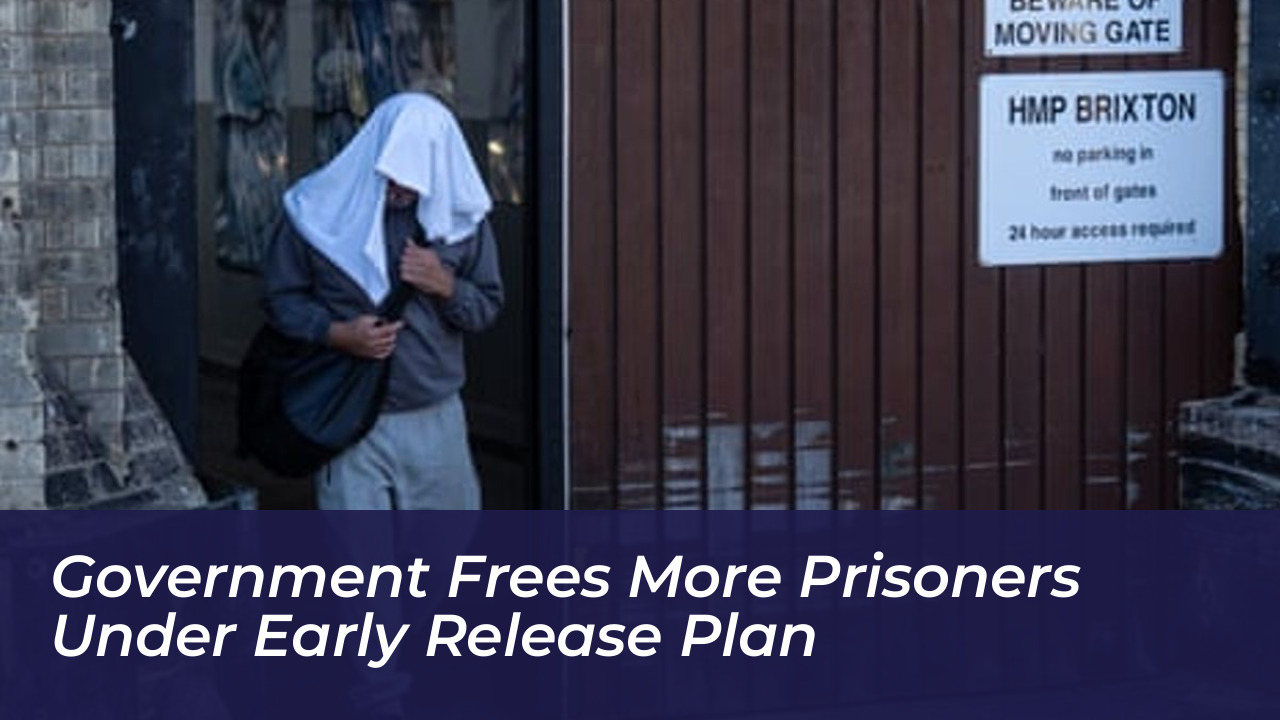

England and Wales have initiated a second phase of early prisoner releases, with approximately 650 offenders leaving jail to help alleviate severe prison overcrowding pressures. The Ministry of Justice confirmed that the measure addresses ongoing capacity strains across the male prison estate while ensuring that released offenders remain subject to strict community monitoring conditions.
Details of the Second Release Phase
The latest group of released individuals includes offenders serving fixed sentences of up to two and a half years. Under the government’s revised early release structure, these inmates are permitted to leave custody after serving one-third of their sentence behind bars, rather than the standard half. This follows an initial wave on October 1, which saw approximately 700 prisoners walk free after serving sentences of less than 19 months.
According to Ministry of Justice data cited by the Guardian, the total prison population in England and Wales stood at 87,499. Government projections indicate that around 2,000 offenders are scheduled to leave prison during the month of October alone, with another 3,000 releases planned in stages over the following year to prevent facilities from running out of cells entirely.
Background and Overcrowding Pressures
The early release scheme was introduced to combat a severe capacity crisis driven by long-term trends of courts jailing more criminals than the number being released, alongside delays in expanding prison infrastructure. Prisons in England and Wales have operated near 97% capacity, leaving only about 1,500 available beds across the male estate prior to the implementation of the new policy.
Prime Minister Andy Burnham’s government adjusted the initial rollout schedule to exclude specific high-harm offences from the programme. Prisoners convicted of manslaughter, death by dangerous driving, serious child s*xual offenses, and grooming-related crimes remain completely barred from early release, preserving their original release dates.
Community Supervision and Monitoring Conditions
Offenders who leave prison early under the progression model do not have their total sentence reduced. Instead, they serve the remainder of their fixed term in the community on licence. The Ministry of Justice has emphasized that these individuals will be monitored under stringent supervision rules, which heavily feature electronic tagging and new technological tools designed to give probation officers near-live tracking capabilities.
Despite these safeguards, the expanded release schedule has created friction within the criminal justice system. The probation union Napo has raised significant concerns regarding staff workloads and officer retention. Union members have engaged in pre-ballot meetings regarding potential industrial action over pay and operational pressures as thousands of additional individuals transition from custody into community oversight.
Future Timeline and Sentence Adjustments
The phased release schedule will continue over the coming months, progressively encompassing offenders serving increasingly longer sentences. Tranches are scheduled to include individuals serving up to three years and two months, four years and three months, and ultimately culminating by next June with fixed-term inmates serving more than 12 years.
In tandem with the release scheme, the government is pursuing parallel reforms within the criminal court system and investing £110 million to convert underutilized spaces within existing prisons-such as storage rooms and offices-into additional operational cells. Ministers maintain that these combined measures are vital to stabilizing the penal system while long-term prison-building programmes work toward delivering thousands of additional spaces by 2030.
Frequently Asked Questions
Why is the government releasing prisoners early?
Prisons in England and Wales are operating near maximum capacity, leaving very few spare cells. The early release scheme prevents facilities from running completely out of space, which would otherwise disrupt courts and policing.
Which prisoners are eligible for the early release scheme?
Adults serving standard determinate sentences (fixed terms) become eligible to leave custody after serving one-third of their sentence instead of the traditional halfway point, depending on the length of their sentence tranche.
Which offences are excluded from early release?
The government explicitly bars prisoners convicted of murder, manslaughter, death by dangerous driving, serious child s*xual offenses, and grooming from participating in the early release scheme.
What happens to prisoners after they are released?
Released offenders serve the remainder of their sentence on licence in the community. They are subject to strict monitoring conditions, including mandatory electronic tagging and curfews, and can be immediately recalled to prison if they breach the rules.
How many prisoners are expected to be released?
Roughly 4,500 prisoners are scheduled to be released in phased tranches over a nine-month period following the launch of the permanent sentencing adjustments.