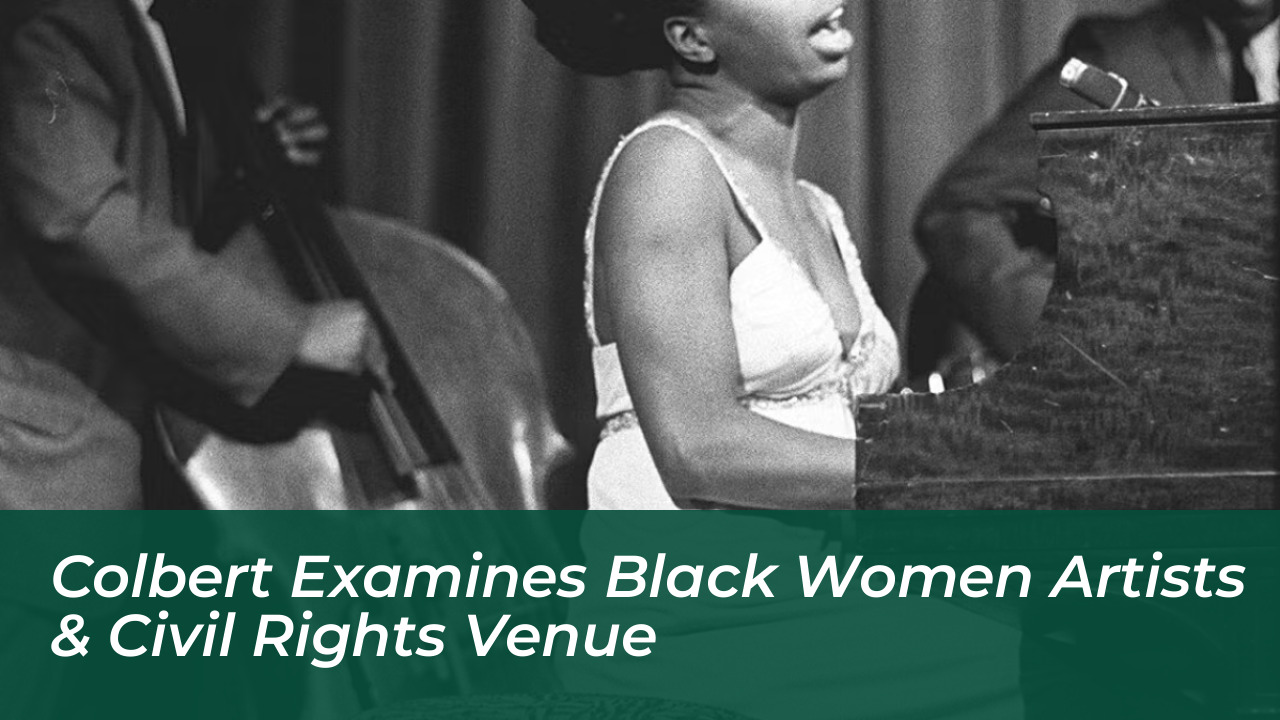

In her book Freedom’s Gate, author and Georgetown interim provost Soyica Diggs Colbert examines how five prominent Black women artists developed their political voices and profoundly influenced the civil rights movement. Centered around the legendary Village Gate nightclub in Greenwich Village, New York, the study highlights the venue’s vital cultural role during the late 1950s and 1960s.
Published by W.W. Norton on October 13, 2026, the 384-page book utilizes letters, journalism, scholarship, and artistic records to explore the lives and careers of Maya Angelou, Lorraine Hansberry, Abbey Lincoln, Miriam Makeba, and Nina Simone. Colbert presents these women not merely as entertainers, but as emerging artists and activists whose ideas flourished alongside prominent cultural figures such as Harry Belafonte, Max Roach, Malcolm X, and James Baldwin.
The Village Gate as a Haven for Black Art and Activism
Situated at 160 Bleecker Street, Art D’Lugoff’s Village Gate operated from 1959 to 1969, serving as a vital hub for desegregated audiences, high-quality music, and political advocacy. Colbert notes that this period marked an unparalleled era of political, artistic, and social transformation for Black creators, providing a supportive space for marginalized women in the entertainment industry.
The venue offered a stage where these artists could express spirited, revolutionary views despite facing individual challenges, including domestic violence, mental and physical illness, and systemic racism. As Colbert writes in the book, the women depended on one another to navigate industries and social movements that often failed to understand or welcome them.
Biographical Overview of the Five Artists
Freedom’s Gate functions as a collective biographical study, detailing the formative years and artistic pivots of its five main subjects:
- Maya Angelou: Born Marguerite Ann Johnson in St. Louis, Missouri, Angelou studied dance and theater at the California Labor School before transitioning to the written and spoken word, ultimately writing her groundbreaking memoir, I Know Why the Caged Bird Sings.
- Lorraine Hansberry: Arriving in New York City at age twenty, Hansberry wrote essays and worked for Paul Robeson’s newspaper, Freedom, before drawing inspiration from women-led civil rights groups to write her acclaimed play, A Raisin in the Sun.
- Abbey Lincoln: Born Anna Marie Wooldridge in Chicago, Lincoln established herself as a jazz singer and actress, eventually adopting her new name to position herself for explicitly political art alongside drummer Max Roach.
- Miriam Makeba: Hailing from Johannesburg, South Africa, Makeba was mentored by Harry Belafonte after moving to the United States, introducing white audiences to the beauty and political power of her traditional African music.
- Nina Simone: Born Eunice Kathleen Waymon, Simone trained as a classical pianist before pivoting to jazz and blues. Facing racial barriers in classical institutions, she channeled her experiences into powerful civil rights anthems like “Mississippi Goddam.”
Frequently Asked Questions
What is the main focus of Soyica Diggs Colbert’s Freedom’s Gate?
The book examines the early careers and political activism of five Black women artists-Maya Angelou, Lorraine Hansberry, Abbey Lincoln, Miriam Makeba, and Nina Simone-and their connection to the Village Gate nightclub in New York City during the 1950s and 1960s.
What was the Village Gate?
The Village Gate was an influential concert venue and nightclub opened by Art D’Lugoff at 160 Bleecker Street in Greenwich Village, operating from 1959 to 1994, with its peak civil rights era activity spanning the 1960s.
Who are the five artists featured in the book?
The featured artists are Maya Angelou, Lorraine Hansberry, Abbey Lincoln, Miriam Makeba, and Nina Simone.
When was Freedom’s Gate published?
Freedom’s Gate was published by W.W. Norton on October 13, 2026.
Who is the author of Freedom’s Gate?
The book was written by Soyica Diggs Colbert, a scholar, author, and interim provost at Georgetown University.