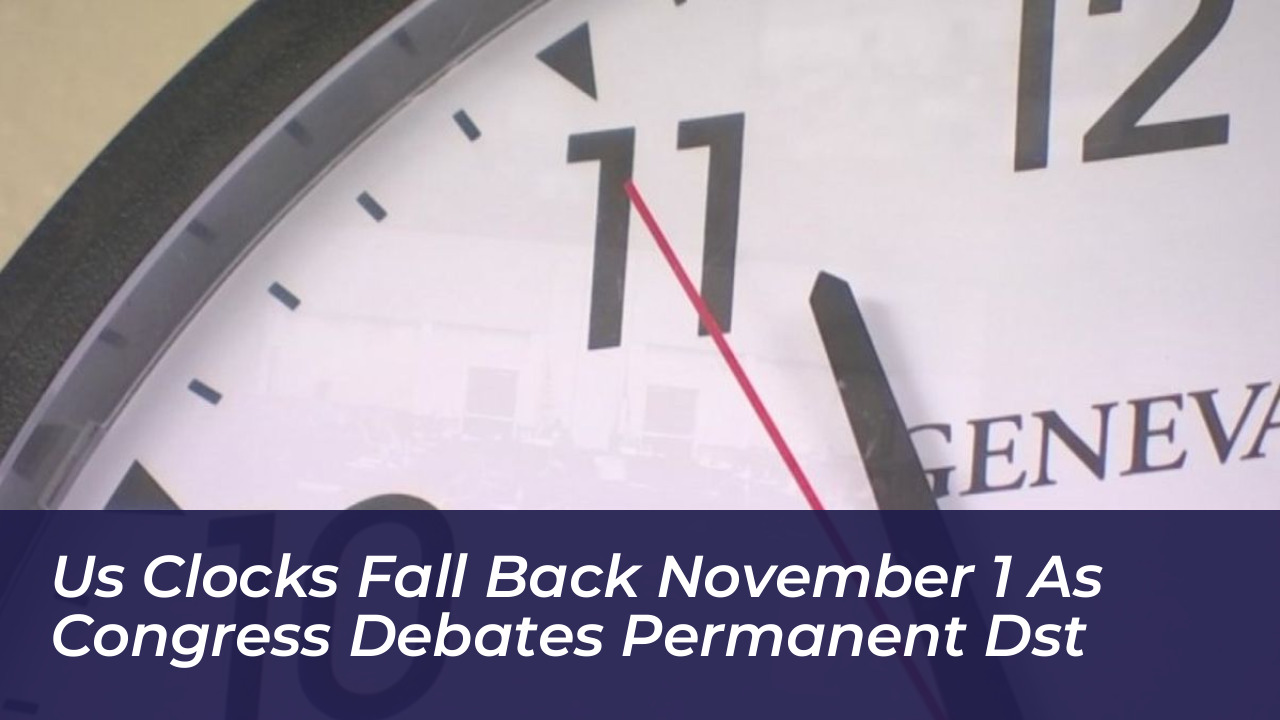

Millions of Americans will turn their clocks back one hour on November 1, 2026, as daylight saving time officially ends and standard time returns across most of the United States. Under the long-standing Uniform Time Act of 1966, this seasonal change occurs at 2:00 a.m. local time, granting residents an extra hour of sleep while shifting sunsets earlier into the evening hours. This routine transition arrives amidst an intense legislative stalemate in Washington, where Congress continues to debate the merits of adopting permanent daylight saving time through the Sunshine Protection Act.
Although the U.S. House of Representatives passed the Sunshine Protection Act (H.R. 139) by a bipartisan vote of 308-117 on July 14, 2026, the legislation has faced significant hurdles in the Senate. Senate leaders, including Majority Leader John Thune (R-S.D.), have questioned whether sufficient votes exist to reach the 60-vote threshold required to advance the measure. With the Senate managing a packed legislative calendar and scheduled recesses, lawmakers have not brought the bill to the floor for a vote, ensuring that the November 1 clock change remains firmly on schedule.
The Legislative Battle Over the Sunshine Protection Act
The push to eliminate twice-yearly clock changes has garnered vocal backing from political figures, most notably President Donald Trump, who has urged senators to approve the legislation and put an end to the shifting time standard. Proponents of permanent daylight saving time argue that keeping the clocks forward year-round eliminates the public inconvenience of the semi-annual transition, reduces evening crime rates by providing extra daylight after standard working hours, and benefits retail, tourism, and recreation industries.
However, regional opposition and profound medical concerns have created a deep legislative divide. Lawmakers representing northern states, rural communities, and the western edges of time zones have expressed strong resistance, warning that year-round daylight saving time would plunge winter mornings into prolonged darkness. In cities like Chicago, where sunset on November 1 is projected at 4:44 p.m., adopting a permanent later schedule would push morning sunrises well past 8:00 a.m. for weeks on end, creating hazardous conditions for children walking to school and early-morning commuters.
Medical and Scientific Objections to Permanent DST
While patient advocacy groups and sleep medicine organizations agree that ending the twice-yearly transition is necessary, major medical bodies-including the American Medical Association (AMA), the American Academy of Sleep Medicine (AASM), and the National Sleep Foundation-strongly endorse permanent standard time rather than permanent daylight saving time.
Chronobiologists explain that human biological clocks are synchronized primarily by morning light, which triggers a natural cortisol surge and resets the suprachiasmatic nucleus in the hypothalamus. Shifting the social clock permanently forward misaligns human biology with the natural solar cycle, a chronic state known as social jet lag. Researchers have linked this ongoing misalignment to adverse health outcomes, including metabolic disorders like type 2 diabetes, cardiovascular strain, mental health challenges, and diminished cognitive performance.
Historical Precedent: The 1974 Experiment
Opponents of permanent daylight saving time frequently point to historical precedent to caution against hasty federal action. In January 1974, Congress enacted year-round daylight saving time as an emergency energy-conservation measure during the Arab oil embargo. Initially popular, the policy quickly soured as families experienced frigid, pitch-black winter mornings. Public backlash was so severe that Congress repealed the measure before it completed a full year in effect, restoring standard time by October 1974.
Today, a competing bipartisan bill, the Sunshine for Our Kids Act, advocates for establishing permanent standard time instead, aligning with the recommendations of sleep researchers who emphasize the vital importance of morning sunlight for physical and psychological health.
What Americans Should Expect on November 1
Absent sudden and unexpected legislative action by the Senate before November 1, 2026, residents across nearly all fifty states should prepare to adjust their timepieces:
- When to Change Clocks: Turn clocks back one hour from 2:00 a.m. to 1:00 a.m. on Sunday, November 1, 2026. Setting clocks back before going to sleep on Saturday, October 31 (Halloween), ensures correct time upon waking.
- Automatic Devices: Smartphones, computers, smart speakers, and digital network-connected devices will update automatically. Traditional wall clocks, wristwatches, and vehicle dashboards will require manual adjustment.
- Exempt Regions: Hawaii and most of Arizona (excluding the Navajo Nation), along with U.S. territories including Puerto Rico, Guam, American Samoa, the U.S. Virgin Islands, and the Northern Mariana Islands, do not observe daylight saving time and will remain on standard time.
As the autumn season progresses, daylight hours will continue to dwindle until the winter solstice, while the national debate over how the United States tracks time persists with no immediate resolution in sight.
Frequently Asked Questions
When do the clocks fall back in 2026?
Clocks fall back one hour on Sunday, November 1, 2026, at 2:00 a.m. local time, returning most of the United States to standard time.
Did Congress pass the bill to stop changing clocks?
The U.S. House of Representatives passed the Sunshine Protection Act on July 14, 2026, but the legislation remains stalled in the Senate Committee on Commerce, Science, and Transportation without a scheduled floor vote.
Why do sleep doctors oppose permanent daylight saving time?
Medical organizations argue that permanent daylight saving time causes chronic circadian misalignment by delaying morning sunlight, which increases risks for metabolic disease, cardiovascular stress, and sleep deprivation.
Do all states observe daylight saving time?
No. Hawaii and Arizona (except for the Navajo Nation) do not observe daylight saving time, maintaining standard time year-round alongside U.S. territories.
What happens if the Senate does not act before November 1?
If Congress fails to pass legislation and secure a presidential signature prior to November 1, the scheduled time change will proceed as mandated by the Uniform Time Act of 1966.