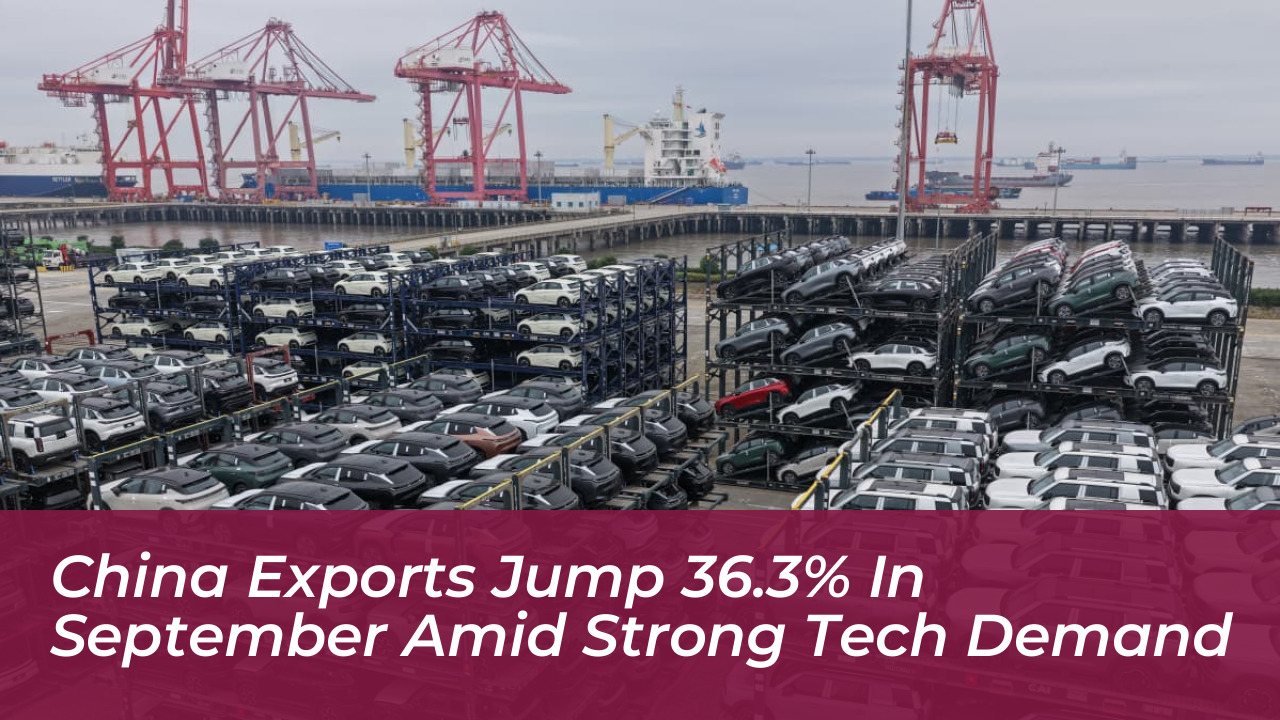

China’s international trade expanded sharply in September 2026. This growth was driven by accelerating overseas demand for artificial intelligence-related goods, semiconductors, and automobiles. Official data released Wednesday by customs authorities showed that exports increased by 36.3 percent from a year earlier, easily surpassing market forecasts and marking the fastest pace of growth since February.
The robust trade figures arrived as a welcome boost for policymakers in Beijing. They helped offset persistent weakness in domestic consumer spending and property markets. The strong economic performance keeps the world’s second-largest economy on track to meet its annual gross domestic product growth target of 4.5 percent to 5 percent.
Imports and Trade Surplus Reach Record Highs
Alongside the surge in outbound shipments, China’s imports recorded their strongest growth since June, jumping 31 percent in September. This figure accelerated from August’s 28.2 percent growth rate. It comfortably exceeded Reuters poll estimates, which had projected import growth of 24.5 percent and export growth of 25.5 percent.
According to Hao Zhou, head of research and chief economist at Guotai Junan International Holdings, China’s monthly trade surplus reached a record high of $133.5 billion. Customs data accessed through Wind Information revealed that cumulative trade figures placed the total trade surplus at $938.11 billion for the first nine months of the year. This puts the manufacturing powerhouse on course to surpass $1 trillion for the full year.
Global Tech Demand and Bilateral Trade Dynamics
The global build-out of artificial intelligence infrastructure remained a primary driver behind the trade data. It sustained heavy demand for Chinese-made technology products and advanced semiconductors. Customs statistics indicated that exports to the United States grew by 39.6 percent in September. This growth outpaced overall export growth and contributed to the highest monthly surplus with Washington since January 2025.
The positive momentum comes in the wake of high-level diplomatic engagements. In September, President Xi Jinping met with U.S. President Donald Trump in Washington. They secured an extension to their tariff truce alongside an agreement to reduce tariffs on $30 billion worth of goods from each nation. Conversely, trade relations with Europe face upcoming adjustments. A recent preliminary agreement with the European Union aims to limit Chinese hybrid vehicle exports to the bloc, a measure expected to be finalized in December.
Economic Policy and Future Outlook
Despite the stellar headline figures, the broader economic recovery remains uneven. Separate data released alongside the trade reports indicated that China’s factory-gate prices rose at their fastest pace in over four years, while consumer inflation edged up slightly but missed consensus expectations.
Western economies continue to scrutinize Beijing’s industrial output and monetary policies, alleging that trade surpluses are artificially maintained. In response, China’s central bank defended its exchange-rate framework. It issued a policy statement rejecting accusations of competitive depreciation or intentional currency weakening.
With manufacturing activity supported by external markets, attention now turns to domestic trade events, including the opening of the Canton Fair. The massive trade exhibition launched on Thursday, giving domestic manufacturers a platform to display their products to thousands of international buyers as exports cement their role as China’s primary economic engine.