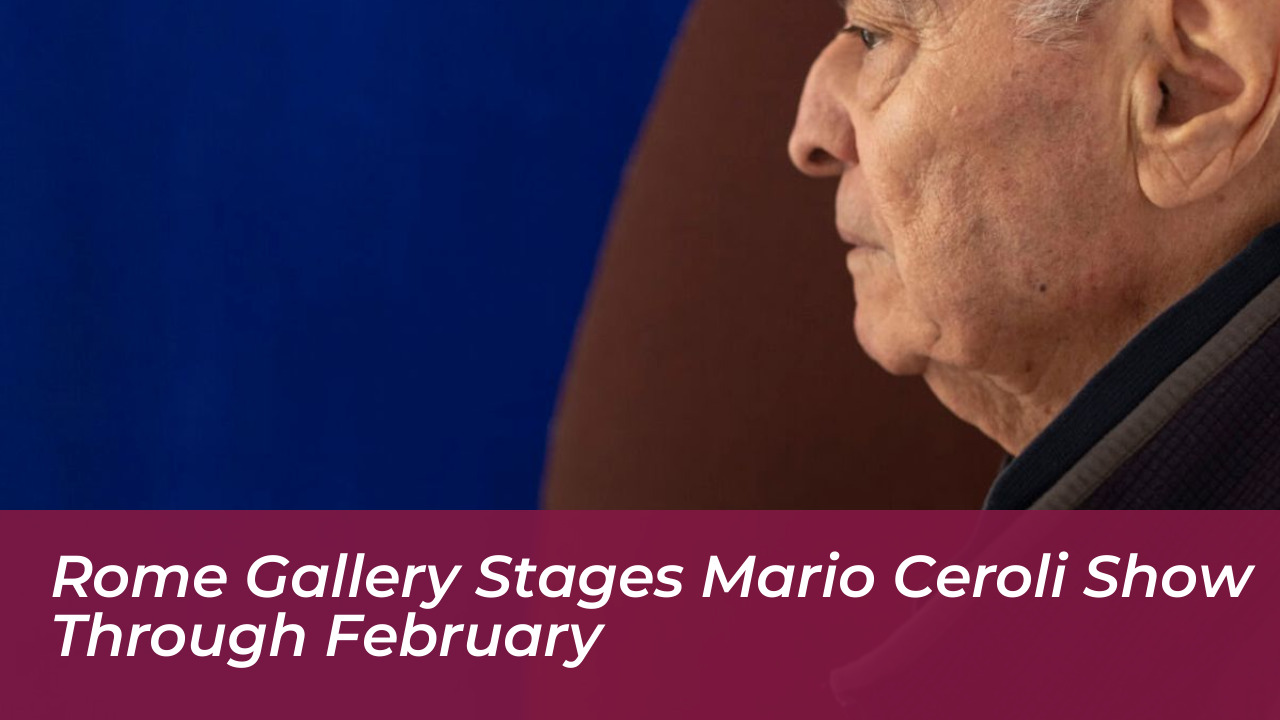

Renowned Italian sculptor and set designer Mario Ceroli has returned to a private gallery space in Rome after more than 20 years. The exhibition, titled {IO}, is currently on display at 21Art Roma, located at Largo della Fontanella di Borghese. Running from October 15, 2026, to February 5, 2027, the monographic show brings together 15 works. These pieces trace how the 88-year-old artist revisits earlier ideas using new materials and site-specific installations.
Curated by Cesare Biasini Selvaggi, the exhibition is designed to function as a theatrical stage rather than a traditional career inventory. Most of the featured pieces were created in 2026. They offer visitors a fresh perspective on Ceroli’s enduring engagement with space, memory, and theatrical display.
Central Works and Reimagined Materials
At the conceptual center of the exhibition is Un anno d’amore, a major 2026 installation composed of 987 metal elements. This piece evolves directly from a 1972 work originally built in wood. That earlier version contained 365 squares-one for each day of the year-plus a single element for the title. By shifting from wood to metal, Ceroli transforms the calendar into an affective accounting system detached from ordinary arithmetic.
Other notable pieces include L’architetto, a 2026 reworking of the 1965 piece Curvilinee e squadra, and Labirinto, an immersive environment comprising 50 distinct elements. The exhibition also features Le campane di Trinità dei Monti, a monumental composition crafted from iron, colored earths, and wood that engages directly with Rome’s urban memory.
Another deeply personal work in the show is Pensiero a Fabrizio De André (2024). Created from wood and colored earths, the sculpture stems from the memory of a guitar given to Ceroli by the late Genoese singer-songwriter, which was later stolen. Rather than relying on anecdote, the piece translates absence directly into physical form.
A Journey Across Seven Decades of Art
Born in Castel Frentano in 1938, Mario Ceroli arrived in Rome at a young age. He became a central figure in the city’s artistic landscape during the 1960s, associated with the Piazza del Popolo circle and Galleria La Tartaruga. Over a career spanning seven decades, he has transitioned from ceramics to wood. He has pioneered sculptures that replace rigid volume with the mobility of outlines and silhouettes.
The current exhibition at 21Art Roma builds on recent high-profile institutional projects. These include retrospectives at Palazzo delle Esposizioni, Palazzo Citterio in Milan, and the Galleria Nazionale d’Arte Moderna e Contemporanea (GNAM), alongside site-specific installations in Treviso and Jesolo.
Exhibition Details
- Exhibition Title: Mario Ceroli {IO}
- Venue: 21Art Roma, Largo della Fontanella di Borghese, Rome
- Dates: October 15, 2026 – February 5, 2027
- Curator: Cesare Biasini Selvaggi
- Hours: Monday to Saturday, 10:00 AM – 7:30 PM (with special holiday openings)
Frequently Asked Questions About Mario Ceroli’s {IO} Exhibition
Where is the Mario Ceroli {IO} exhibition located?
The exhibition is hosted at 21Art Roma, situated at Largo della Fontanella di Borghese in Rome. This marks the artist’s return to a private Roman gallery after more than two decades.
When can visitors view the exhibition?
The show runs from October 15, 2026, through February 5, 2027. Regular viewing hours are Monday through Saturday between 10:00 AM and 7:30 PM.
Who is the curator of the exhibition?
The exhibition is curated by art critic Cesare Biasini Selvaggi, who has collaborated extensively on previous monographic projects with Mario Ceroli.
What is the central artwork of the exhibition?
The conceptual centerpiece is Un anno d’amore (2026), an installation made of 987 metal elements that reinterprets a 1972 wooden calendar piece created by the artist.
What materials feature prominently in the new works?
Alongside his signature wood and newly introduced metal elements, the exhibition makes striking use of the color blue. This shade is achieved through natural coloring earths sourced from Verona to unify the spatial layout.