
When fresh batteries fail to power a TV controller, the underlying problem is rarely the power cells themselves. Instead, repeated battery swaps gradually stretch the internal metal contact springs, creating microscopic gaps that cut off the electrical circuit entirely. Because household remotes endure frequent handling and drops, their internal battery compartments degrade faster than most consumer electronics. Placing a small piece of folded aluminum foil between a loose battery spring and the cell instantly restores power to an unresponsive TV controller without requiring an expensive replacement.
The Hidden Cause Behind Failed Remote Battery Terminals
Every time you replace the cells inside a remote control, the negative terminal spring compresses and rebounds. Over time, that coil loses its structural elasticity and remains partially compressed against the compartment wall. Once tension diminishes, the battery terminal stops resting firmly against the metal plate.
This micro-separation prevents electricity from reaching the remote’s main circuit board. Many consumers mistakenly assume the device has completely died or that their brand-new cells are defective, leading to unnecessary electronic waste. A loose battery spring breaks the continuous electrical circuit, mimicking the symptoms of a dead device even when equipped with brand-new batteries.
Mechanical Wear Versus Electrical Failure
The common misconception is that unresponsive buttons point to failed internal chips or dead transmitters. In reality, the issue is purely mechanical. Restoring physical pressure against the terminal instantly re-establishes the pathway needed for current to reach the board. When tension drops, the remote either cuts out intermittently or requires aggressive button mashing to register a signal.
How Folded Aluminum Foil Bridges the Gap
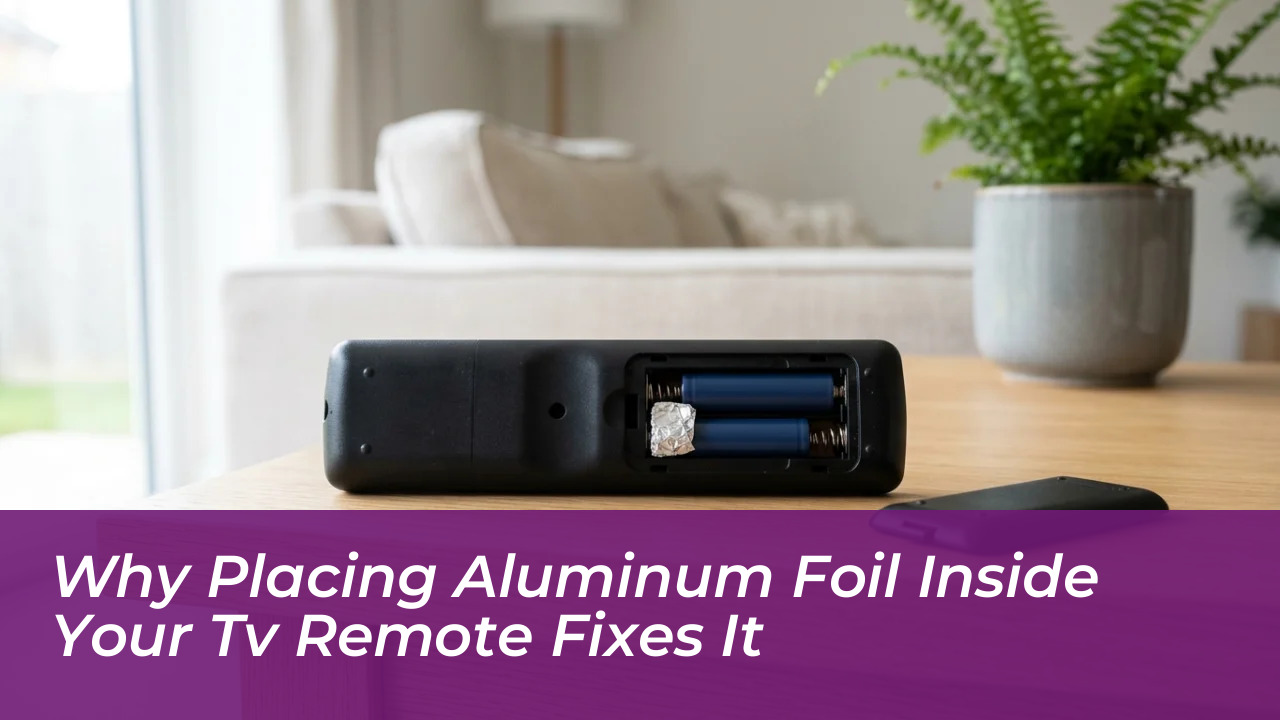
Aluminum is an exceptional electrical conductor. When folded into a dense pad, it functions as a conductive shim that increases physical pressure while preserving the pathway for electrical current. Rather than discarding the unit or ordering an expensive replacement, a simple household metal insert bridges the gap and stabilizes the current for months.
To execute this DIY fix correctly, follow these step-by-step instructions:
- Size it accurately: Tear a scrap of aluminum foil roughly the size of a fingernail.
- Fold for thickness: Fold the foil in half or quarters until it creates a small, firm pad with noticeable resistance.
- Clean before inserting: Wipe the compartment contacts with a clean, dry cloth to strip away accumulated dust and debris.
- Position the shim: Slide the folded foil directly between the negative end of the battery and the weakened metal spring, ensuring the compartment door can still snap shut securely.
A shim that is folded too thin will fail to create adequate pressure, while one that is excessively thick can prevent the battery compartment door from clicking shut.
Tackling Corrosion with Household Vinegar
If inserting an aluminum foil remote shim fails to revive the connection, examine the metal coils closely for signs of a greenish-white residue. This coating indicates chemical corrosion caused by past battery leakage rather than simple mechanical loosening. Corrosion forms an insulating barrier that blocks the flow of electricity even under strong physical pressure.
To remove it safely, dip a cotton swab in a small amount of household vinegar and gently rub the corroded spring. The mild breaks down the alkaline deposits cleanly without damaging delicate internal components, restoring a pristine contact surface at virtually zero cost.
Quick Reference Guide for Remote Battery Fixes
Use the following breakdown to match your remote control symptoms with the correct household remedy:
- Symptom: Loose or stretched terminal spring. Solution: Folded aluminum foil shim between cell and contact.
- Symptom: Greenish-white crust or residue build-up. Solution: Cotton swab lightly dampened with household vinegar.
- Symptom: Intermittent button response after drop. Solution: Re-tension spring and check foil placement.
Try this foil technique the next time your remote acts up before tossing it in the trash. Have you ever restored a faulty household gadget using a simple DIY fix? Leave your thoughts in the comments below and share your results.
Frequently Asked Questions
Why does aluminum foil fix an unresponsive TV remote?
Aluminum foil acts as a conductive shim that bridges the gap created when stretched battery terminal springs lose their tension, restoring the electrical circuit.
Can aluminum foil replace a dead battery?
No. Aluminum foil only addresses mechanical connectivity issues caused by loose springs or minor gaps. It cannot generate electrical power if the battery itself is completely dead.
Is it safe to use aluminum foil inside electronic devices?
Yes, when used strictly as a spacer to bridge loose battery contacts, aluminum foil is safe and acts as a strong electrical conductor.
How thick should the folded foil shim be?
The foil should be folded into a small pad roughly the size of a fingernail with enough thickness to restore pressure, but thin enough to allow the battery door to close fully.
What should I do if my remote has battery corrosion?
Clean away any white or green powdery residue using a cotton swab lightly dampened with household vinegar before attempting any foil adjustments.