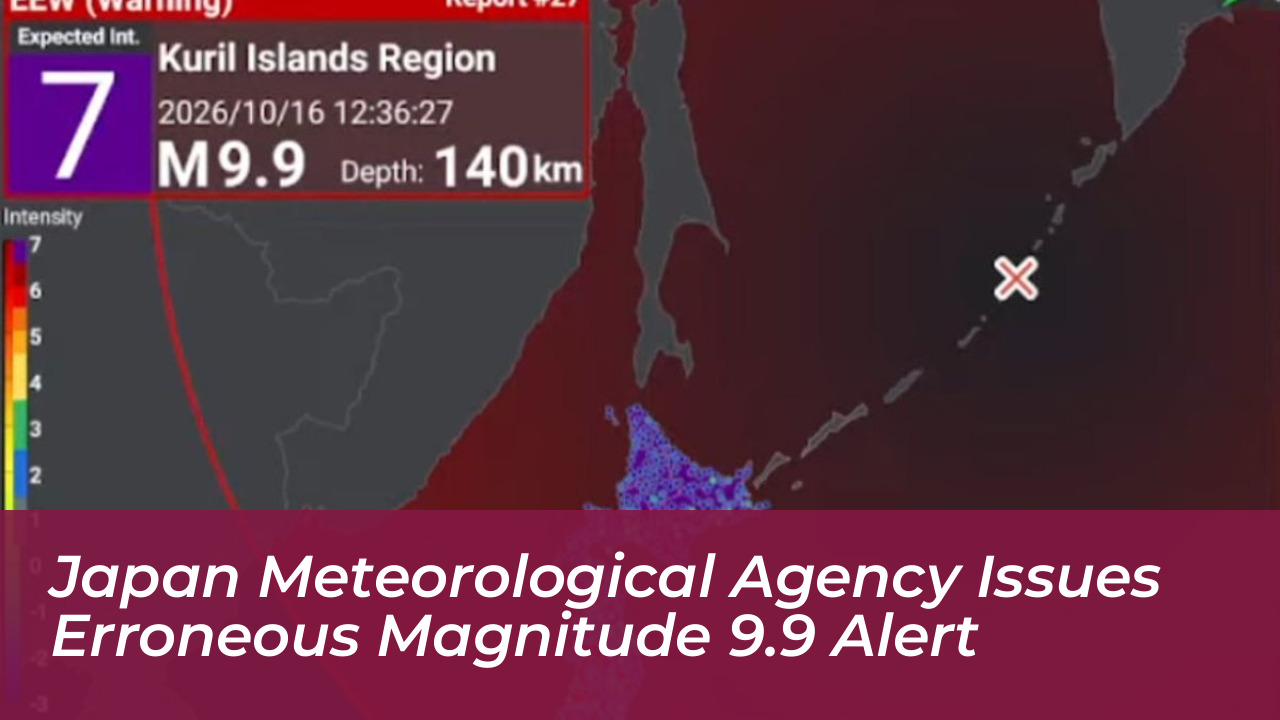

Japan’s Meteorological Agency (JMA) mistakenly issued an emergency early warning estimating a catastrophic magnitude 9.9 earthquake and forecasting strong shaking across much of the country. The false alert was triggered by a genuine magnitude 6.9 earthquake that struck near Russia’s Kamchatka Peninsula.
The erroneous alert went out at approximately 12:36 p.m. Friday in Japan, prompting widespread concern before officials successfully canceled it just 12 minutes later at 12:48 p.m., according to public broadcaster NHK. The automated warning predicted severe shaking across northern and central Japan, including the densely populated Tokyo metropolitan region.
Details of the Erroneous JMA Alert
According to early-warning display logs, the automated system incorrectly identified the Kuril Islands region as the epicenter location. It estimated a monumental magnitude of 9.9 at an operational depth of 140 kilometers (87 miles).
However, public safety officials confirmed that the warning was not followed by any actual ground shaking in Japan, and no tsunami advisories or warnings were issued. The Japan Meteorological Agency has formally stated that it will launch an immediate investigation into the technical error that caused the extreme overestimation.
Comparison With Actual Seismic Activity
Data provided by the U.S. Geological Survey (USGS) measured the actual earthquake at a significantly lower magnitude of 6.9. The USGS placed the true epicenter approximately 76 kilometers (47 miles) northeast of Ozernovskiy, Russia, with an estimated depth of 143.2 kilometers (89 miles)-remarkably close to the depth figure generated by Japan’s erroneous early system.
Seismological experts noted the extreme nature of the computational error:
- A magnitude 9.9 earthquake would rank as the largest seismic event ever scientifically recorded globally.
- It would easily exceed the historical magnitude 9.5 earthquake that struck Chile in 1960, which currently holds the record for the most powerful instrumentally recorded earthquake.
- According to energy release calculations by the USGS, a magnitude 9.9 quake would release roughly 32,000 times as much energy as the actual magnitude 6.9 earthquake that shook the Kamchatka region.
Japan’s Earthquake Early Warning System
Japan operates one of the most advanced earthquake early warning systems in the world, designed to detect primary seismic waves (P-waves) and alert the public seconds to minutes before destructive secondary waves (S-waves) arrive. The system is programmed to rapidly calculate magnitude and location to automatically trigger public transit shutdowns, elevator safety protocols, and mobile phone alerts.
While false alarms are rare, sudden shifts or overlapping seismic signals from neighboring tectonic zones like the Kuril-Kamchatka trench can occasionally confuse automated processing algorithms. JMA officials have assured the public that they are examining the software logs to prevent similar high-scale miscalculations in the future.