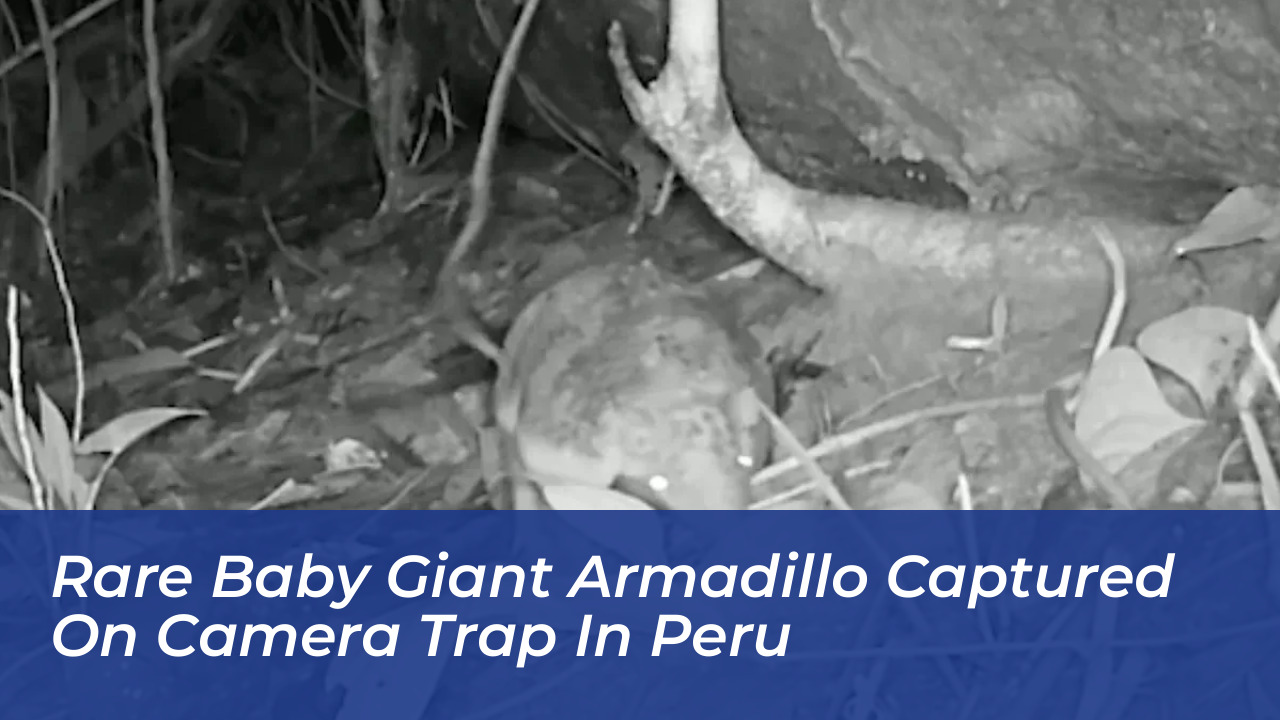

A camera trap operated by Amazon Research Internacional has recorded a rare baby giant armadillo in the Native Community of San Francisco in Loreto, Peru. This exciting discovery highlights an important conservation area for one of the Amazon’s most elusive and difficult mammals to document in the wild.
The groundbreaking footage was captured as part of an ongoing project dedicated to documenting endangered mammals in the Peruvian Amazon. To achieve this, Amazon Research Internacional utilized traditional Indigenous knowledge combined with a strategically limited number of camera traps to locate wildlife across the region.
“Giant armadillos are amongst the most difficult animals to see on a camera-trap,” said Rosa Vásquez Espinoza, conservationist and founder of Amazon Research Internacional. “People can spend over a year with hundreds of cameras to try to get a single clip. We’ve been able to do it in a short period, with very limited cameras, based on the Indigenous knowledge with our Indigenous colleagues.”
The Ecological Importance of Giant Armadillos
As the largest armadillo species in the world, the giant armadillo plays a critical ecosystem role. Their massive underground burrows are frequently utilized by numerous other Amazonian species for vital shelter and feeding grounds.
Despite their ecological significance, giant armadillos face severe pressures. They reproduce only every three years and produce very small litters. , populations are increasingly threatened by rampant rainforest fragmentation and illegal hunting.
The newly captured footage of the baby giant armadillo emphasizes this specific part of the Peruvian Amazon as a critical space for wildlife conservation. The region is already being actively protected through local monitoring initiatives focused on stingless bees and their nesting trees. These tiny pollinators indirectly help secure the preservation of larger umbrella species like the giant armadillo.
Pushing for Local Conservation Laws
Amazon Research Internacional plans to use this newly acquired footage as compelling evidence to spearhead the introduction of a local law in Loreto. This proposed legislation calls for the formal protection of the giant armadillo and other large mammals currently listed on the IUCN Red List, which serve as crucial indicators of overall forest health in the Amazon basin.
The organization previously helped introduce a similar protective law in Satipo, located within the Junín province in the central Amazon rainforest of Peru.
“Seeing a baby giant armadillo is not something we ever dreamed of, and it just happened to be there with his little baby little fingers and just being playful,” Vásquez Espinoza reflected. “It’s so hopeful for us, seeing all this wildlife.”
Frequently Asked Questions About Giant Armadillos
What is a giant armadillo?
The giant armadillo (*Priodontes maximus*) is the largest living species of armadillo, found primarily throughout South America. They are solitary, nocturnal mammals recognized by their heavy armor, dark brown coloring, and massive front claws.
Why are giant armadillos so hard to film on camera traps?
Giant armadillos are reclusive, nocturnal animals that maintain vast home ranges and low population densities. Because they spend much of their time underground in deep burrows, capturing them on standard wildlife camera traps requires extensive patience and precise placement.
How often do giant armadillos reproduce?
Giant armadillos have an extremely slow reproductive rate, giving birth to only a single offspring roughly every three years. This low birth rate makes recovering from population losses caused by habitat destruction or hunting exceptionally difficult.
What role do giant armadillos play in the Amazon ecosystem?
They act as ecosystem engineers. The massive burrows they excavate for sleeping and foraging are subsequently abandoned and used by dozens of other Amazonian species, including birds, reptiles, and smaller mammals, for protection against predators and extreme weather.
Where was the baby giant armadillo recorded?
The rare baby giant armadillo was recorded by a camera trap in the Native Community of San Francisco within the Loreto region of the Peruvian Amazon, managed by Amazon Research Internacional.