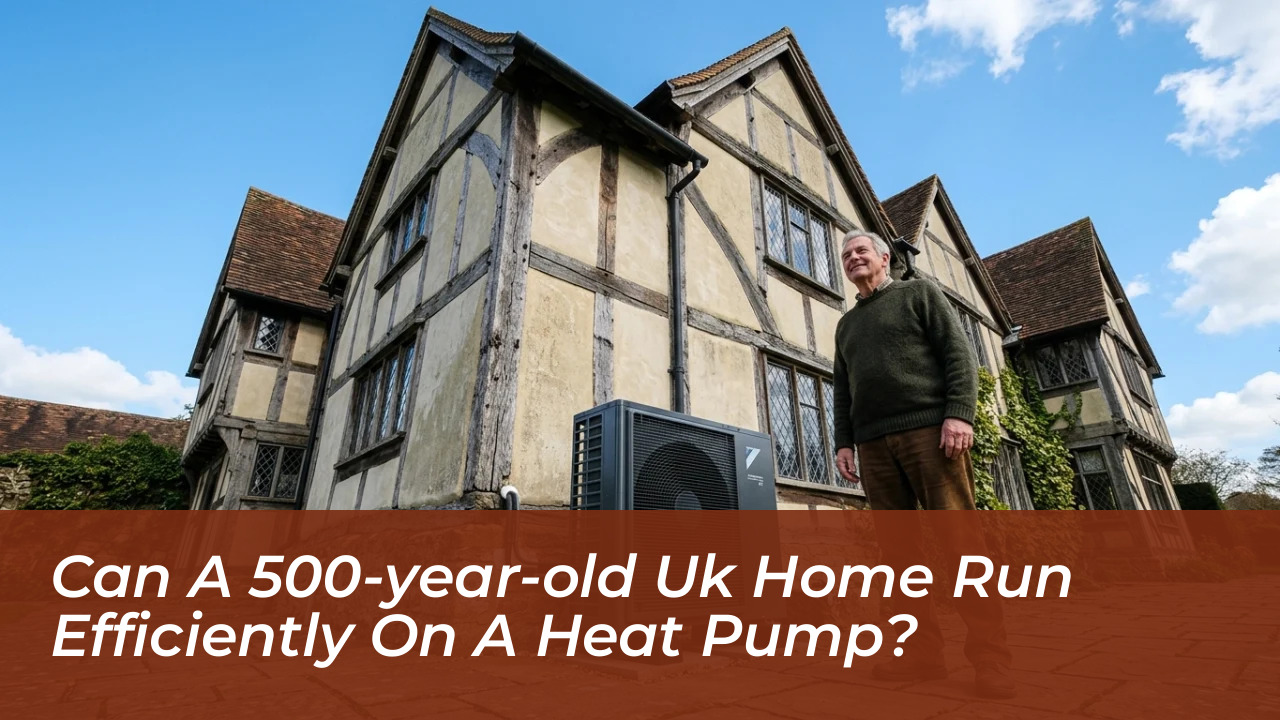

Centuries-old UK properties dating back as far as the 1500s are staying warm with modern heat pumps while cutting operational costs well below traditional heating oil. Homeowners replacing aging oil boilers report maintaining constant indoor temperatures of 20°C (68°F) alongside domestic hot water for roughly £500 to £600 per year. This proves property age alone does not prevent a successful transition to clean heating.
For decades, British households living in historic architecture have faced warnings that low-carbon heating works only inside modern, airtight new-builds. However, verified field experiences from occupants of heritage properties-ranging from Tudor structures to 1880s single-skin brick terraces and 1910s homes-show that correctly engineered systems can outperform legacy fossil fuels even in uninsulated environments.
Real-World Data: Running Costs Versus Heating Oil
The debate gained traction when an owner evaluating the replacement of a legacy Trianco oil boiler turned to community forums to determine whether electrification would cause heating bills to skyrocket. Experienced owners responded with long-term operating numbers that contradict conventional heating assumptions.
One owner of an 1880s solid-brick property measuring 1,507 square feet (140 square metres) confirmed that switching from an oil boiler to an air-to-water system-aided by a £5,000 installation grant-yielded annual running expenses between £500 and £600. Even more striking, an occupant of a single-glazed residence built around 1650 reported total running costs dropping to approximately one-quarter of their former oil expenditures. Meanwhile, an owner of a 1900 brick house noted the system had reliably heated the space across three consecutive winters.
“You can heat literally anything with a heat pump, but every single decision you make comes with a trade off.”
These real-world outcomes expose the myth that older structures must be completely rebuilt before ditching oil or gas. While thermal efficiency improves operational margins, successful heating hinges directly on hydraulic design and proper system sizing rather than the construction year on the deeds.
Engineering Challenges in Period Properties
While low running figures are achievable, larger historical buildings present distinct engineering constraints. An owner of a 2,799-square-foot (260-square-metre) Georgian property explained that without bringing total property heat loss below 14 kW, the setup requires choosing between an industrial-capacity unit or splitting demand across two independent systems. System hydraulics dictate whether an installation thrives or inflates electricity bills.
Operating flow temperatures represent the dividing line between efficiency and excessive costs. Heating engineers note that radiator dimensions, pipework layouts, equipment placement, and water flow temperatures govern efficiency. A flow temperature engineered above 40°C forces the heat pump compressor to work harder, generating significantly higher utility expenses over time. Upgrading to oversized radiators can also become expensive once emitters exceed 5.9 feet (1.8 metres) in length.
Property Performance Across Historic Eras
- 1650 Single-Glazed Residence: Running expenses reduced to approximately 25% of former oil bills.
- 1880s Solid-Brick Home (140 m²): Maintains 20°C plus hot water for £500-£600 annually with an air-to-water system.
- 1900 Brick House: Proven consistent comfort over three full winter heating seasons.
- 1910s Traditional Home: Operating costs matched previous gas usage without comfort loss.
- 260 m² Georgian Residence: Requires heat loss below 14 kW to avoid multi-unit or oversized hardware setups.
Steps for Transitioning an Older Property to Clean Heat
Homeowners navigating a boiler replacement can protect performance by following a structured planning sequence before committing to hardware:
- Conduct a room-by-room heat-loss survey: Calculate exact thermal loss rather than relying on rough square-footage estimates to establish baseline capacity.
- Target high-impact thermal barriers: Prioritise sensible fabric interventions. One owner of a 120-year-old stone terrace installed 52 mm insulation boards on exterior-facing walls, added 100 mm loft insulation, and fitted A+ argon-filled windows before commissioning a 7 kW Vaillant unit.
- Optimise emitter sizes and pipework: Verify that radiators provide sufficient surface area to warm rooms using flow temperatures near or below 40°C.
- Leverage smart tariffs and microgeneration: Integrate off-peak electricity rates, home battery storage, or rooftop solar panels to offset cold-weather electrical draw.
Upgrading a period property requires balancing thermal insulation improvements against system design parameters to secure the lowest long-term energy bills. Thorough technical planning ensures low-carbon systems deliver steady warmth regardless of building age.