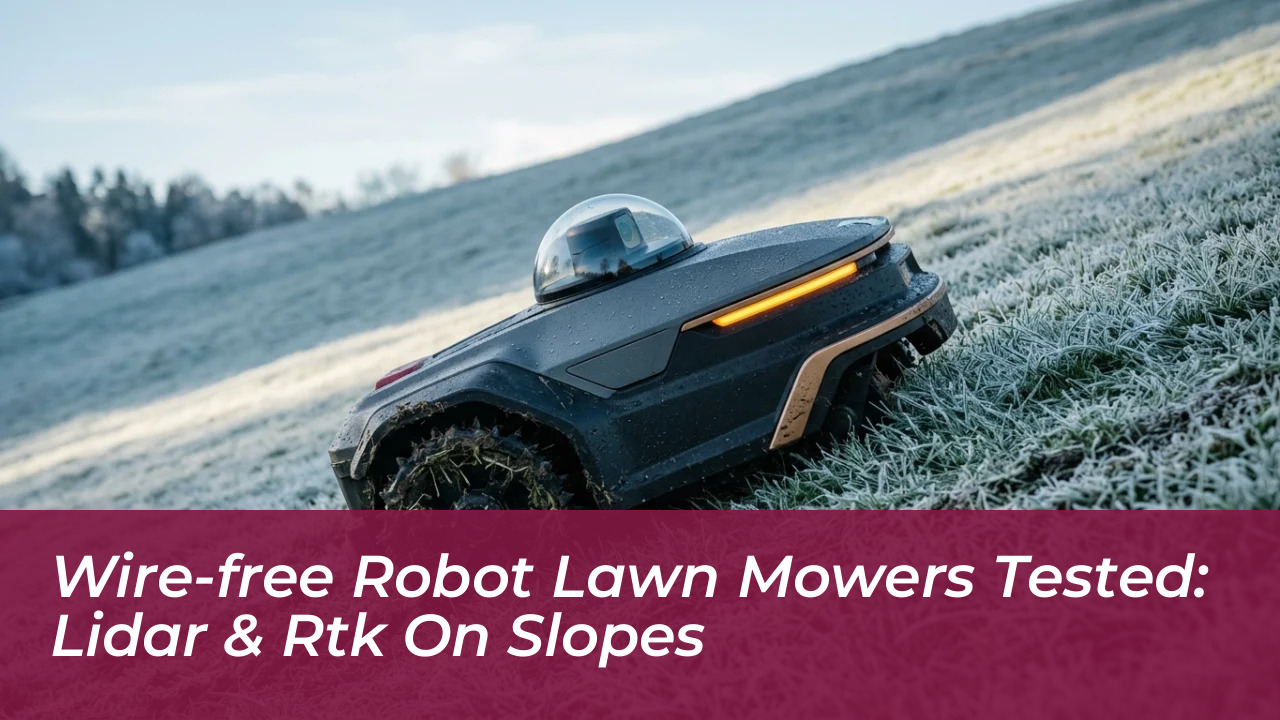

Robotic lawn mowers equipped with all-wheel drive, satellite RTK tracking, and 3D LiDAR can now conquer slopes up to 80% without burying a single boundary wire. Real-world testing across steep gradients, obstructed satellite lines, and separate lawn zones shows that wire-free mowers like the Sunseeker Elite X7 Plus Gen 2 and the Mova Lidax Ultra AWD series successfully eliminate traditional perimeter fencing. Tackling large properties with multiple patches separated by pathways, shaded tree canopies, and drainage dips previously caused automatic cutters to stall or roll off boundaries. Next-generation navigation systems combine visual odometry with laser mapping to ensure machines stay within centimetre-level paths without relying on buried electronic fences.
Navigation Breakdown: RTK Antennas Versus Solid-State LiDAR
The primary battleground in modern wire-free garden robotics lies between satellite real-time kinematics (RTK) and optical 3D LiDAR. The Sunseeker Elite X7 Gen 2 relies on Net-RTK GPS paired with an upgraded VSLAM 2.0 vision system, calculating exact coordinates for lawns up to 3,000 square metres. Installing the Sunseeker involves mounting a dedicated RTK antenna on a post with an unobstructed line of sight to open skies, alongside an outdoor mains power connection. When tall building walls or dense foliage momentarily degrade satellite signals, its onboard VSLAM cameras take over to maintain direction.
In contrast, the Mova Lidax Ultra AWD series bypasses external aerials completely by employing an UltraView 3.0 stack featuring two 360-degree 3D LiDAR lenses alongside 1080p visual cameras. It directly maps spatial point clouds to recognize changes between grass, patio slabs, and gravel borders without requiring satellite handshakes. This architectural difference determines how each machine handles overcast tree canopies and narrow domestic corridors.
Handling Complex Multi-Zone Layouts and Pinch Points
Properties broken into isolated patches separated by driveways expose the operational limits of mapping software. During hands-on trials, configuring boundaries via remote control inside an app allowed both units to plot separate cutting zones in under 15 minutes.
- Sunseeker Elite X7: Seamlessly bridged separated zones across a central tarmac driveway via custom pathways, continuing scheduled edge-following runs without human intervention.
- Mova Lidax Ultra: Accommodates up to 150 independent zones, front-and-back dual map memory, and specific exclusion perimeters for garden features.
Navigating intricate garden boundaries without physical wire perimeters relies entirely on how effectively sensor fusion offsets momentary GPS blindness. One operational quirk emerged in the Mova application: it restricted connecting a single continuous zone back into itself via distinct secondary pathways, resulting in a slightly longer return trip to the charging dock.
Slope Climbing and Terrain Capabilities
Steep banks, uneven transitions, and surface ruts frequently cause standard automated units to slip or lose traction. Both test models employ heavy-duty all-wheel-drive configurations designed to tackle aggressive gradients.
The Sunseeker utilizes a three-wheel AWD platform with large front off-road wheels and independent suspension, certified for slopes up to 70%. It features an IPX5 water-resistance rating alongside dual floating cutting discs spanning 35 cm, with cutting heights adjustable between 20 mm and 100 mm. Meanwhile, the Mova Lidax Ultra AWD pushes engineering limits further with four independent hub motors, omni-wheels for zero-radius turning, and an 80% slope rating. It cuts a 40 cm swath using twin floating discs adjustable between 3 cm and 10 cm, while clearing vertical obstacles up to 6 cm tall.
Myth Versus Reality: Robotic Lawnmower Navigation
Myth: Satellite-guided mowers fail whenever tree cover blocks GPS signals.
Fact: Modern premium platforms blend RTK satellite tracking with optical VSLAM or LiDAR, maintaining centimetre precision through dead reckoning when satellite reception drops.
Myth: Robot mowers only manage billiard-table flat turf without scalping.
Fact: Independent suspensions combined with floating cutting decks continuously track ground undulations up to 60-80 mm to prevent soil gouging.
Direct Specification Comparison
| Specification | Sunseeker Elite X7 Gen 2 | Mova Lidax Ultra AWD |
|---|---|---|
| Navigation Stack | Net-RTK GPS + VSLAM 2.0 | Dual 3D LiDAR + 1080p optical array |
| Maximum Rated Incline | 70% slope rating | 80% slope rating |
| Cutting Width | 35 cm dual discs | 40 cm dual discs |
| Cutting Height Range | 20 mm to 100 mm | 30 mm to 100 mm |
| Drive Configuration | Tri-wheel AWD | 4-wheel hub-motor AWD with omni-wheels |
| Zone Management | Multi-zone paths supported | Up to 150 zones and dual maps |
Software Ecosystems, Security, and Smart Features
Operating a robotic mower long-term depends heavily on mobile app stability, cellular connectivity, and theft-deterrence hardware. Sunseeker provides real-time local weather animations, live status displays, and a 4G anti-theft module with geofencing alerts and power-off protection. The manufacturer bundles between 24 and 60 months of Net-RTK and 4G connectivity out of the box.
In contrast, Mova incorporates broader smart home utility through its TrueGuard security system. It includes three years of 4G connectivity, an integrated Apple AirTag bay, off-map alarms, and on-board camera patrolling featuring human detection and two-way audio communication. For homeowners managing expansive grounds, choosing between these flagship tools comes down to property infrastructure versus terrain extremity.
Frequently Asked Questions
Do wire-free robot lawn mowers require an internet connection to function?
No. Once virtual boundaries are mapped, the onboard positioning and navigation systems operate independently. An internet connection is only needed for remote app control, live tracking, and software updates.
Can RTK-based robot mowers work under heavy tree cover?
Pure RTK systems can struggle or drift under thick, uninterrupted foliage. However, hybrid models like the Sunseeker combine RTK with VSLAM or LiDAR, ensuring continuous navigation when satellite signals drop.
How steep of a slope can an AWD wire-free robot mower climb?
Top-tier all-wheel-drive wire-free mowers can safely navigate and cut on slopes ranging from 70% up to 80% (approximately 35 to 38 degrees), depending on turf conditions and tire traction.
Do I need to bury a perimeter wire for LiDAR or RTK mowers?
No. These modern mowers rely on satellite positioning, reference base stations, or onboard laser mapping to establish virtual perimeters through a companion mobile application.
What happens if someone steals a wire-free robot mower?
Most premium models feature multi-layered anti-theft security, including 4G cellular tracking, real-time geofencing alerts, PIN code locks, and integrated smart tracking hardware like Apple AirTag compatibility.