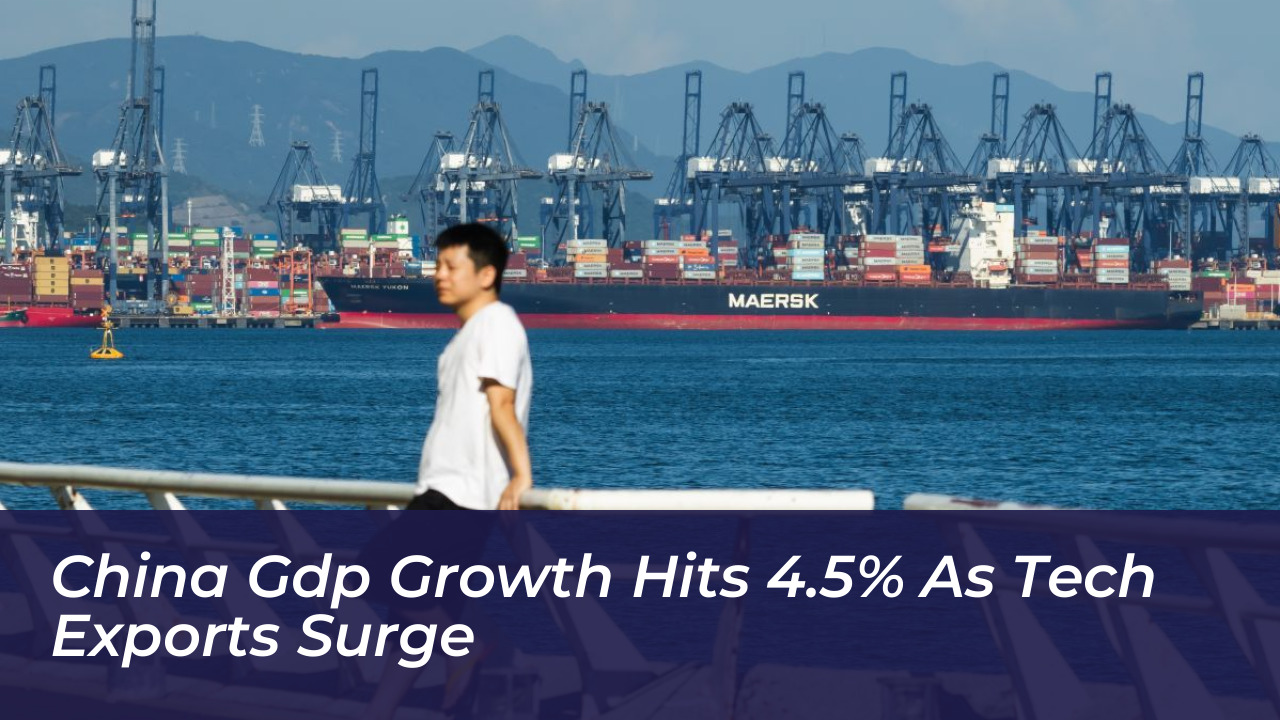

China’s economy expanded 4.5% year over year in the third quarter. Robust overseas demand for technology products helped offset weak domestic household spending, falling investment, and a prolonged property downturn. Official figures released by China’s National Bureau of Statistics on October 19 showed that growth accelerated from 4.3% in the previous quarter. Manufacturing and exports tied to the global artificial intelligence boom heavily bolstered this progress.
The latest expansion surpassed the 4.4% growth forecast predicted in a Reuters poll of economists. It successfully matched the lower end of Beijing’s annual growth target range of 4.5% to 5%. According to official government figures, China’s broader economy grew 4.6% during the first nine months of the year.
Economic Indicators Show Mixed Signals Across Sectors
Detailed economic data for September highlighted the uneven nature of China’s economic recovery. Retail sales rose 1.1% year over year, outperforming economists’ expectations of a 0.6% increase. Meanwhile, industrial production increased by 5.5%, aligning closely with market forecasts.
Labor market and investment metrics, however, continued to reflect underlying domestic challenges. The urban unemployment rate held steady at 5.2%. At the same time, fixed-asset investment in urban areas experienced a sharp decline, falling 7.2% during the first nine months of the year compared to the same period twelve months prior.
External Trade and High-End Manufacturing Drive Momentum
Strong global demand for high-end technology, automotive, and aerospace goods remains a primary engine keeping China’s macroeconomic indicators afloat. Traditional domestic drivers like real estate and consumer spending struggle under the weight of falling property prices and cautious household sentiment. Despite this, export-oriented manufacturing continues to capture global market share.
Analysts note that Beijing’s ongoing focus on strategic industries-such as new materials, quantum technology, and biomanufacturing-is successfully preventing a deeper economic slowdown. However, policymakers face sustained pressure to stimulate domestic consumption and reverse the contraction in fixed-asset investment to ensure sustainable, balanced long-term growth.
Frequently Asked Questions
What was China’s GDP growth rate for the quarter?
China’s economy expanded by 4.5% year over year, accelerating slightly from 4.3% in the previous quarter and beating analyst forecasts.
What drove China’s economic expansion?
The growth was primarily driven by strong overseas demand for technology products, manufacturing, and exports tied to the global artificial intelligence boom.
How did retail sales and industrial production perform?
September retail sales rose 1.1% year over year, beating the 0.6% forecast. Industrial production increased by 5.5%, matching market expectations.
What challenges is the Chinese economy currently facing?
The economy continues to grapple with weak household spending, falling property prices, cautious consumer sentiment, and a 7.2% decline in urban fixed-asset investment.