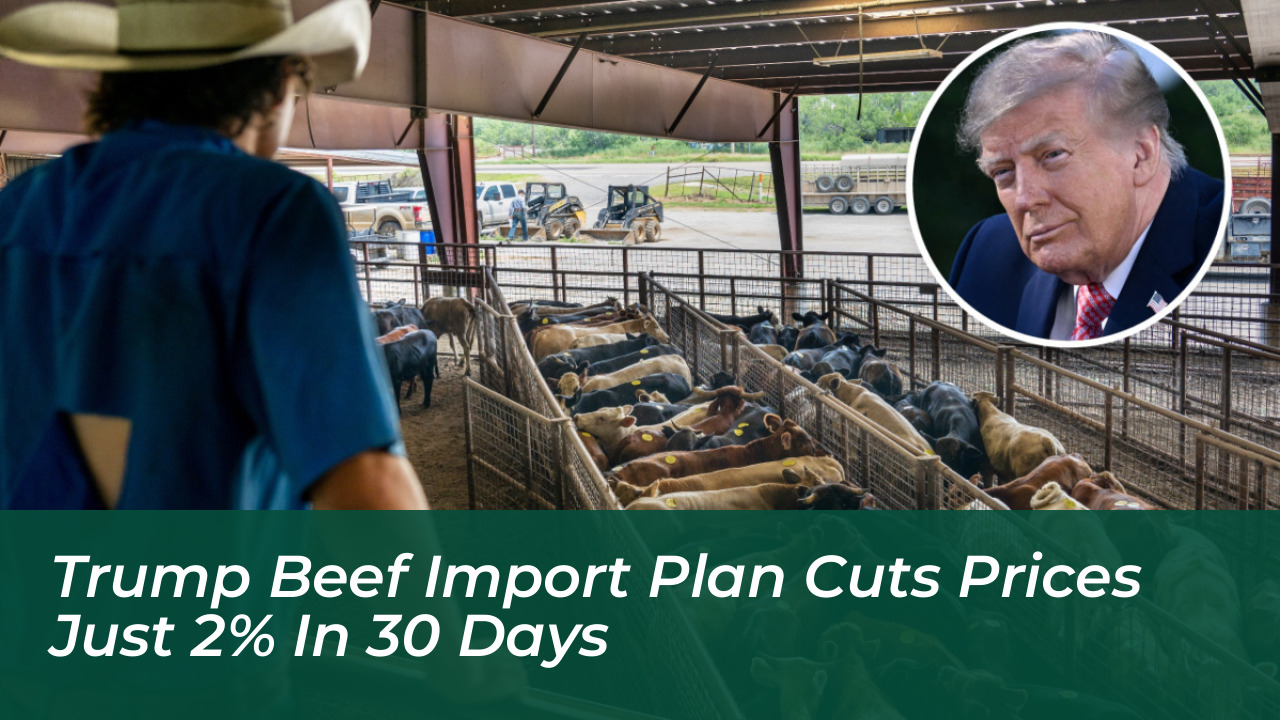

President Donald Trump’s administration initiative to lower United States beef prices through increased foreign imports has yielded minimal savings for shoppers while imposing severe financial pressure on domestic cattle producers. A comprehensive 30-day post-implementation analysis published by Farm Action reveals that the national average price of ground beef dropped by less than 2%, falling significantly short of the administration’s aggressive target to sell imported product at 25% below prevailing market values.
The policy, initially announced by President Trump on August 26, authorized up to 300,000 metric tons of additional lean beef imports to enter the domestic market under reduced tariff rates across a 90-day window. According to the White House, the measure was explicitly designed to make a staple American grocery item more affordable amid ongoing cost-of-living concerns while simultaneously allowing local cattle herds time to recover from multi-decade lows.
Consumer Savings Fall Flat After 30 Days
Data compiled during the first month of the executive policy show modest movement at the supermarket meat counter. Farm Action’s market evaluation notes that the average national price of a pound of ground beef declined slightly from $6.92 to $6.79 during the initial 30 days. Agricultural economists note this fractional drop falls well short of meaningful relief for everyday households.
“The first 30 days raise serious questions about whether this policy is actually delivering on its promises,” said Sarah Carden, senior director of research and policy at Farm Action. “Ranchers are seeing steep declines in the prices they receive, and consumers still haven’t seen clear, meaningful relief at the grocery store.”
Experts attribute the muted impact to the relatively small volume of the tariff-relief quota relative to total domestic consumption. Jaime Luke, an assistant professor and livestock economist at Michigan State University, pointed out that 300,000 metric tons translates to roughly a 2% expansion of the overall domestic beef supply, limiting its capacity to fundamentally alter broader market pricing trends.
American Cattle Ranchers Bear the Cost
While grocery shoppers experienced negligible relief, domestic cattle producers absorbed substantial financial blows. Farm Action’s review indicates that prices for cull cows and feeder cattle-the livestock utilized primarily to produce ground beef trimmings-dropped by as much as 13.9% following the policy enactment.
The downturn exacerbates existing vulnerabilities across the U.S. agricultural sector. Driven by historical droughts, wildfires, high operational overhead, and localized trade restrictions tied to the New World screwworm, the total U.S. cattle inventory has contracted to approximately 86.2 million head, representing a 75-year low.
Industry groups, including the National Cattlemen’s Beef Association, issued sharp criticisms following the announcement. Stakeholders argue that undercutting domestic operations with foreign competitors impairs long-term market confidence and actively discourages producers from rebuilding depleted herds. The policy also prompted rare pushback from several Republican lawmakers representing heavy agricultural constituencies, who warned that the initiative complicates recovery efforts for domestic ranchers.
Broader Economic Context and Industry Outlook
The debate over beef import quotas highlights the intense political sensitivity surrounding food inflation heading into upcoming elections. Federal data indicates that ground beef prices have climbed steeply over the past decade, compounding consumer frustration with broader cost-of-living pressures.
Proponents within the administration maintain that the temporary import expansion injects necessary supply into the marketplace to counter structural deficits and protect consumers. However, agricultural analysts emphasize that sustained affordability will ultimately require addressing deep-seated supply chain concentration, high operational expenses, and long-term investments in the domestic livestock infrastructure rather than relying on short-term foreign trade adjustments.