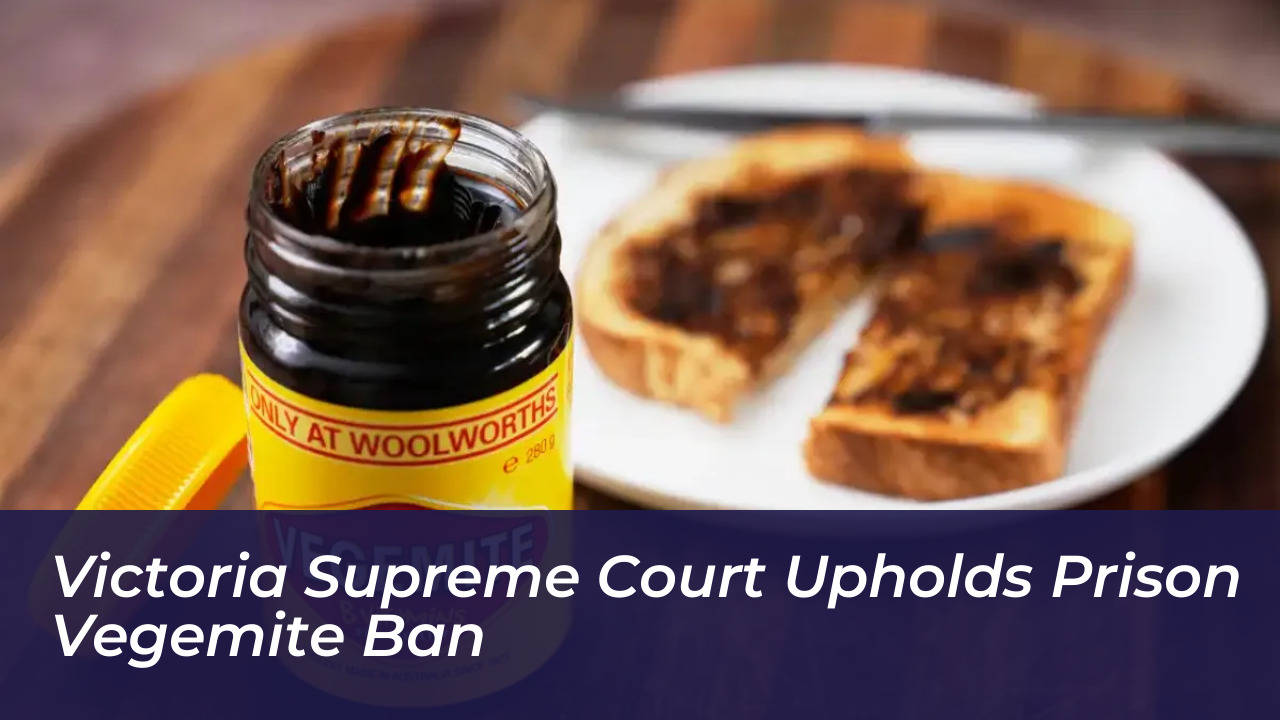

An Australian prisoner serving a life sentence for murder has lost a legal challenge to Victoria’s prohibition on Vegemite. On Monday, October 26, 2026, the state’s Supreme Court ruled that prison security concerns entirely justified restricting the popular yeast-based spread.
Justice Claire Harris acknowledged in her 47-page judgment that the statewide ban limited Andre McKechnie’s cultural rights. However, she ultimately upheld the policy because corrections authorities cited operational risks involving drug detection and illicit alcohol production behind bars.
Legal Challenge and Human Rights Arguments
Andre McKechnie, 55, brought his case against Victoria’s Department of Justice and Community Safety while housed at the maximum-security Barwon Prison west of Melbourne. He argued that denying him access to Vegemite infringed his rights under the Charter of Human Rights and Responsibilities Act.
According to court records, McKechnie maintained that the restriction prevented him from participating in Australian cultural traditions alongside other citizens. He stated that the lack of the condiment made him feel deprived, sad, and disconnected from his family and community.
McKechnie was originally sentenced to life in prison after being found guilty of a 1994 murder in Queensland before later being transferred to Victorian custody.
Security Concerns: Sniffer Dogs and Home-Brewing
Vegemite has been banned in Victorian correctional facilities since approximately 2006. During the court hearings, prison management testified regarding the practical reasons behind the ongoing restriction.
Kevin White, a manager at Corrections Victoria, gave evidence that the strong, pungent odor of Vegemite could distract canine units from effectively detecting illicit drugs. , authorities argued that the yeast properties within the spread could be utilized by inmates to speed up the fermentation process when brewing illicit alcohol.
While McKechnie argued that neighboring New South Wales permits Vegemite in its correctional centers as proof of less restrictive alternatives, Justice Harris concluded that Victoria’s prohibition remained a proportionate and reasonable measure.
Court Findings on Cultural Rights and Wellbeing
Justice Harris recognized the cultural significance of the condiment, noting that it rolled off production lines in Melbourne in 1923 and is found in over 80 percent of Australian pantries. She noted that Vegemite is a food strongly and traditionally associated with people of Australian background.
However, the judge ruled that McKechnie failed to show the ban breached the state’s Corrections Act regarding inmate health and wellbeing. She stated that statutory food obligations do not extend to providing culturally significant items to enhance daily inmate comfort.
The Department of Justice and Community Safety welcomed the Supreme Court decision, reiterating that ensuring the safety of staff and prisoners remains the top operational priority for the state’s correctional system.
Key Facts of the Victoria Vegemite Court Case
- Plaintiff: Andre McKechnie, 55, serving a life sentence at Barwon Prison.
- Ruling Date: Monday, October 26, 2026.
- Presiding Judge: Justice Claire Harris.
- Core Reasons for Ban: Interference with drug detection dogs and potential use in brewing illicit alcohol.
- Jurisdiction: Supreme Court of Victoria, Australia.