Ordinary donation bins across the United Kingdom frequently conceal items of astonishing historical and financial value. While shoppers often hunt for everyday apparel, the back rooms of thrift storefronts sometimes process high-value antiques and rare literary treasures. The United Kingdom charity shop network operates as a massive clearinghouse for pre-loved goods, processing millions of items every year across more than 11,000 storefronts nationwide. Organizations like Oxfam, the British Heart Foundation, Barnardo’s, and regional hospice trusts process a constant stream of house clearances, attic cleanouts, and downsizing donations. While the vast majority of stock consists of contemporary high-street paperbacks and modern homeware, an extraordinary subset of donations contains museum-grade artifacts. The transformation of British charity shops from simple secondhand outlets into recognized corridors of antiquarian discovery highlights a unique intersection of public generosity, eagle-eyed retail staff, and specialized valuation networks.
Discarded boxes left at donation points regularly yield items that rewrite personal histories and fund major global humanitarian missions. From 19th-century imperial ceramics tucked inside cardboard containers to pristine literary classics sitting on two-pound shelves, charity shop intake rooms remain dynamic grounds for historical preservation. As volunteer training improves and retail teams develop sharper instincts for identifying rarities, the charity retail sector continues to yield astonishing windfalls for charitable causes.
The Portobello Road Discovery: Unearthing Harper Lee
At the Oxfam Bookshop on Portobello Road in west London, routine processing of a donated batch of American titles led to one of the most significant literary discoveries in recent retail history. Deputy Manager Gurpreet Karlcut was sorting through a newly arrived box of unsorted books when an early hardback edition of Harper Lee’s seminal novel, To Kill a Mockingbird, caught his attention. Recognizing that the volume possessed structural characteristics inconsistent with standard modern reprints, Karlcut flagged the item for senior administrative evaluation.
Shop Manager Olivia Haysman-Walker initiated a comprehensive authentication protocol. Verifying an authentic first US edition of To Kill a Mockingbird requires rigorous bibliographic examination. Haysman-Walker analyzed the print dates, the physical composition of the binding, and the specific design features of the dust jacket. Published in 1960 by J.B. Lippincott Company, the genuine first printing carries clear internal markers, including a specific statement of first edition status on the copyright page and precise typographical alignment that subsequent printings altered.
Authenticating rare 20th-century American fiction demands close attention to original jacket mechanics and publisher cloth choices. For the 1960 Lippincott imprint of To Kill a Mockingbird, experts inspect several key physical attributes. The original jacket must display the correct unclipped price of three dollars and ninety-five cents on the front inner flap. First-issue dust jackets feature specific critical praise on the back cover, including quotes from Jonathan Daniels and Shirley Ann Grau, alongside a photograph of Harper Lee credited to Truman Capote. The original volume features brown paper-covered boards paired with a green cloth spine, accompanied by gold foil lettering on the spine. The copyright page must explicitly state first edition without subsequent impression notices.
Institutional Acquisition and Public Preservation
Rather than sending the volume to a public commercial auction house, Oxfam coordinated with academic curators to secure the book’s preservation within a public repository. Following a detailed physical condition assessment, the Eccles Institute for the Americas and Oceania at the British Library acquired the rare first edition. The volume joined the British Library’s permanent national collection, ensuring long-term conservation and research access for literary scholars worldwide.
The acquisition coincided with Oxfam’s annual Second Hand September campaign, an initiative highlighting sustainable resource consumption and circular retail practices. The proceeds from the sale were transferred directly to Oxfam’s international emergency response funds, converting a forgotten donation into actionable relief capital. This approach guarantees that high-value literary rescues directly impact contemporary humanitarian crises across the globe.
Imperial Porcelain and 19th-Century Artifacts
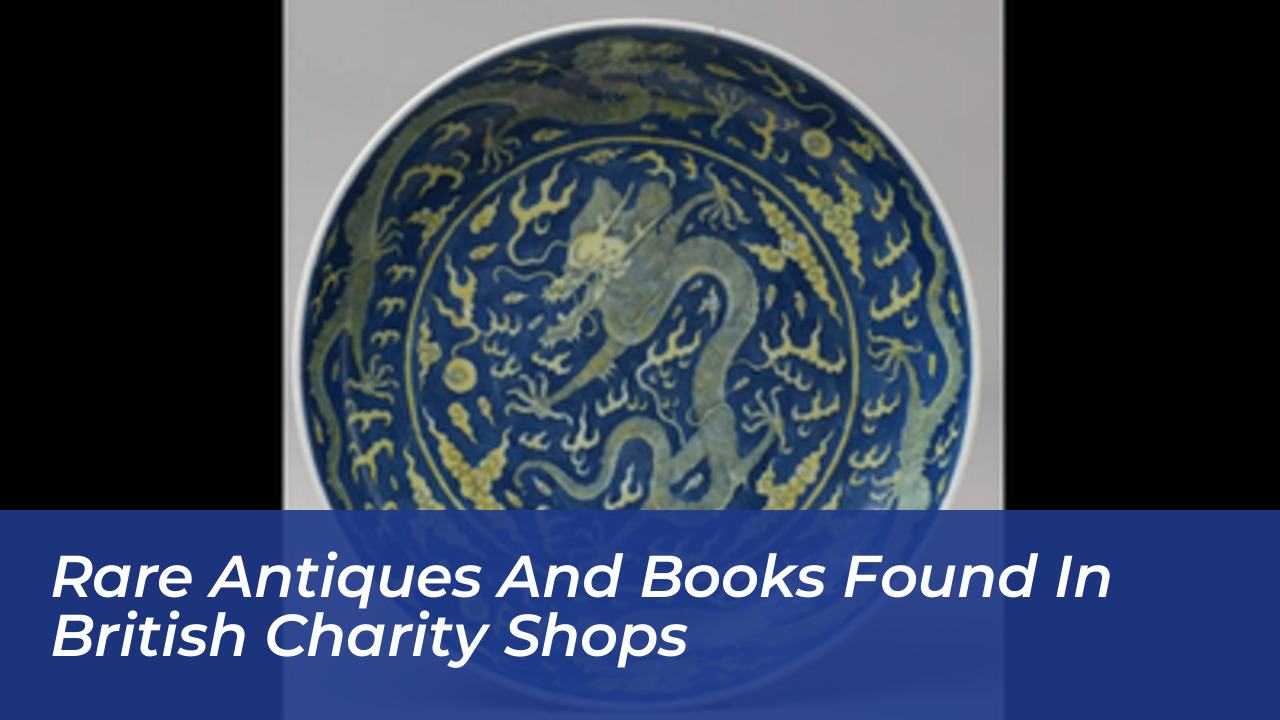
Literary works are not the only museum-grade items surfacing in donation bins. British charity shops regularly receive ceramic pieces donated during routine house clearances following estate settlements. Among these donations, staff recently uncovered two outstanding pieces of 19th-century Chinese imperial porcelain, which fetched thousands of pounds and entered permanent national collections. The 19th century in China, spanning the late Qing Dynasty under the reign of emperors such as Daoguang, Xianfeng, Tongzhi, and Guangxu, produced complex ceramic wares characterized by intricate hand-painted enamels, underglaze blue decorations, and precise reign marks.
Non-specialist donors frequently misidentify these historical treasures as mid-century decorative reproductions or standard export homeware, leading to their casual placement in charity collection bags. Distinguishing genuine 19th-century Chinese imperial porcelain from later 20th-century commercial copies requires specialized technical expertise. Valuers focus on distinct structural markers during assessment. Imperial pieces display hand-painted script or seal script marks in underglaze blue, centered on the base rim. Authentic marks exhibit subtle variation in brush stroke thickness and natural cobalt pigment settling.
Qing Dynasty pieces frequently utilize the Famille Rose palette, characterized by opaque rose-pink enamels derived from colloidal gold. The glaze should feature slight surface irregularities, micro-bubbles, and natural, age-appropriate foot-rim wear. Imperial workshops used refined kaolin clay, producing a dense, white body. The unglazed foot rim of a genuine 19th-century vessel feels smooth to the touch, often described as having a greasy or soapy texture, rather than a dry, modern ground finish.
Record-Breaking Literature: £70,000 in Auction Finds
The discovery of the Harper Lee volume mirrors a broader trend across British charity retail networks, where vigilant staff continuously intercept exceptional literary and pop-culture items. In a remarkable series of discoveries across regional branches, Oxfam volunteers recently identified and authenticated three distinct lots that together raised over seventy thousand pounds at public auction.
At an Oxfam shop in Harborne, a suburban district of Birmingham, a donor handed over a box containing a scarce 1937 first edition, second impression of J.R.R. Tolkien’s The Hobbit. Published by George Allen and Unwin, the volume featured original black-and-white illustrations and robust map endpapers. Intense bidding at specialist auction houses drove the final sale price to £38,400, providing an enormous financial boost to the charity branch.
Similarly, volunteer Maria Fenner discovered a signed first edition of Virginia Woolf’s The Waves in Bristol. Inspecting the flyleaf, Fenner noticed a handwritten fountain pen inscription from the author. Following collaborative historical verification with manuscript experts using archival samples, the book went to auction and achieved £25,600. These extraordinary returns demonstrate the vital economic impact of thorough volunteer training and careful sorting practices.
Conclusion
Rigorous volunteer training and careful sorting turn ordinary charity drops into historical preservations. As staff and volunteers become more adept at spotting anomalies in paper stock, binding styles, and maker marks, the pipeline of rescued antiquities continues to grow stronger. This meticulous approach protects cultural heritage from ending up in landfills or scrap yards.
The enduring impact of charity retail on both global humanitarian aid and museum-grade artifact rescue cannot be overstated. Every rare book or antique porcelain piece discovered in a donation bin generates essential funding for vulnerable populations while returning lost historical items to the public domain. Charity shops remain unexpected guardians of our shared cultural and literary past.