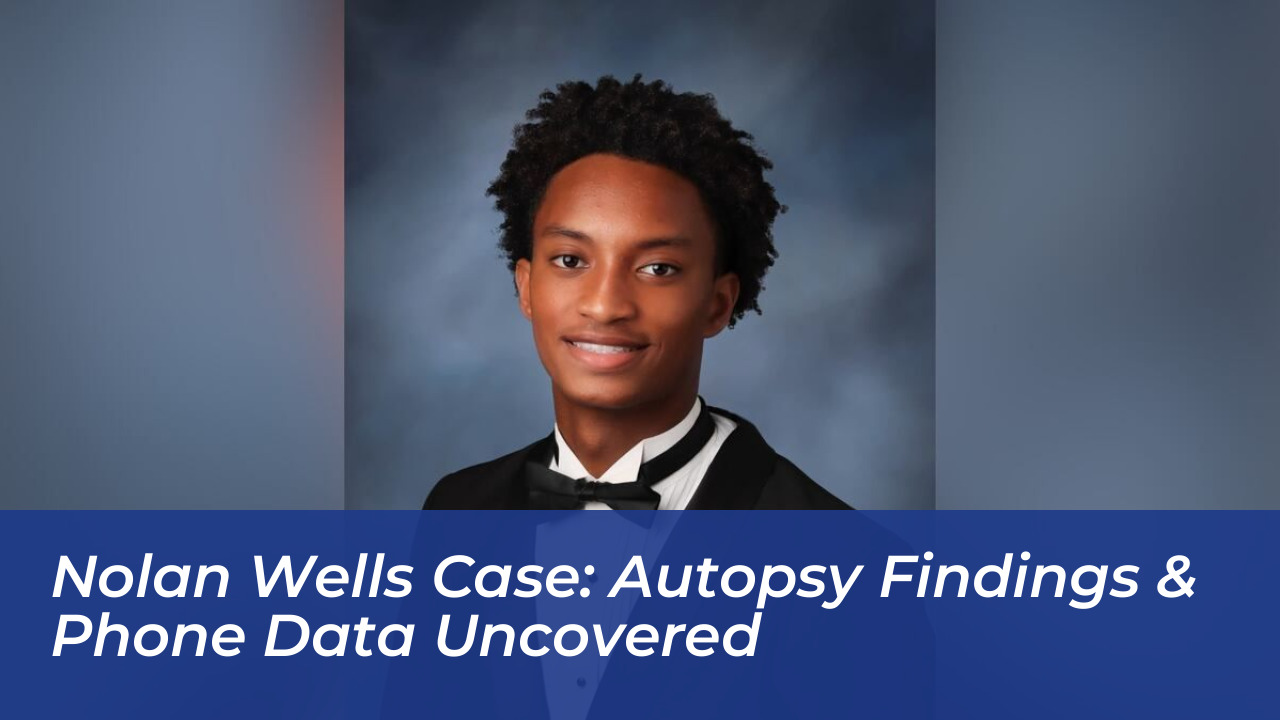
The tragic death of 18-year-old Nolan Wells continues to draw intense public and legal scrutiny following a July 4 holiday outing to Horn Island, Mississippi. Recently released findings from both state and independent autopsies, alongside comprehensive digital forensic extractions, reveal critical new details about the teenager’s final hours. Civil rights attorney Ben Crump, working alongside the family’s legal team, brought these findings to light during a heavily attended press conference, challenging initial assumptions and calling for further transparency in the Nolan Wells case.
- Introduction to the Nolan Wells Investigation
- The Autopsy Contradictions: Medical Evidence and Anatomy
- State Versus Independent Findings
- Key Medical Metrics and Anomalies
- Digital Forensics: Reconstructing the Timeline of July 4
- Garrett Discovery Extraction Methodology
- Chronological Movement Pattern
- Disputed Evidence: Deleted Social Media and Group Chat Insights
- Overcoming Technical Barriers in Snapchat Forensics
- Insights from Recovered Communications
- Law Enforcement Interaction and Inter-Agency Friction
- Collaboration Breakdowns
- Timing of Document Disclosure
- Comparative Analysis of Official Findings Versus Private Investigation
- Future Case Monitoring and Unresolved Questions
- The Mechanics of Snapchat Cloud Syncing in Forensics
- Calls for Federal Oversight
Despite a Jackson County grand jury returning a unanimous no true bill, which indicates insufficient evidence to bring criminal charges, the family’s investigators argue that unanswered questions remain. The core of the ongoing debate centers on contradictory medical evidence, specifically the absence of water in the victim’s respiratory tract, and newly uncovered deletions on the teenager’s mobile device.
Introduction to the Nolan Wells Investigation
The incident began as a celebratory holiday excursion to Horn Island, a barrier island off the Mississippi coast. What should have been a standard summer outing turned into a profound tragedy, leaving a family searching for answers after their son did not return home alive. Because local law enforcement, state medical examiners, and private investigators arrived at different interpretations of the physical evidence, the case quickly escalated into a national focal point for civil rights advocacy and independent forensic oversight.
The involvement of civil rights attorney Ben Crump and specialized digital forensics firms introduced a parallel investigative track. While the state grand jury relied primarily on standard law enforcement reports and official medical examiner summaries, the family legal team enlisted independent pathologists and data recovery experts. This dual approach highlighted a profound gap between official institutional conclusions and the demands of a grieving family seeking verifiable truth.
This article examines the complex layers of the investigation by analyzing the striking contrasts between state grand jury findings, independent medical reviews, and advanced digital forensic extractions. By breaking down the anatomy reports, cell phone telemetry, and communication logs, we provide an objective look at the evidence shaping this ongoing inquiry.
The Autopsy Contradictions: Medical Evidence and Anatomy
State Versus Independent Findings
Medical examinations serve as the bedrock of any suspicious death investigation. In the Nolan Wells case, the official state autopsy and an independent review conducted by renowned forensic pathologist Dr. Roger Mitchell reached the same formal conclusion regarding the cause and manner of death. Both reports listed the cause and manner of death as undetermined.
However, specific anatomical details within the reports fuel skepticism from the family and their legal representatives. Attorney Liza Park, speaking on behalf of the legal team, pointed out that the brevity of the official three-page state autopsy report left critical questions unanswered. While the state’s review suggested that the body’s positioning on the shore was consistent with drowning, the supporting internal metrics told a vastly different story to independent specialists.
Key Medical Metrics and Anomalies
Independent medical analysts scrutinized the physical findings documented during the initial examination. Several distinct physiological anomalies emerged:
- Respiratory Tract: The examination confirmed no fluid, debris, or water was present in the airways, lungs, throat, or stomach.
- Skeletal Integrity: The larynx, hyoid bone, and cervical spine showed no fractures, hemorrhages, or structural damage, ruling out traditional manual strangulation or severe neck trauma.
- Head Trauma: The report documented two distinct 2-inch contusions on the scalp near the base of the skull on either side of the neck.
Dr. Mitchell’s independent review focused heavily on the scalp contusions found near the base of the skull. The absence of white blood cells within the bruised tissue indicates that the blunt force trauma occurred within a very narrow window, specifically within four hours of Wells’ death. While the grand jury report downplayed these injuries as non-life-threatening, the timing and physical nature of the blows remain a central point of contention for private investigators.
Digital Forensics: Reconstructing the Timeline of July 4
Garrett Discovery Extraction Methodology
To reconstruct the precise movements and interactions of July 4, the family hired Florida-based digital forensics firm Garrett Discovery to extract and analyze data from Wells’ mobile phone. CEO Andrew Garrett reported that his team processed over one million digital artifacts, ranging from GPS logs to unified logs, media caches, and application databases.
Standard law enforcement extractions often miss deep file structures or temporary caches. The specialized forensic team utilized advanced hardware-level parsing to bypass standard operating system restrictions, recovering deleted records and hidden metadata that standard investigative suites failed to register.
Chronological Movement Pattern
The geographical mapping established by the phone’s telemetry established a clear chronological movement pattern throughout the holiday:
- Morning Transit: The phone’s GPS data placed Wells near a local restaurant early in the morning before traveling to a friend’s residence.
- Horn Island Arrival: The device boarded a boat around 10:30 a.m. and arrived at Horn Island at approximately 11:18 a.m., remaining stationary for several hours.
- Activity Window: The phone remained locked for extended periods, with Wells’ final active interaction recorded between 2:17 p.m. and 2:18 p.m.
- Return Trip and Recovery: The boat departed the island around 4:30 p.m., placing a call to Sea Tow at 4:36 p.m., before reaching a mainland dock at 6:10 p.m. Wells’ parents ultimately retrieved the device from acquaintances at approximately 3:00 a.m. on July 5.
Disputed Evidence: Deleted Social Media and Group Chat Insights
Overcoming Technical Barriers in Snapchat Forensics
A major point of contention in the digital investigation involves missing social media content. Wells was a frequent user of Snapchat and Instagram, yet his mother noticed an unusual lack of history upon retrieving the device. Garrett Discovery confirmed that specific social media data was deleted between the time Wells last used the phone and when his family recovered it.
Because popular commercial forensic suites like Magnet Axiom and Cellebrite could not natively parse the specific version of Snapchat installed on the device, Garrett’s team extracted the database directly and wrote custom code to read the messages. This technical workaround allowed investigators to bypass encryption barriers and recover hundreds of messages sent after Wells’ death, which continued to sync to the device until the formal forensic examination began.
Insights from Recovered Communications
The recovered group chat conversations shed light on the social dynamics and perceived tensions during the island outing. According to Ben Crump, the digital logs contained notable concerns expressed by participants regarding their immediate environment.
Additional recovered messages discussed unfamiliar individuals on nearby boats. Participants noted that some nearby boat occupants were rumored to have criminal backgrounds or were described as visibly intoxicated, adding a layer of social friction that family attorneys argue warrants a deeper law enforcement probe.
Law Enforcement Interaction and Inter-Agency Friction
Collaboration Breakdowns
Public friction also developed regarding access to the physical phone and the official investigative documents. Jackson County District Attorney Angel Myers McIlrath stated that her office attempted to coordinate a joint forensic examination of the phone, but accused the family of failing to cooperate and missing agreed-upon deadlines.
Conversely, the family’s legal team argued that the parameters for the joint inspection shifted unexpectedly. Attorney Liza Park asserted that the designated inspection site would have barred the family and their private experts from observing the process directly, leading to a complete communication breakdown between state prosecutors and private counsel.
Timing of Document Disclosure
The release of vital investigative files further strained relations. The official state autopsy report was ultimately provided to the family on September 23, just before the public press conference held by Ben Crump and the legal team. This delayed disclosure fueled public skepticism regarding transparency and inter-agency communication throughout the proceedings.
Comparative Analysis of Official Findings Versus Private Investigation
| Investigative Category | State / Grand Jury Findings | Private Investigation (Crump & Garrett Discovery) |
|---|---|---|
| Manner of Death | Undetermined (Drowning consistent with body position) | Undetermined (Disputes drowning due to medical metrics) |
| Water in Lungs/Stomach | Not explicitly detailed as disqualifying in summaries | Confirmed complete absence of water, fluid, or debris |
| Head Trauma | Contusions noted; deemed non-life-threatening | Two 2-inch scalp contusions flagged; trauma timed near death |
| Phone Data Status | Reviewed via standard law enforcement channels | Over 1 million artifacts extracted; confirmed intentional deletions |
Future Case Monitoring and Unresolved Questions
The Mechanics of Snapchat Cloud Syncing in Forensics
The recovery of post-mortem messages highlights a complex reality in modern digital forensics. When a mobile device remains connected to cellular or Wi-Fi networks after a user’s demise, cloud infrastructure often attempts to synchronize unread threads. Understanding how these applications cache data locally versus cloud storage helps investigators determine who possessed the device during critical windows of custody.
, evaluating device custody by secondary parties prior to formal forensic extraction remains a primary objective. Digital forensics experts continue to analyze metadata stamps to isolate actions taken by the owner versus actions executed by third parties after the incident.

Calls for Federal Oversight
As state-level proceedings conclude with the grand jury’s no true bill, civil rights advocates and the Wells family continue their petitions for review by federal authorities, including the Department of Justice and the FBI. Independent legal teams are evaluating post-mortem contusion dating alongside biometric data correlations from background health sensors to push for a comprehensive federal inquiry.
The combination of unexplained anatomical findings, deleted digital artifacts, and conflicting accounts from witnesses ensures that the Nolan Wells investigation will remain a heavily monitored case as legal experts seek absolute accountability.